Breathing exercises for anxiety, grounded in Patanjali’s fourth limb: the classical pranayama sutras, current evidence, and a five-minute daily practice.
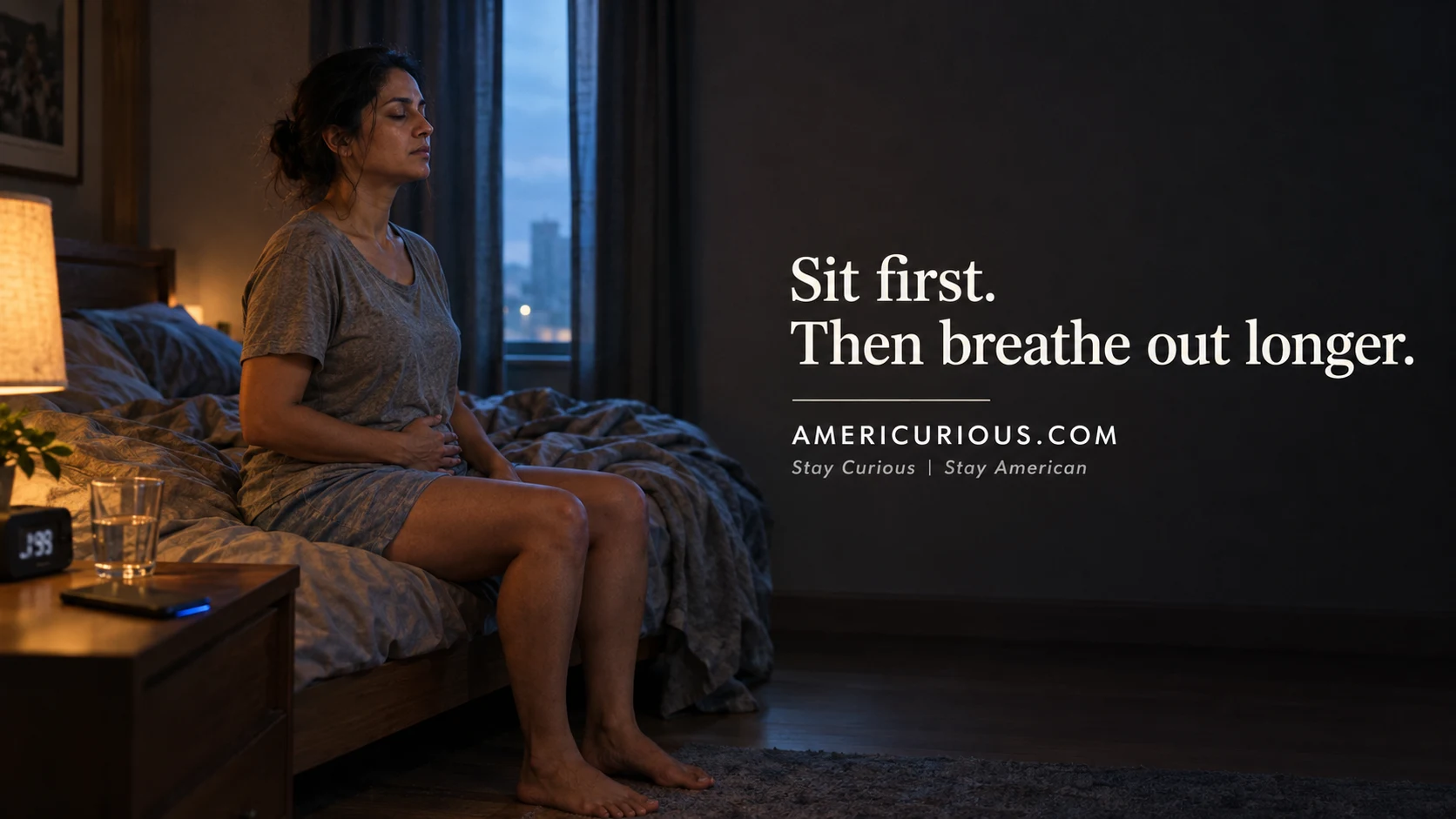
It is 2:40 a.m. and your chest is doing that thing again — tight, fast, shallow, as if you have been running although you have been lying perfectly still. Someone, probably a well-meaning app, has told you to “just breathe.” You try. You take a big breath. Nothing changes, and now you are also annoyed at yourself for failing at something as basic as inhaling.
Here is what almost nobody tells you: the instruction to “just breathe” is not wrong, but it is incomplete. Roughly 2,000 years ago, Patanjali gave breathing exercises for anxiety a structure so precise that it still outperforms most modern advice — not because he promised calm, but because he specified where to sit, what to count, how long to go, and when to stop. His fourth limb of Ashtanga Yoga, pranayama (breath regulation), is a technology of attention, not a relaxation trick. And the limb that follows it, pratyahara (withdrawal of the senses), explains why your phone is part of this conversation.
You May Like This….
How to Overcome Severe Anxiety: Tim Ferriss’s Biological Protocol
The Classical Foundation: What Patanjali Actually Says
In the Sadhana Pada of the Yoga Sutras, Patanjali lists the eight limbs at verse 2.29 — yama, niyama, asana, pranayama, pratyahara, dharana, dhyana, samadhi — and then spends five sutras on breath alone (2.49–2.53).
His definition is sharper than the modern word “breathing exercise” suggests. Sutra 2.49 reads: tasmin sati śvāsa-praśvāsayor gati-vicchedaḥ prāṇāyāmaḥ — “when that [asana] is accomplished, pranayama is the interruption of the movement of inhalation and exhalation.” The key term is gati-viccheda: a cutting-off, a stilling of the breath’s momentum. Patanjali is not describing a bigger breath. He is describing the point at which the breath stops running you.
Two details from the following sutras matter enormously for anyone anxious:
Sutra 2.49 begins with a precondition. Tasmin sati — “that being accomplished” — refers back to asana, the steady, comfortable seat of 2.46. Classical pranayama does not begin in a panic on a crowded train. It begins in a settled posture. You do not start with the breath; you start with the seat.
Sutra 2.50 gives the parameters. Breath has three movements — bāhya (outward), ābhyantara (inward), and stambha (held) — and each is regulated by deśa (place), kāla (duration), and saṃkhyā (count), until the breath becomes dīrgha (long) and sūkṣma (subtle, fine). Sutra 2.51 adds a fourth kind that transcends effort altogether.
Then come the two payoff sutras. In 2.52, tataḥ kṣīyate prakāśa-āvaraṇam — “then the covering of the light is thinned.” Edwin Bryant renders it as the veil over illumination weakening; B.K.S. Iyengar reads pranayama here as “the gateway to concentration.” Sutra 2.53 confirms the outcome: dhāraṇāsu ca yogyatā manasaḥ — the mind becomes fit for dharana, for fixing itself on one point.
Notice what is absent. No promise of bliss, no claim that breath cures anything. The classical claim is narrower and more useful: steady, measured breathing removes obscuration and makes the mind usable.
The Modern Bridge: Why This Matters in an Anxious World
The World Health Organization estimates that more than 301 million people live with an anxiety disorder, making anxiety the most common mental health condition on earth; its 2025 report World Mental Health Today put the combined productivity cost of depression and anxiety near $1 trillion a year. Meanwhile, “breathwork” has become a genuine consumer category, with the practice migrating from ashrams into smartwatches, corporate wellness calendars, and app subscriptions. The risk of that boom is dilution: everything from gentle humming to aggressive hyperventilation now travels under the same label.
The research, read carefully, actually supports Patanjali’s emphasis on slow, measured, subtle breathing over dramatic breathing.
A 2025 systematic review and meta-analysis in Frontiers in Psychiatry (Mütze, Mitzinger, and Haller) pooled six randomized controlled trials involving 517 patients with PTSD, depression, and mixed non-psychotic disorders. Pranayama significantly reduced symptom severity compared with passive controls, with a small-to-moderate effect (standardized mean difference −0.27), and performed comparably to standard care when added to it. Two findings deserve highlighting: the authors judged most included trials at high risk of bias and explicitly concluded pranayama “should not be used instead of standard therapies.” And adverse events were more frequent with fast breathing techniques than with slow ones.
For anxiety specifically, a randomized controlled trial published in Annals of Neurosciences in 2024 by Kavitha and colleagues at JIPMER in India put 140 patients with anxiety disorders on eight weeks of slow pranayama plus savasana alongside routine psychiatric care. Compared with care alone, the pranayama group improved on heart rate variability measures toward parasympathetic dominance and showed better baroreflex sensitivity — meaning their bodies got measurably better at downshifting.
The most cited recent trial comes from Stanford: Balban and colleagues, publishing in Cell Reports Medicine in 2023, randomized roughly 108 adults to five minutes a day of cyclic sighing, box breathing, cyclic hyperventilation, or mindfulness meditation for 28 days. Cyclic sighing — a double inhale through the nose followed by a long exhale — produced the largest gains in positive mood and the biggest drop in resting respiratory rate. But read the fine print: state anxiety fell across all arms, including meditation, and the study found no significant change in trait anxiety, heart rate variability, or sleep. Five minutes of breathwork is a reliable daily mood tool; it is not a treatment for an anxiety disorder.
A 2025 meta-analysis of 18 studies in adolescents in the International Journal of Adolescent Medicine and Health found a larger pooled effect on stress and anxiety (SMD −1.17), though it too relied heavily on small, unblinded trials. The honest summary: consistent, modest, real — and easiest to overstate.
The Practice: A Five-Part Pranayama Protocol for Anxiety
This sequence follows Patanjali’s own logic: settle first, measure second, then withdraw.
1. Establish the seat before the breath (2 minutes)
Sit on a chair with both feet flat, spine upright but not rigid, hands on thighs. This is the tasmin sati condition. Let the breath be however it currently is for sixty seconds — fast, shallow, ragged. Do not fix it yet. You are only doing what sutra 2.46 asks: finding a posture that is sthira (steady) and sukha (comfortable). Anxiety worsens when you try to change something before you have agreed to be in it.
2. Lengthen the exhale (5 minutes)
Inhale through the nose for a count of 4. Exhale through the nose for a count of 6. That ratio produces roughly six breaths per minute, the rate at which heart rate variability tends to peak. If six is too long, use 3 and 5. The classical requirement in 2.50 is dīrgha and sūkṣma — long and fine. If your shoulders lift, your jaw clenches, or you hear yourself gasping, you have crossed from pranayama into strain. Reduce the count.
For acute spikes — the 2 a.m. version — use the physiological sigh: two inhales through the nose (one full, one short top-up), then a slow, complete exhale through the mouth. Repeat for two or three minutes. This is the pattern that won the Stanford trial, and it is the closest modern equivalent to what traditional texts call a sigh — the body’s own reset reflex.
3. Hum on the way out (3 minutes)
Bhramari pranayama: close the lips, inhale through the nose, and exhale with a low humming sound, letting the vibration sit in the face and chest. The hum mechanically lengthens the exhale and gives the mind an object to rest on. A 2024 literature review counted 46 experimental studies on Bhramari since 2006, reporting associations with lower self-reported stress and anxiety — promising, though sample sizes remain small.
4. Practise pratyahara with numbers (2 minutes)
Patanjali’s three parameters in sutra 2.50 — place, duration, count — are, functionally, attention anchors. Use them. Without changing your breath, silently note where you feel it (place: nostrils, ribs, belly), how long it lasts (duration: “long,” “short”), and keep a count of breaths to ten, then start again. This is pratyahara in miniature: the senses, which were foraging in the room and in your notifications, are called back to imitate the mind’s own form (sutra 2.54). Losing count is not failure; noticing you lost count is the practice.
5. Close the loop once a day
Ten to twenty minutes daily is the classical dose; five minutes is the dose the modern trials actually tested and found effective. Consistency beats duration: in the Stanford study, benefits grew across the 28 days rather than arriving at once. Pick a fixed anchor — after brushing your teeth, before your first email — so the practice is not a decision but a default.
Common Misconceptions and Pitfalls
The myth: harder breathing works better. Kapalabhati, breath of fire, and Wim Hof-style hyperventilation are popular because they produce dramatic sensations. They are also sympathetic — stimulating. Rapid breathing blows off carbon dioxide, causing hypocapnia, which narrows cerebral blood vessels and produces tingling hands, dizziness, and a dissociation that closely mimics the early signature of a panic attack. The 2025 Frontiers in Psychiatry review found adverse events more common with fast techniques, and practitioners generally advise against unsupervised high-ventilation work for people with panic disorder, cardiovascular conditions, or a trauma history. If your goal is anxiety, fast breathing is usually the wrong tool pointed at the right problem.
The myth: pranayama replaces treatment. Cognitive behavioural therapy and medication remain first-line, evidence-backed treatments, and the meta-analysis authors themselves warn against substituting breathwork for them. Think of pranayama the way the JIPMER trial used it: as an adjunct that improved physiological markers on top of routine psychiatric care. If anxiety is interfering with sleep, work, or relationships, or if you experience panic attacks, please involve a clinician. Breathing exercises are a complement to care, never a replacement for it.
The myth: the goal is to feel calm. The classical goal is yogyatā — fitness of the mind for concentration. Some sessions will feel pleasant; many will feel ordinary. Judging each practice by its calm-per-minute return is how people quit in week two.
Integration: Where This Sits in the Eight Limbs
Pranayama is limb four of eight, and it is deliberately sandwiched. It rests on asana — a body stable enough to sit still — and on the ethical limbs before it: ahiṃsā (non-violence) applied inwardly means not forcing your breath past its capacity, and satya (truthfulness) means admitting that today’s breath is short rather than pretending otherwise. It leads directly into pratyahara, limb five, and then into dharana, limb six, which sutra 2.53 promises as the natural result.
That architecture is the practical takeaway. Breathwork for anxiety does not work because it is relaxing. It works because it is the hinge between an outward-facing nervous system and an inward-facing attention — the moment where a body stops scanning for threats and a mind becomes, in Patanjali’s word, fit.
A Closing Thought
You will not breathe your way out of anxiety in a single sitting, and no honest teacher will tell you otherwise. What you can do, tonight, is sit down before you try to change anything — and then take one breath that is slightly longer on the way out than on the way in. That is not a cure. It is a seam in the loop. Patanjali built an entire eight-limbed system on the observation that such seams, repeated, eventually become a path.
Quick Reference
- Primary limb: Pranayama (4th) — the stilling and lengthening of the breath’s movement (YS 2.49–2.53).
- Secondary limb: Pratyahara (5th) — redirecting the senses inward, using place, duration, and count as anchors (YS 2.50, 2.54).
- Best-evidenced pattern: slow breathing at roughly six breaths per minute, exhale longer than inhale; cyclic sighing won the 2023 Stanford trial on mood.
- Avoid for anxiety: fast, high-ventilation techniques — adverse events are more common with fast than slow breathing.
- Dose: five minutes daily is enough to start; consistency over four weeks matters more than session length.