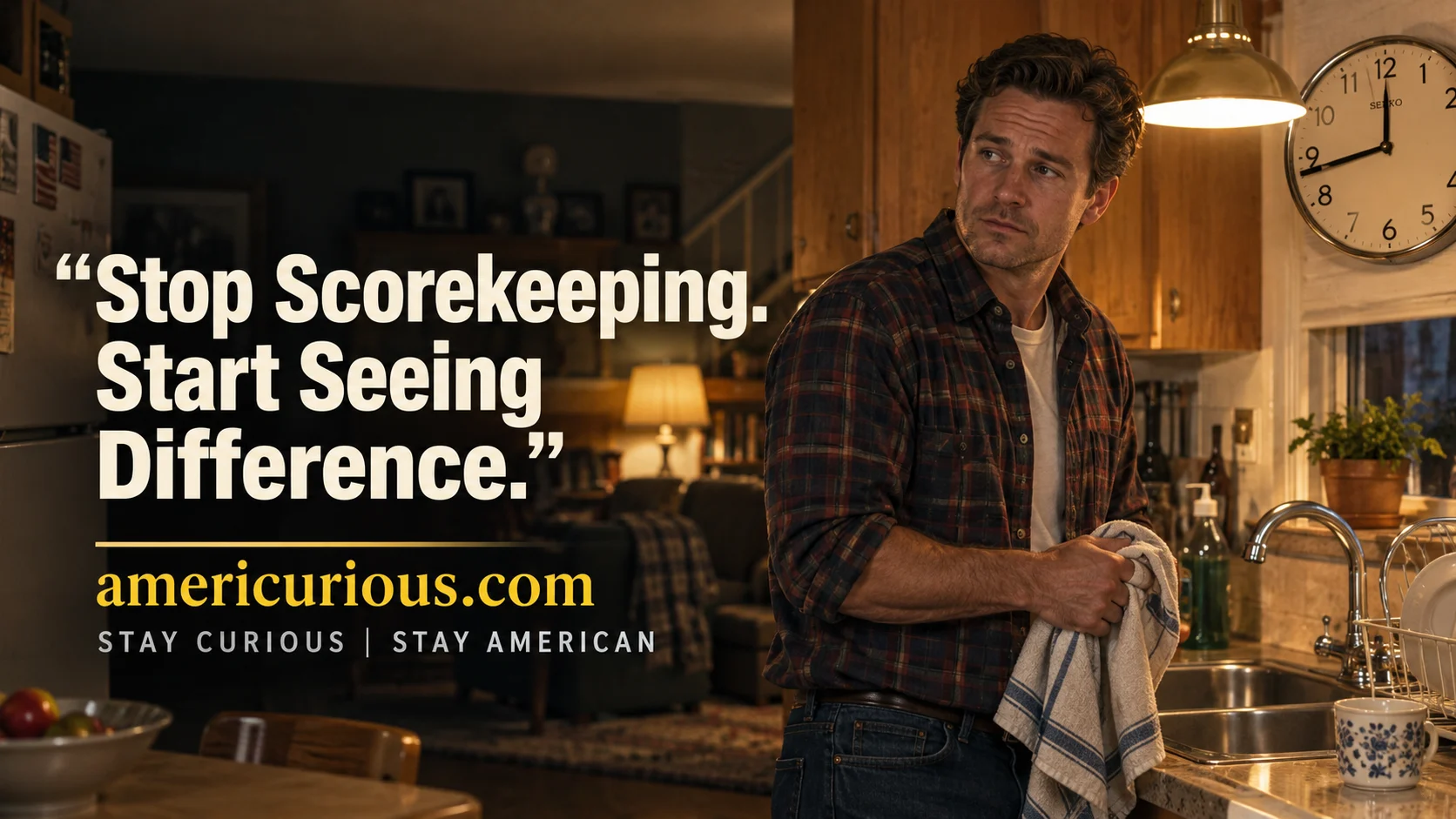
Struggling with relationship conflict resolution? The real issue isn’t communication—it’s otherness. Learn how to stop scorekeeping and rebuild your marriage.
TL;DR: Most couples think their constant fighting comes down to bad communication, but top clinical psychoanalysts reveal the real culprit: “otherness”. When we live with someone who operates differently from us, our ego treats those differences like a threat. By dropping transactional scorekeeping, recognizing our unconscious family loyalties, and co-creating new solutions together, we can turn chronic friction into deep, lasting connection.
It is 11:42 p.m. on a Saturday. The last guests just walked out the front door of your brick split-level, and you’re standing alone in the kitchen.
The sink is overflowing with wine glasses and grease-stained plates. You’ve got a dish rag in your hand, scrubbing like your life depends on it, while your chest tightens into a hard, cold knot.
Meanwhile, your spouse is stretched out on the couch in the living room, laughing at her phone.
You tell yourself you’re mad about the dishes. But as you listen to the hum of the dishwasher, a terrifying thought creeps in at 2 a.m.: Is this just what year six of marriage feels like, or are we quietly slipping away?
If you’ve ever stared at your sleeping partner and wondered when they turned into your adversary, listen to me: you aren’t broken, and neither is your marriage.
You’ve been told for years that relationship conflict resolution is all about mastering “I feel” statements and communication hacks. But here’s the catch—talking isn’t your actual problem.
In this post, we’re gonna break down why human difference triggers such deep resentment, why traditional compromise feels like a trap, and how you can finally stop scorekeeping so you can get back on the same page.
Related Post…
It’s Not a Lack of Love. It’s the Loss of Friendship That Makes a Marriage Unhappy
The “Communication” Myth: Why Relationship Conflict Is Really About Otherness
Look, almost every couple who walks into a therapist’s office starts with the exact same script: “Doctor, we just have a problem with communication”.
It makes sense on the surface. Talking is how we interact, so whenever friction shows up, it manifests in our words.
“Usually, there are real issues underlying the issues of communication. Often people make communication difficult because it’s hard for them to touch the real issues, so they defensively create problems in communication.”
The legendary psychoanalyst Dr. Orna Guralnik points out that the true battleground of partnership isn’t communication at all—it’s otherness. It’s the shocking, daily reality of living with a human being who is fundamentally different from you.
+-------------------------------------------------------------------------+
|                         THE CYCLE OF OTHERNESS                          |
|                                                                         |
|  [Partner Does Things Differently] --> [Ego Feels Intrusive Threat]     |
|                   ^                                  |                  |
|                   |                                  v                  |
|  [Defensive Communication Fights] <-- [Build "Villain" Theory to Win]   |
+-------------------------------------------------------------------------+
When your spouse loads the dishwasher differently or wants to relax after a party while you feel compelled to clean right away, their “otherness” infringes on your habits and rules.
Reality Check:
When your partner handles a task differently than you would, your brain doesn’t just see a preference. It senses a threat to your way of life, immediately asking: Who’s right, who’s wrong, and who’s on top?
Instead of accepting that two people simply have different styles, we build elaborate theories to make ourselves the good guy and our partner the villain.
How Small Habit Clashes Mask Deep Incompatibilities
Take that post-party kitchen cleanup. If you stay behind to clean while your partner sits with guests, you might build a theory that they’re lazy, entitled, or shirking responsibility.
Meanwhile, your partner builds a theory that you’re rigid, obsessive, and incapable of having fun.
Neither of you is actually fighting about plates. You’re fighting because their way of moving through the world feels like a direct critique of yours.
The Theories We Build to Make Our Partner the Villain
We construct these scripts so we don’t have to face the raw discomfort of difference. It’s like a thorn stuck under your skin.
Rather than pulling out the thorn and asking why it hurts so badly, it’s much easier to snap: “Why can’t you just do it the right way for once?”
Unconscious Loyalties: Why Navigating Differences in Marriage Triggers Ego Defenses
Have you ever caught yourself thinking: Why does everything have to be a negotiation with us lately?
Here’s real talk: when your partner does things differently, it doesn’t just annoy your schedule—it rattles your identity.
+------------------------------------------------------------------------------------+
| TABLE 1: WHAT WE SAY VS. WHAT THE EGO IS PROTECTING UNDERNEATH                    |
+--------------------------------------------------+---------------------------------+
| What We Say to Our Partner                       | What the Ego Is Protecting      |
+--------------------------------------------------+---------------------------------+
| "You're so disorganized and lazy."               | Unconscious loyalty to a strict |
|                                                  | childhood home blueprint|
+--------------------------------------------------+---------------------------------+
| "You're gaslighting me!"                         | Fear of sitting in uncomfortable|
|                                                  | inner conflict or error|
+--------------------------------------------------+---------------------------------+
| "You don't care about our financial future."     | Deep-seated anxieties about     |
|                                                  | control and security   |
+--------------------------------------------------+---------------------------------+
The Invisible Blueprints of Family of Origin
We all carry invisible blueprints from how we were raised. If your mother swept the floors every night before dessert, keeping a immaculate kitchen feels like home and safety to you.
When your spouse leaves coffee mugs in the sink, your brain interprets it as a betrayal of your family heritage.
Dr. Guralnik notes that agreeing to your partner’s way often feels like being disloyal to your parents or your upbringing. We defend our habits fiercely because we’re terrified that letting go means losing ourselves.
                          [Childhood Blueprint]
                                    |
                                    v
                    [Unconscious Family Loyalty]
                                    |
                                    v
                  [Partner's Habit Differs (Otherness)]
                                    |
                                    v
               [Ego Protection & Relational Resistance]
Pop-Psychology Labels: How “Gaslighting” and “Narcissism” Stop Self-Investigation
In modern culture, we’ve gotten real fancy with TikTok therapy terms. The moment our partner pushes back, we reach for heavy weapons: “You’re a narcissist!” or “You’re gaslighting me!”
Now, real talk—are people narcissistic? Technically, 100% of us have narcissistic defenses designed to protect our fragile egos.
“Usually the way people use these words is they have a feeling about something but they don’t exactly know what that something is, so they grab a word from TikTok that supposedly captures it, and then they’re done thinking.”
Slapping a clinical label on your spouse gives you immediate relief because it puts all the blame outside of you. But it completely halts your own self-investigation.
You Might be Interested in This Article…
Anxious-Avoidant Marriage: 2 AM, He Went Quiet, I Asked AI
The Compromise Trap: Why Meeting in the Middle Can Backfire
We’ve been conditioned to believe that compromise is the gold standard of healthy relationships.
That sounds simple, but it isn’t. In practice, traditional compromise often functions like a cheap band-aid that breeds ugly, slow-burning resentment.
+-------------------------------------------------------------------------+
|                  TRANSACTIONAL VS. CO-CREATED SOLUTIONS                 |
|                                                                         |
|  Transactional Split: "I did X, so you owe me Y." (Breeds Bitterness)  |
|                                                                         |
|  Co-Created Design:  "What serves the total good of our home?"          |
+-------------------------------------------------------------------------+
Transactional Marriage vs. Shared Ownership
When you compromise transactionally—“I’ll sweep the deck if you fold the laundry”—you’re treating your marriage like a business contract.
You keep score. And when you keep score, you inevitably focus on every ounce of effort you put in while missing the subtle ways your partner carries the weight.
Eventually, one of you snaps: “I changed for you, I did all these things, and you still don’t value me!”
Designing a “New Home” Together
Instead of transactional bargaining, think of your partnership like designing a physical house.
You wouldn’t want your new house to be an exact copy of your parents’ home, and your spouse wouldn’t want it to mirror theirs either. You sit down and design something fresh that fits both of your tastes.
That requires relaxing your rigid convictions and working for the total good of the unit, rather than winning a temporary argument.
5 Signs Your Compromise Is Breeding Resentment:
- You keep a mental tally of who did more chores this weekend.
- You feel a cold, churning dissatisfaction even after your partner agrees to your demand.
- You catch yourself thinking: “Fine, I’ll do it, but don’t expect me to be happy about it.”
- You bring up past concessions during totally unrelated arguments.
- You view your partner’s preferences as something you have to “tolerate” rather than understand.
Turning Inward: How to Stop Scorekeeping in Marriage and Reclaim Connection
So how do we break the cycle of relationship conflict resolution and stop acting like roommates who share a mortgage?
It starts when you stop hyperfocusing on your partner’s flaws and turn your gaze inward.
The Two Hard Questions Every Partner Must Ask Themselves
If you wanna transform the atmosphere in your home, ask yourself these two fundamental questions:
- Am I actually ready to let someone else in with their otherness?
Are you willing to tolerate another human being without needing them to be your clone? - Can I give without scorekeeping?
Can you step up out of genuine care, rather than using your generosity as leverage?
                       [Facing Relationship Friction]
                                     |
                                     v
                       [Pull Back Hyperfocus on Partner]
                                     |
                                     v
                 +-------------------+-------------------+
                 |                                       |
                 v                                       v
     [Question 1: Can I Give?]             [Question 2: Am I Ready for Otherness?]
                 |                                       |
                 +-------------------+-------------------+
                                     |
                                     v
                        [Co-Create Shared Solutions]
Replacing the “Gotcha” Gaze with Mutual Respect
Look, your partner responds directly to the “music” you send out.
If you look at them with a “gotcha” gaze—waiting for them to mess up or forget a task—they’re gonna retreat into defensive deadness or go play video games.
But when you approach them with elemental awe and basic respect, you invite their best self to step forward.
Navigating Money, Power, and “Mine vs. Ours”
Financial clashes are rarely just about bank accounts; they’re about reality, power, and boundaries. Money forces the question: Where do I end, and where do we begin?
Whether you’re debating savings goals or discretionary spending, get your underlying economic ideologies on the table. Stop arguing about individual purchases and start negotiating the political system of your shared life.
Mindset Shift:
A healthy relationship doesn’t mean staying 50/50 every single day. Some years your partner carries you; other years you carry them. Stop measuring daily output and start honoring the long-term journey.
Frequently Asked Questions About Relationship Conflict
Why does my wife get mad when I clean or manage the house my way?
It’s rarely about the cleaning itself. When you manage chores with rigid perfectionism, your spouse may feel judged, controlled, or pushed out of shaping your shared environment. She doesn’t see a helpful act; she sees an unspoken critique of her standards.
How do I know if we’re just in a busy phase or if my husband feels like a roommate?
Look at the underlying “music” or atmosphere between you. A busy phase still has undertones of warmth, humor, and mutual appreciation. A “roommate” dynamic is marked by emotional stinginess, scorekeeping, and a gotcha gaze where both partners operate defensively.
Is it bad if my partner and I rarely argue about our differences?
Couples who never argue actually scare top therapists. Zero conflict often means one or both partners have completely repressed their differences to keep an artificial peace. Real closeness requires facing otherness, not hiding from it.
How can I accept my partner’s differences without fighting all the time?
Pull back your hyperfocus from their behavior and ask yourself why their habit triggers such intense frustration in you. Once you identify your own unconscious loyalties and ego defenses, you can replace judgment with genuine curiosity.
Conclusion: Putting Down the Mirror
Let’s head back to that quiet, dim kitchen in East Grand Rapids.
The last plate is clean and stacked in the cupboard. You dry your hands on the dishtowel, but instead of brooding over the hum of the empty dishwasher, you walk into the living room.
You sit down next to your spouse on the couch. You don’t bring up the chores, and you don’t start a debate about scheduling. You just lean in, look at her with genuine warmth, and ask how her night went.
The dishes are done, but more importantly, the invisible wall between you starts to crumble.
Here are your core takeaways for relationship conflict resolution:
- Communication is a symptom; otherness is the root cause. Focus on accepting human difference rather than fixing surface talk.
- Ditch pop-psychology buzzwords. Labeling your spouse as a narcissist protects your ego but kills real intimacy.
- Stop scorekeeping. Transactional compromise breeds bitterness; co-creating a new home builds unity.
- Shift your gaze. Look at your partner with suspicion, and you’ll get defensiveness; look at them with respect, and you’ll invite connection.
Your Next Step:
Tonight, before you bring up that recurring complaint, pull back the lens and ask yourself: Am I demanding my partner change just so I don’t have to face my own discomfort?
If this post brought you a moment of clarity, bookmark americurious.com or subscribe to our newsletter for raw, grounded takes on modern love.
Real love doesn’t require your partner to become your mirror—it simply requires you to put down the mirror and finally see them as they are.
— Dr. AmeriCurious