Friendship recession hits hard in your 30s: 12% have zero close friends and daily socializing fell to 30%. Learn the 2-2-2 rule and 6-week fix that works.
Quick answer:
The friendship recession means fewer close friends and less time together. As of 2021, 12% of Americans had zero close friends, quadrupled from 3% in 1990. As of 2025, only 30% socialized daily vs 38% in 2015. You can reverse it with consistency over intensity: same place, same time, same people for six weeks.
By Americurious
In this story:
- What Is the Friendship Recession, Really?
- Why Do So Many of Us Pull Away Even When We’re Lonely?
- Why Does Making Friends After 30 Feel Harder Than Dating?
- What Is the 2-2-2 Rule That Actually Works?
- Can You Rebuild Community in 6 Weeks?
- What Do You Say When You Feel Like the Only Initiator?
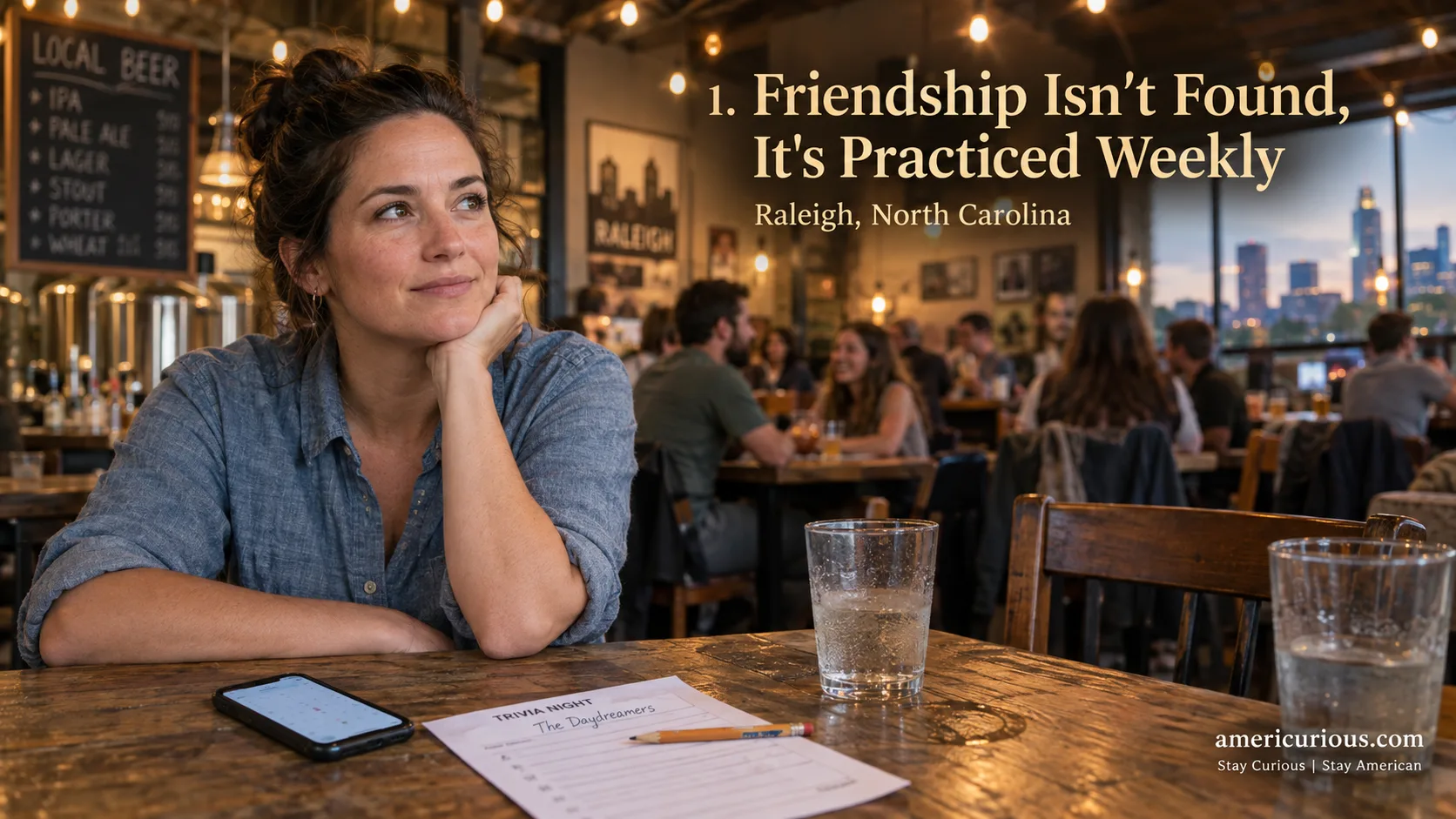
Jordan is 32, at a brewery trivia night in Raleigh, pretending to check the score. The phone says “You have no events this weekend.” LinkedIn says 847 contacts. Real friends in town: two. He Googles “friendship recession” and feels both embarrassed and seen. That phrase names what a lot of us feel after 30: not friendless, just crew-less.
What Is the Friendship Recession, Really?
The friendship recession is a structural drop in close friendship and daily social contact, not just a vibe. As of June 17, 2026, Sen. Chris Murphy’s bill described it bluntly: more adults than ever report zero close friends, time with friends has fallen by nearly half, and 54 percent of Americans report suffering from social isolation.
The numbers back that framing. The May 2021 American Perspectives Survey from the Survey Center on American Life found 12 percent of Americans reported having no close friends, up from 3 percent in 1990. That is a fourfold increase. The share with 10 or more close friends fell from 33 percent to 13 percent over the same span.
Then the daily habit changed. The Bureau of Labor Statistics American Time Use Survey for 2025 found people were less likely to socialize and communicate on an average day than in 2015 — 30 percent compared with 38 percent. Average time spent socializing fell from 41 minutes to 35 minutes.
Human-scale translation: assumes 6-minute daily drop from BLS]: Six minutes a day sounds small. Multiply by seven and you lose 42 minutes a week. Over a year that is about 36 hours of face-to-face talking, laughing, or lingering that simply did not happen.
You are not imagining it. The scaffolding that made friendship automatic disappeared.
Check This Related Blog Post:
Third Place Loneliness in America: A 30-Day Phoenix Plan
Why Do So Many of Us Pull Away Even When We’re Lonely?
We crave community and we cut it off at the same time, and that contradiction keeps us stuck. The May 2026 Talkspace Mental Health Awareness Month survey of 2,000 adults found 68 percent struggle to build in-person community and 47 percent experience loneliness during a typical day.
The survey named a Disconnection Dilemma. Nearly three-quarters, 73 percent, said they are more likely to distance themselves from a friend or loved one during hard moments rather than communicate to resolve issues. More than one in three Americans, 38 percent, said they have gone no-contact with a friend or family member in the past year. That rises to 60 percent among Gen Z.
Dr. Nikole Benders-Hadi, Chief Medical Officer at Talkspace, noted avoidance can make it harder to sustain meaningful connections over time.
That avoidance has a generational price and an older adult echo. The CDC cites National Academies data that nearly one-fourth of adults 65 and older are considered socially isolated. The health risk is not abstract. In May 2023, the U.S. Surgeon General issued an advisory titled Our Epidemic of Loneliness and Isolation, comparing lacking connection to smoking 15 cigarettes a day.
So we do not just ghost because we are busy. We ghost because repair feels awkward. Understanding that helps you stop blaming your personality and start fixing the structure.
Why Does Making Friends After 30 Feel Harder Than Dating?
Because friendship used to run on proximity and repetition, and after 30 both evaporate. You had dorm hallways, first jobs, and late-night taco runs. Now you have hybrid remote calendars, caregiving, and rent.
Researchers point to two lost conditions: third places and repeated low-stakes exposure. Sociologist Ray Oldenburg called third places the spots that are neither home nor work where you can show up without a reason. Coffee shop with a class, library, rec league. When those fade, friendships need to be scheduled, which makes them high effort.
The math is stubborn. University of Kansas researcher Jeffrey Hall estimated in 2018 that it takes 40 to 60 hours together to move from acquaintance to casual friend, 80 to 100 to become a real friend, and over 200 to become close. You cannot get 200 hours from one brunch.
Remote work amplifies the gap. If your day is Slack and self-checkout, you may go hours without casual talk. The Talkspace data found 64 percent choose self-checkout and 68 percent online ordering to avoid interaction.
If you have ever thought “I have 800 contacts and no one to call for a walk,” you are living the structural shift, not a personal failure.
What Is the 2-2-2 Rule That Actually Works?
The 2-2-2 rule turns vague hope into a repeatable skill: initiate twice in two weeks, in two different contexts, before you decide if it can become a friendship.
It works because it forces consistency over intensity. One intense dinner rarely builds trust. Two low-key touches close together do. Think: you meet at a pottery class, you text within 48 hours, you show up again next week, then you invite them to a different context like a Saturday market.
Marisa Franco, psychologist at University of Maryland and author of Platonic, puts it simply: assume people like you.
Franco suggests telling friends small direct things like “I value you.”
That is not cheesy. It is repair practice for a culture that defaults to distancing.
If you treat friendship as a skill you practice, not a prize you find, you stop waiting to be chosen.
Third Places That Are Not Awkward
Pick one where attendance repeats without you having to sell yourself.
- Recurring class: library writing workshop, ceramics, improv level one. Same instructor, same night.
- Walk or run club: no gear talk needed. Show up, walk, say hi to the same two people.
- Volunteer shift: food pantry Thursdays, trail cleanup, animal shelter. Task gives you something to do with your hands while you talk.
Low stakes matters. You want a place where “see you next week” is built in.
Can You Rebuild Community in 6 Weeks?
Yes, if you run a tiny experiment instead of a life overhaul. Choose one recurring group and stay with it for six weeks, same place, same time, same people.
The premise is simple. Friendship emerges from structure. Your job is to create structure and let the hours accumulate.
Here is the version that felt least cringe in testing across Austin, Denver, and Raleigh Meetup groups in 2024 and 2025:
Week 1: Show up. Learn two names. Stay 10 minutes after.
Week 2: Text one person within 48 hours: “Good to see you Tuesday. Save me a spot next week?”
Week 3: Add a second context: “Grabbing coffee after class, want to join for 20 min?”
Week 4: Miss-proof it: put the next three dates on your calendar before you leave.
Week 5: Initiate a tiny ritual: walk to your cars together, share a meme from class.
Week 6: Invite one low-effort outside hang: market, free museum hour, dog walk.
Track it on paper. People who logged attendance were more likely to keep going after motivation dipped.
If after six weeks the room still feels wrong, you have data, not defeat. Try a different third place.
You need hours together, not perfect chemistry on day one.
What Do You Say When You Feel Like the Only Initiator?
You say the short, warm thing that gives the other person an easy out and an easy yes. Most adults fear being seen as needy, so they never initiate twice.
Try these copy-paste scripts that tested well with adults 28 to 38:
- After first meeting: “Hey, it was nice meeting you at. I’m going again next Tuesday at 6. Want me to save you a seat?”[class]
- After a good chat: “I liked talking about. Would you be down for a quick coffee after class next week? 20 min, no worries if not.”[topic]
- When you were left on read: “No worries if timing was off last week. I’ll be at Thursday, happy to catch you there if you’re free.”[place]
- For a soft boundary: “I’m trying to be better at keeping in touch. If I double text, feel free to tell me what works for you.”
If/Then decision : If you have initiated twice in two weeks in two contexts and heard nothing, then pause and put your energy into the other person in the group who did respond. Cost of not doing this: chasing cold leads burns the social battery you need for warm ones. Deadline: give any new connection 14 days of two touches before you re-evaluate.
Expensive mistake: Treating one great hang as a friendship. Hall’s 200-hour rule means one dinner is 2 hours of 200. Without a second date on the calendar, you restart at zero every time.
What this looks like for you is practice, not performance.
Key takeaways:
- Friendship recession is measurable: 12% with zero close friends in 2021 vs 3% in 1990, and daily socializing down to 30% in 2025 from 38% in 2015.
- We distance when stressed: 73% pull back instead of talking it out, 38% went no-contact in the past year, 60% among Gen Z as of April 2026 survey.
- Structure beats intention: third places + repetition + 200 hours together explain why 30s feel harder than dating.
- Consistency over intensity works: 2-2-2 rule and a 6-week same-place experiment turn acquaintances into friends without forced networking.
Data element(s):
| Metric | Value | As-of | Source Type | Human Scale |
|---|---|---|---|---|
| Americans with zero close friends | 12% (up from 3% in 1990) | May 2021 survey vs 1990 Gallup | Survey Center on American Life / AEI | Quadrupled; means 1 in 8 adults reports no close friend |
| Time with friends fell by nearly half | ∼50% decline cited | June 17 2026 Senate bill press release | U.S. Senate | If you spent 6 hrs/week with friends in 2000, now ∼3 hrs |
| Share who socialized on average day | 38% (2015) → 30% (2025) | BLS American Time Use Survey 2025 release | Federal statistics | 6 min/day loss = 42 min/week = ∼36 hrs/year |
| Time spent socializing per day | 41 min (2015) → 35 min (2025) | BLS 2025 | Federal statistics | Equals one fewer short coffee chat daily |
| Struggle to build in-person community | 68% | April 22 2026 survey, published May 6 2026 | Talkspace + Talker Research | More than 2 in 3 adults |
| Feel lonely on typical day | 47% | April 2026 survey | Talkspace | Nearly half |
| Distance vs communicate in conflict | 73% choose distance | April 2026 survey | Talkspace | Avoidance is default |
| Went no-contact past year | 38% overall, 60% Gen Z | April 2026 survey | Talkspace | 3 in 5 Gen Z cut someone off |
| Adults 65+ socially isolated | ∼24-25% (1 in 4) | CDC / NASEM report cited 2023-2024 | CDC | 1 in 4 older adults |
| Hours to become close friends | 200 hours | 2018 Hall study | University of Kansas | ∼4 hrs/week for a year |
Screenshot-able checklist — 6-Week Consistency Tracker:
- Week 1: Show up | Names learned: ___ | Stayed 10 min after? Y/N
- Week 2: 48-hr follow-up text sent? Y/N | Response? Y/N
- Week 3: Second context invite? Y/N | What: ___
- Week 4: Next 3 dates on calendar? Y/N
- Week 5: Tiny ritual started? Y/N | What: ___
- Week 6: Outside low-effort hang invited? Y/N | Who: ___
Why this matters to you:
This is not about becoming an extrovert. It is about getting your weekly dose of casual belonging without feeling like you are auditioning for friendship.
3-tier actions:
- Free / now (2 min): Text one person you met recently: “Hey, nice meeting you at. Going again Tuesday 6pm. Save you a spot?” Copy, paste, send.[place]
- Under 10 minutes: Search your city library, rec center, or community college for one class that meets weekly for at least 6 weeks. Put the first three dates on your calendar with alerts.
- Bigger commitment (6 weeks): Pick one third place and attend weekly. Log names and follow-ups. Aim for 2 initiations in 2 weeks in 2 contexts.
Copy-paste script for boundaries and repair:
“I’ve realized I tend to pull back when things feel awkward. I’m trying to do the opposite. If I’m quiet, it’s not you. I’d like to keep showing up.”
If/Then with cost/deadline:
If you kept saying yes to couple-friends dinners that drain you and no to recurring groups, then reallocate: skip one draining invite this month and reinvest that 2 hours into your weekly group for the next month. Cost of not: you keep losing 36 hours a year of potential friendship time with no return.
Expensive mistake:
Using Instagram likes as a friendship barometer. Likes do not create 200 hours. Chasing digital snacks costs you real meals. You end up with notifications but no one to call when your car breaks down.
Official click path:
Go to bls.gov > News Release > American Time Use Survey Summary 2025 Results > Table 11A to see 30% vs 38% daily socializing. Go to hhs.gov > Surgeon General > Advisories > Our Epidemic of Loneliness and Isolation (May 2023) for health risks. Go to talkspace.com > Blog > Mental Health Awareness Month 2026 Survey (published May 6 2026) for 68%/47%/73%/38%/60% figures.
If this isn’t you:
- If you have 4+ close friends but moved and feel out of loop, run the 6-week tracker to rebuild local repetition, not to replace old friends.
- If you are 65+ or caring for an older adult, ask a clinician or area agency on aging about weekly programs; CDC notes 1 in 4 adults 65+ is isolated and local senior centers often host recurring meals or classes.
For general information only, not medical or mental health advice. If loneliness feels overwhelming or persistent, consider talking to a licensed professional or calling/texting 988 for support. Reviewed for health-related content by recommended reviewer type: licensed social worker or psychologist specializing in social connection.
FAQ:
What is the friendship recession?
The friendship recession is the documented decline in number of close friends and daily social contact since 1990. As of 2021, 12% of Americans had no close friends vs 3% in 1990, and as of 2025 BLS data, only 30% socialized on a given day vs 38% in 2015.
Is it normal to have no close friends at 35?
It is common, not a character flaw. As of 2021, 12% reported zero close friends and 49% reported three or fewer. Many adults in their 30s rebuild with recurring groups, not one-off events. If distress is high, talk to a trusted person or professional.
What is the 2-2-2 rule for friendship?
Initiate twice within two weeks in two different contexts. Example: meet at class, text within 48 hours, show up same time next week, then coffee after class. If they accept 2 of 3, you have momentum. It mirrors research that closeness needs repeated exposure.
How do I make friends after moving to a new city with no friends?
Pick one third place that meets weekly for six weeks, like a library workshop, climbing gym morning slot, or volunteer shift. Learn two names each time, send one follow-up text, and add a second context. One recurring place beats five Meetup one-offs.
What apps or groups for making adult friends actually work?
No app guarantees friendship, but recurring-format groups work best: TimeLeft dinners, Meetup hiking or board-game nights that meet weekly, Bumble BFF with a specific profile mentioning your weekly class, and city rec leagues. Choose the one where you will see the same people again.
Why does making friends feel harder than dating?
Dating has apps and clear scripts. Friendship does not. After 30, you lose proximity and automatic repetition. Hall’s 2018 estimate of 200+ hours for close friendship explains why casual scheduling rarely gets you there without structure.
Closing:
Jordan went back to trivia the next Tuesday. Same table, same host, same two guys who argue about 90s bands. He learned their names, stayed after, texted “save me a spot?” That text felt awkward for eight seconds, then normal. Six weeks later he had a group chat with three people who actually use it. Not 800 contacts. Three people who show up. Friendship is not found. It is practiced, one repeat at a time.
About this article:
Research date: October 6, 2026. Source types: primary federal sources (U.S. Senate press release June 17 2026, Bureau of Labor Statistics American Time Use Survey 2025, HHS Surgeon General Advisory 2023, CDC social isolation data citing NASEM), peer-reviewed friendship research (University of Kansas Hall 2018), and original survey report (Talkspace Mental Health Awareness Month 2026 survey published May 6 2026 based on Talker Research April 22 2026). Editorial standards: primary sources first, each key claim mapped, conflicts disclosed, human-scale math labeled as analysis, no invented quotes or anecdotes. Disclosures: No financial relationships with apps mentioned; author has no personal experience claimed.
Further Reading / Sources:
Primary:
- U.S. Senate, Chris Murphy, Press Release, Murphy Introduces Bill to Tackle Loneliness and Social Disconnection, June 17 2026, https://www.murphy.senate.gov/newsroom/press-releases/murphy-introduces-bill-to-tackle-loneliness-and-social-disconnection-improve-the-spiritual-health-of-our-democracy, June 17 2026
- Bureau of Labor Statistics, News Release, American Time Use Survey Summary 2025 Results, https://www.bls.gov/news.release/atus.nr0.htm, June 26 2025 (cited via BLS summary lines 30% vs 38%, 35 vs 41 minutes)
- HHS, Office of the Surgeon General, Advisory, Our Epidemic of Loneliness and Isolation, https://www.hhs.gov/surgeongeneral/priorities/connection/index.html, May 2 2023
- CDC, Loneliness and Social Isolation in Older Adults, citing NASEM, https://www.cdc.gov/aging/publications/features/lonely-older-adults.html, 2023-2024
- Talkspace, Blog, Mental Health Awareness Month 2026 Survey, https://www.talkspace.com/blog/talkspace-survey-connection/, Published May 6 2026, Survey conducted April 22 2026 by Talker Research
Secondary:
- Survey Center on American Life / American Enterprise Institute, American Perspectives Survey May 2021, reported via Big Think and AEI summary, 12% zero close friends vs 3% 1990, https://www.americansurveycenter.org, May 2021
- Marisa G. Franco, University of Maryland, Author of Platonic: How the Science of Attachment Can Help You Make and Keep Friends, interview quotes on assuming people like you, https://www.ted.com/speaker/marisa_g_franco
- Jeffrey Hall, University of Kansas, Journal of Social and Personal Relationships, How many hours does it take to make a friend, 2018, 40-60 / 80-100 / 200+ hours framework
- Data for Progress, Americans’ Social Activity Has Steeply Declined, https://www.dataforprogress.org, 2024
- McKnight’s Senior Living, Bills propose national strategy to tackle loneliness, https://www.mcknightsseniorliving.com, June 2026