
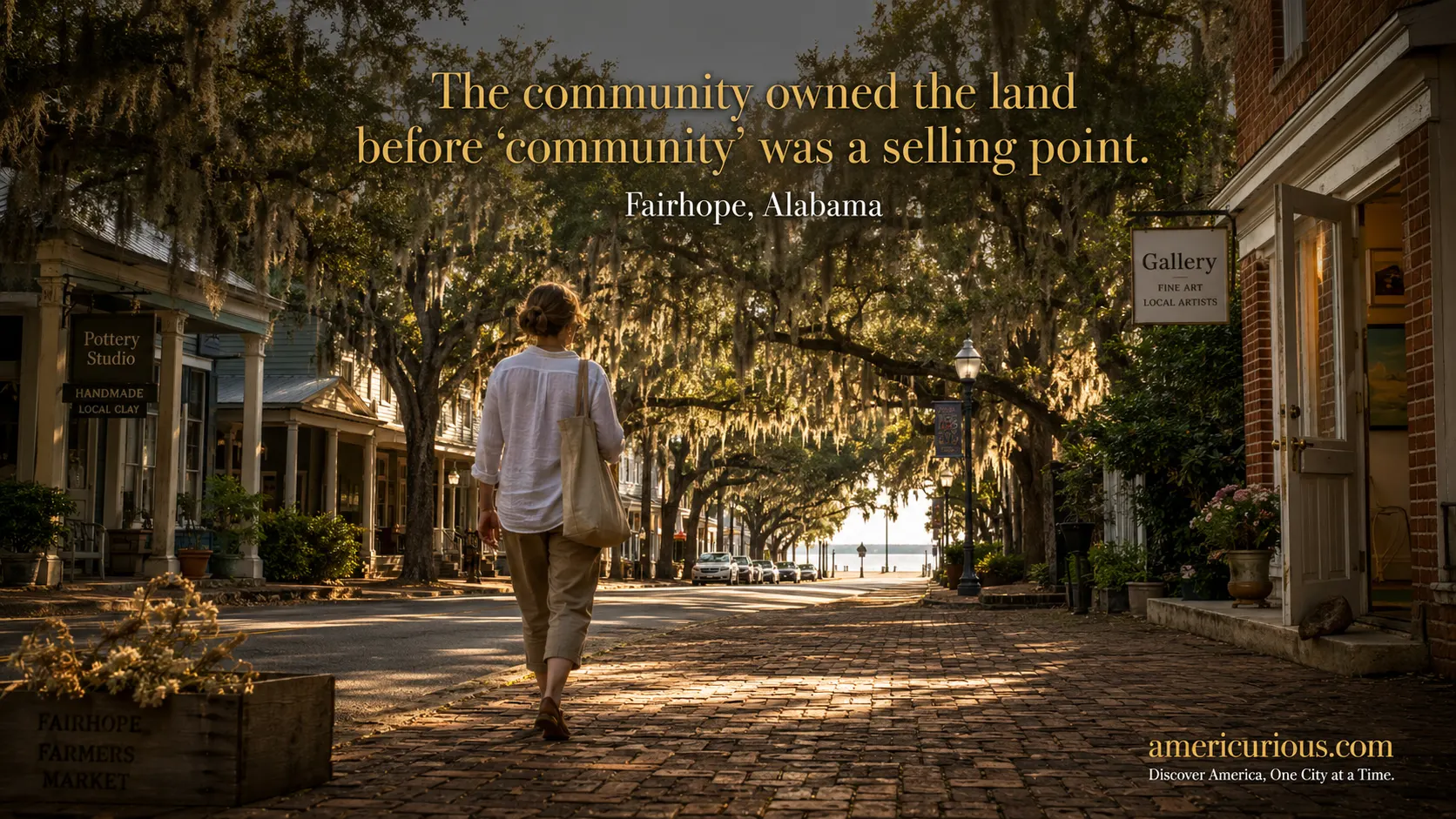
Fairhope, Alabama is one of America’s last living single-tax colonies. Here’s what intentional living in Fairhope Alabama actually costs — and who it’s for.
Primary Keyword: intentional living in Fairhope Alabama
Secondary Keywords: cooperative community, walkable downtown Alabama, Mobile Bay lifestyle, slow living Gulf Coast, single tax colony
Intentional Living in Fairhope Alabama: Why This 130-Year Utopia Still Delivers
The sun drops behind Mobile Bay in long streaks of amber, and the people walking Fairhope’s bluff-top trails aren’t rushing anywhere. They didn’t end up here by accident — they chose it, just as 28 idealists from Des Moines, Iowa chose it in 1894. If you’re searching for a place where the bones of intentional living were literally written into the founding documents, Fairhope may be as close as America gets.
Why Fairhope Is Built for Intentional Living
Most towns claim community values; Fairhope has a corporation that legally enforces them. The Fairhope Single Tax Corporation still owns approximately 4,000 acres today, and residents on Colony land lease through 99-year renewable agreements rather than owning it outright — a structure designed from the start to prioritize community benefit over private speculation. That philosophy is not nostalgia. It is the operating system beneath the flower beds and the brick sidewalks.
The founders’ corporate constitution explained their purpose plainly: to establish a model community free from all forms of private monopoly, and to secure equality of opportunity, the full reward of individual effort, and the benefits of cooperation in matters of general concern. For people who are tired of places where those words are slogans, Fairhope is the rare town where they were once codified into a land lease.
The cooperative ethic also shaped the physical commons that residents enjoy today. The original colonists deeded all the parks along the bayfront to the City of Fairhope in the 1930s with the stipulation that they could only ever be used as parks — a gift that has kept Fairhope’s waterfront public and walkable for nearly a century since.
🎯 What Makes It Genuinely Different
Single-tax cooperative roots. There are only two single-tax colonies remaining in the United States — Arden, Delaware, and Fairhope, Alabama. In a single-tax colony, the community owns the land and leases it for citizens to use, and taxes are paid on the leased land rather than on structures built atop it. For value-driven relocators, living on Colony land means your rent actively funds community infrastructure rather than individual land speculation.
A living arts ecosystem
The Eastern Shore Art Center hosts an annual outdoor art show that draws more than 250,000 visitors and is ranked among the top 15 art shows in the nation by Sunshine Artist Magazine. This is not an occasional event bolted onto a sleepy town — Fairhope’s arts identity runs deep enough that the festival has been held continuously since 1952.
A city-run farmers market with expanded access in 2026
Beginning in April 2026, the city added a once-a-month Saturday morning market alongside its regular Thursday afternoon markets, per the City of Fairhope’s official market page. Vendors include local produce growers, honey producers, bakers, and artisans — the kind of market that functions as a weekly community gathering rather than a tourist attraction.
Walkable downtown with bayfront access
Fairhope’s hydrology and outdoor infrastructure include Mobile Bay, the Municipal Pier, the Weeks Bay Reserve, and the Eastern Shore Trail, all accessible from the town core. The bluff trails above the water offer a daily rhythm of movement that most small towns simply don’t have.
Is Fairhope Affordable for What You’re Building?
The honest answer is: compared to coastal markets of similar character, yes. Compared to most of Alabama, no. In March 2026, the median sale price of a home in Fairhope was $490,000, according to Redfin’s MLS data — down 19.5% compared to the same month last year, with homes averaging 65 days on market. That cooldown creates a meaningful window for buyers who were priced out during the 2021–2023 run-up.
Source conflicts are worth flagging here. A real estate guide updated for 2026 places the median in the mid-$600s depending on proximity to the bay, while Redfin’s March 2026 market data reports $490,000 as the transacted median. The discrepancy likely reflects the difference between list-price estimates and actual closed sales. For planning purposes, the Redfin closed-sale figure of $490K is the more conservative and reliable anchor.
Rental data from HomeSnacks, using U.S. Census ACS 2019–2023 figures, puts the median rent in Fairhope at $1,637 per month — meaningfully higher than the Alabama average of roughly $811, but significantly below comparable coastal markets in Florida. The overall cost of living index for Fairhope sits at approximately 114 — about 14% above the national average and 13% above the Alabama average, driven primarily by housing costs. Groceries, transportation, and healthcare run close to or below national norms, which softens the housing premium for daily life.
Who does the math work for? Remote workers earning coastal or urban salaries will find Fairhope a genuine value play. Retirees with paid-off homes relocating from pricier markets will likely feel the affordability immediately. First-time buyers on local incomes will need to plan carefully — this is not an entry-level market.
What Does Daily Life Actually Look Like?
A Tuesday morning in Fairhope moves at a pace most Americans have to travel to find. You walk the bluff trail before 8 a.m. while the bay is still flat, stop for coffee in a downtown where live oaks drape Spanish moss over brick sidewalks, and make it to the library by mid-morning without once sitting in traffic. Many residents describe the lifestyle as walkable, community-focused, and scenic — a slower pace that families and retirees have sought out specifically as an alternative to the fragmented rhythms of larger metros.
Thursdays have a particular texture from April through summer. The city-run farmers market sets up behind the public library from 2 to 6 p.m., and what happens there is less a shopping errand than a social institution — neighbors catching up, local farmers explaining their growing practices, kids picking through the plant stalls. In March, the 74th annual Fairhope Arts & Crafts Festival takes over the downtown streets for a weekend, and the whole town reconfigures itself around it.
Climatically, Fairhope sits in a humid subtropical zone. The area receives an average of 65 inches of precipitation annually, and summers bring consistent temperatures in the upper 80s to low 90s°F with high humidity. Winters are mild enough that outdoor walking remains viable most months. The Gulf breeze along the bayfront provides real relief from summer heat, making the proximity to water a practical asset, not just a scenic one.
⚖️ The Real Tradeoffs — No Glossing Over
Climate and storm risk
This is the most important tradeoff to confront before signing anything. According to Redfin’s First Street climate data, 100% of properties in Fairhope are at extreme risk of severe wind events over the next 30 years, primarily from hurricanes, with 10% of properties at risk of severe flooding over the same period. Homeowners insurance in coastal Alabama reflects this reality, and buyers should budget for it explicitly — not as an asterisk, but as a line item.
Heat trajectory
Fairhope is expected to see a 228% increase in the number of days over 106°F (feels-like temperature) over the next 30 years, per First Street climate projections. For intentional livers drawn to outdoor community rhythms, this is a meaningful long-term variable. Spring and fall remain excellent, but summer outdoor activities will increasingly require early-morning or evening timing.
Tourism and growth pressure
With new development comes increased traffic, higher housing costs, and added pressure on schools and public services — and many residents are concerned about maintaining the walkable, peaceful lifestyle that has defined Fairhope for generations. Festival weekends particularly compress parking and downtown access; those who live within walking distance fare far better than those who drive in from outlying neighborhoods.
Price premium without mitigation
Fairhope costs more than every neighboring city in Baldwin County. For buyers who need to commute to Mobile daily, the lifestyle premium may not offset the longer drive compared to choosing Daphne or Spanish Fort. There is no genuine workaround here — it is a values tradeoff that each relocator must price honestly.
👥 Who Thrives Here — and Who Might Not
Remote workers with values-led priorities.
If your work is location-independent and you are choosing a place based on community character, ethics, and daily quality of life rather than proximity to an office, Fairhope is optimized for you. The walkable downtown, arts culture, and cooperative history give remote workers an unusually rich social infrastructure to plug into.
Retirees seeking slow-living and cultural engagement.
The combination of the arts center, bayfront access, a farmers market, and a genuine history of progressive community governance makes Fairhope one of the most culturally substantive small towns in the South. Retirees who want intellectual and civic engagement alongside physical beauty will find both here.
Creatives and makers.
The Eastern Shore Art Center, the annual festival infrastructure, and a long history of attracting artists and intellectuals — Fairhope became a popular wintering spot for artists and intellectuals dating back to its earliest decades — means creative relocators are joining an existing ecosystem rather than building one from scratch.
Who this isn’t for.
If your income depends on local employment rather than remote work, the cost-of-living gap between Fairhope and surrounding towns will be a persistent strain. Buyers who want new construction with low maintenance profiles will also find limited inventory; Fairhope’s character is inseparable from its older housing stock, which carries higher insurance and upkeep realities.
❓ Fairhope for Intentional Living — Quick Answers
Q: Is Fairhope affordable for remote workers?
A: Relative to coastal markets of similar character, yes. The March 2026 median sale price was $490,000 per Redfin’s MLS data, and HomeSnacks census data places median rent at $1,637/month. Remote workers earning salaries benchmarked to higher-cost cities will find their purchasing power meaningfully stronger here than in comparable coastal towns in Florida or the Carolinas. The tradeoff is that homeowners insurance in coastal Alabama adds real cost.
Q: What’s the real community vibe like?
A: Residents and reviewers consistently describe Fairhope as walkable, arts-forward, and community-oriented — a place with a “slower pace” that draws people who want to know their neighbors and their farmers. The downtown is characterized by morning coffee spots, bayfront sunsets, neighborhood streets shaded by live oaks, and a strong sense of community that distinguishes it from neighboring towns. The cooperative history gives this vibe a structural foundation, not just an aesthetic one.
Q: What should newcomers know before relocating?
A: Two practical realities stand out. First, location within Fairhope matters enormously — the walkable, community-connected experience is concentrated in and near downtown; homes further east of Highway 181 feel more suburban and less connected to the town’s character. Second, storm preparedness is not optional here. All properties face extreme wind risk over the next 30 years per First Street data, and smart relocators visit during hurricane season (June–November), not just in the mild spring months.
Q: Is there real intentional community infrastructure here?
A: Yes — and it is over a century old. The Fairhope Single Tax Corporation, a 501(c)(4) nonprofit, still owns approximately 4,500 acres of land in and around the city, leases lots through 99-year renewable agreements, and continues to hold elections for its board. The Eastern Shore Art Center anchors the arts community, and the City of Fairhope’s farmers market operates as a municipally supported local food institution. These are functioning, verified organizations — not curated branding.
Q: What are the climate and environmental risks?
A: Fairhope’s climate risks are significant and should be weighted seriously in any relocation decision. According to Redfin’s First Street climate data, 100% of properties face extreme wind risk from hurricanes, 10% face severe flood risk over the next 30 years, and the town is projected to see a 228% increase in days where the “feels-like” temperature exceeds 106°F over the same period. The bayfront location that makes Fairhope beautiful is the same geography that creates storm surge exposure. Flood insurance, wind mitigation features in any home you purchase, and a practiced hurricane evacuation plan are non-negotiable parts of life here.
🔍 Verified Sources
- Redfin’s March 2026 Fairhope housing market data — The most current closed-sale median price data and First Street climate risk projections for Fairhope properties; essential for any buyer’s financial planning.
- City of Fairhope official history and farmers market page — Primary government source for the founding story of the Single Tax Colony and current farmers market schedules for 2026.
- Explore Eastern Shore: What Is the Fairhope Single Tax Corporation? — Clear explanation of how the Colony’s land-lease system works today, including the 4,500-acre land holdings and 99-year lease structure.
- WKRG News: Fairhope’s Single Tax Colony (March 2025) — Recent local reporting with verified quotes from the director of Fairhope’s Museum of History on the Colony’s current status.
- Eastern Shore Art Center: 2026 Outdoor Art Show — Official source for the annual art show, including its national ranking and 2026 programming details.
- HomeSnacks Fairhope Cost of Living — U.S. Census ACS 2019–2023 data on median home value, median rent, and median income in Fairhope; useful for benchmarking affordability.
Last verified: May 13, 2026. Intentional living is deeply personal. Visit during an off-peak season, attend the Thursday farmers market, walk the bluff trails at dusk, and trust your values before signing anything.