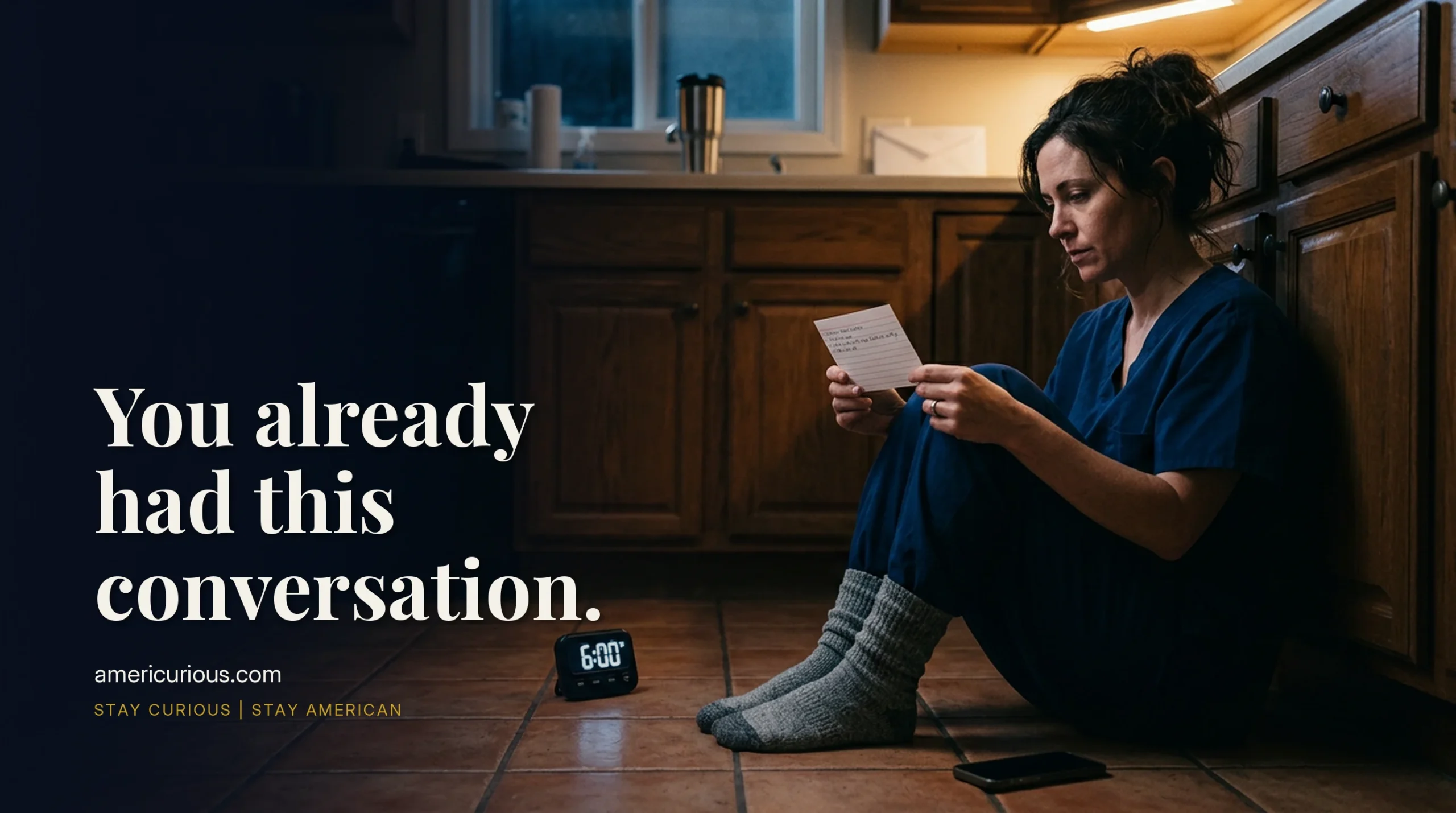
⚡ TL;DR — How to Stop Rehearsing Conversations in Your Head Before They Happen
- ✔ The problem isn’t anxiety. It’s a document. You wrote a script, reality redlined it, and the replay is your brain auditing the difference.
- ✔ The fix is S.C.R.I.P.T. — six moves in a fixed order: Sentence not script · Cap it at six minutes · Run it out loud standing · Isolate the one dread · Pre-commit a freeze phrase · Tape over the replay.
- ✔ Who it’s for: anyone who has already had a hard conversation four times, and only once with another human being.
- ✔ The result: the meeting costs 11 minutes instead of a week — a card in your hand, not a script in your head.
🌙 It’s 11:47 p.m. and Alyssa Is Winning an Argument That Already Happened
Sunday, November 1, 2026. Round Rock, Texas. 11:47 p.m.
Alyssa Herrera is on her left side with her phone at 4% brightness, and she is not thinking about Monday’s meeting. She’s editing Thursday. She has finally found the exact sentence she should have said to Dana by the ice machine — “I’m not asking for less work, I’m asking for a different shape to it” — and she is furious that she found it on Sunday instead of Thursday.
The number she’s actually afraid of is $186.40. That’s the night differential she’d give up for a fixed Monday–Wednesday line, the one that would let her do school drop-off for the first time since her daughter started third grade. Dana will have to say that number out loud on Monday at 9:10 a.m., and Alyssa needs to hear it without folding like a lawn chair.
So at 11:47 she typed how to stop rehearsing conversations in my head before they happen into her phone, and got back a wall of articles telling her to breathe, be present, and challenge her thoughts.
Not one of them mentioned the obvious thing. She has already had this conversation four times, and only once involved another human being.
The short answer: To stop rehearsing conversations in your head before they happen, swap the script for one opening sentence and three outcome bullets, rehearse aloud once for six minutes standing up, pre-answer the single question you dread, and pre-commit one freeze phrase for the moment your mind blanks. You are not trying to think about it less. You are trying to think about it once, on purpose, and then stop.
Count the versions. She has now had Monday’s meeting in the shower on Friday, at the sink on Saturday, on the drive home from H-E-B, and right now — where she is finally winning it. So how many more times are you going to have this conversation before you actually have it?
In this article: why your preparation is backfiring, the six-move S.C.R.I.P.T. method, and the 90-minute protocol for after the door closes — including what to do at 11:47 p.m. if you’re reading this in bed right now. (Jump to ⏱️ C = Cap It at Six if you have three minutes and a meeting in the morning.)
🧠 Why Every “Just Be More Confident” Tip Made It Worse
You’ve already tried the advice. Let’s be honest about how it went.
- “Just be present.” She was present. Presence is exactly where the script broke.
- “Practice until it feels natural.” Practice is what built the expectation. Natural is what made the collapse feel like a betrayal.
- “Write it out.” Writing is how the script got sharp enough to cut her. The tool isn’t journaling — it’s the format you journal in.
- The one that works: change the unit of rehearsal from a script to a sentence, and the replay loses its ruler.
- What to do instead: one opening sentence, three outcome bullets, six minutes, standing up, out loud.
Here’s what the research actually says, and it’s blunt. In a controlled comparison, people who ran an upcoming event through their heads beforehand stayed more anxious through the wait and hit a higher peak of anxiety once the event started than people given something else to think about.
It held for the calm participants too. Preparation that feels like armor behaves like a hair shirt.
And in a study of 245 adults, “planning what to say” was not significantly linked to social anxiety. What was linked: going in circles without reaching a decision, and imagining dramatic outcomes.
Read that twice. The plan isn’t the problem. The looping is.
💡 Why This Works (and why the usual advice doesn’t): You don’t have an anxiety problem. You have a document problem. You drafted a script, you handed a copy to reality, and reality redlined it. The pain you’re feeling afterward isn’t the conversation. It’s the diff.
So what do you do instead — ban yourself from thinking about it? That’s the trap that makes it louder. Psychologist Daniel Wegner showed in the 1980s that trying to suppress a thought reliably brings it back harder.
Tell yourself don’t think about the ice machine and see how that goes. Which is why most advice on how to stop rehearsing conversations in your head before they happen fails at the first step: it tells you not to think about it, then hands you a list of things to think about instead.
Which rehearsal type are you?
Four questions. You’ll get the one S.C.R.I.P.T. move that fixes your specific loop.
🔍 Meet S.C.R.I.P.T.: Six Moves to Stop Rehearsing Conversations in Your Head Before They Happen
The method is six letters, and the order matters more than the letters. Four moves fire before the door opens; one fires at the exact moment you fail; one fires after the door closes.
That sequencing is the whole trick. Any single move below, used alone, is a tip you’ve already read. Used in order, they remove the thing the replay feeds on.
Here’s the whole thing on one screen:
| Letter | Move | When it fires | What it does |
|---|---|---|---|
| S | Sentence, Not Script | Before | One opening sentence + three outcome bullets. No dialogue. |
| C | Cap It at Six | Before | One six-minute rehearsal, timer running, then it’s closed. |
| R | Run It Out Loud, Standing | Before | Rehearse delivery, not dialogue. Out loud, on your feet, twice. |
| I | Isolate the One Dread | Before | Name the single question you’re afraid of. Answer only that. |
| P | Pre-Commit a Freeze Phrase | During | One sentence that buys time when your mind blanks. |
| T | Tape Over | After | Three lines in 90 minutes. One repair max. File closed. |
Table 1: The S.C.R.I.P.T. protocol — the six moves in the order they fire.
Now the sentence that no other article on this topic will give you:
“The replay isn’t judging the conversation. It’s judging the distance between the conversation and the script you wrote. Delete the script, and the replay has nothing to measure.”
That’s the entire mechanism. Everything below is just how you do it with your hands.
🗣️ S = Sentence, Not Script
The scene: Thursday, by the ice machine. Alyssa had fourteen lines ready, and Dana opened with a question that wasn’t on the list, and the whole thing went out the window in about nine seconds.
What it is: One opening sentence and three bullets. Bullets are things you want to leave with, not things you want to say. That’s it. Nothing in between.
Her card, which took four minutes to write:
“I want to ask for a fixed Mon–Wed line before the bid closes.”
— Drop-off is 7:25 a.m.
— I’ll cover two weekend shifts a month to offset.
— If not now, I’d like a date to ask again.
How to do it (4 minutes): Open a note. Write the opening sentence in plain words. Then write three bullets, each one a thing you want to walk out holding. If a bullet has quotation marks around it, delete it — that’s dialogue creeping back in.
Why it works: A real conversation is a collaborative improvisation, and the other person’s lines are unknowable. That’s not a motivational poster, it’s the actual failure point. Rehearse exact wording and your memory of the wording gets disrupted by arousal the moment your heart rate climbs, which is precisely when you need it. Interesting footnote: in the r/socialanxiety comments on this exact problem, the highest-value advice already circulating is “imagine it less like a script and more like an outline, so when conversations divert I can divert too.” Someone in a comment thread figured out the fix. The SEO industry just didn’t build a system on it.
The nuance, because you deserve it: this article is not anti-preparation. If you’re giving a toast, sitting a deposition, or doing a media interview, memorize away — those are performances with a known script. Your Monday 9:10 is not.
📦 Pro Tip: Your three bullets should be answers to “what do I want to walk out with?” If any bullet is a sentence you want to say, you’re writing a script with extra steps.
⏱️ C = Cap It at Six
The scene: Alyssa’s shower rehearsal ran 41 minutes on Friday. She knows it was 41 because the water went cold around minute 30 and she stayed in anyway.
What it is: One rehearsal. Six minutes. A timer on the counter, visible, running. When it beeps, the rehearsal is closed — not paused, closed. For the next thirty-eight times your brain offers it back, the answer is five words: “Already done. Move.”
How to do it:
- Phone face-down in a different room. Not silent. Different room.
- Kitchen timer, 6:00. Visible.
- One pass, aloud, standing (this is R, next section).
- At 0:00, say “Already done.” Out loud. It feels stupid. Do it anyway.
- Leave the room the timer is in.
⏱️ The Six-Minute Ceiling
One rehearsal. One timer. When it hits zero, the answer is “already done.”
0 times refused today · streak 0 day(s)
Your count is saved on this device. Nothing is sent anywhere.
Why it works: Bounded, scheduled thinking is a real clinical technique — worry-window and stimulus-control protocols are the standard of care in CBT-I for sleep, with reported reductions of 70–80% in pre-sleep cognitive arousal across 4–6 weeks of consistent practice. You're not trying to feel calm. You're trying to put a fence around a feral animal.
The honest caveat: capping a thought without the other five moves can backfire, because suppression rebounds. C works because S already removed the script, R already burned the delivery, and T is waiting on the other side. Don't use C alone.
⚠️ Reality Check: Six minutes once is not a trick that makes you brave. It's a ceiling. The gain isn't confidence — it's that you stop paying interest on a loan you never took out.
🧍 R = Run It Out Loud, Standing
The scene: She'd rehearsed the opening in her head a hundred times and said it out loud zero times. So on Thursday, her voice did something strange on the word "fixed" — went up at the end, like she was apologizing for the sentence.
What it is: Two lines, out loud, standing up, twice. Your opening sentence and your freeze phrase. That's the whole rehearsal. Not the exchange — the delivery.
How to do it (90 seconds): Stand. Feet under you. Say your opening sentence out loud. Then say your freeze phrase. Do the pair twice. Stop. Notice you're breathing.
Why it works: Silent rehearsal trains the wrong system. It rehearses the movie, which is the exact thing that hijacks you the moment the room looks different from the one in your head. Out-loud practice builds the thought-to-speech connection — pacing, breath, volume — and it's the version your body can actually retrieve under pressure.
And there's a comment-thread consensus on this too, from people who learned it the hard way: rehearsing purely inside your head adds anxiety and trips you up when you actually speak. The version that helps is the one that involves your mouth moving.
The nuance again: if you're autistic, ADHD, recovering from aphasia, or working in your second or third language, scripting isn't a pathology — it's an accessibility tool, and it might be the right call. Use S and C to keep it bounded. Skip nothing else.
"You are not rehearsing the conversation. You are rehearsing the first nine seconds of it — because that's the only part you control."
🎯 I = Isolate the One Dread
The scene: Alyssa's dread has a name, and it took her four days to say it out loud: "Isn't this just you not wanting to work weekends anymore?" Not the schedule. Not the differential. That question. The one that makes her nine years old again.
What it is: You are not afraid of forty outcomes. You're afraid of one question. Find it, write it down, and write a one-line honest answer. Nothing else gets a line.
How to find it (60 seconds): Ask yourself, "What question would make my stomach drop if Dana asked it?" If nothing drops, you don't have a dread — you have static, and you can skip to P. If something drops, that's the one. Write it in the left column.
| The dread question | What I'm afraid it actually means | My one-line answer | My honest fallback |
|---|---|---|---|
| "Isn't this just you not wanting weekends?" | I'm being selfish and she's about to see it. | "I'll work weekends. I'm asking to change when I work, not whether." | "If the answer's no, I'd rather hear no than wonder." |
Table 2: The Dread Worksheet — one question, not forty.
Why it works: This is where the research is most counterintuitive. "Planning what to say" wasn't significantly linked to social anxiety in that 245-adult study. Going in circles and imagining dramatic outcomes was. So the target isn't your topics. The target is the catastrophic variant — and it's a single item, not a list.
It also helps to know the room is watching roughly half as closely as you feel. In the famous 2000 spotlight-effect study, students wearing an embarrassing Barry Manilow T-shirt guessed that 46% of the room would remember the shirt. The actual number was 23% — roughly double.
That's the magnitude of your overestimate. It's a rule of thumb, not a law of physics, but it's a good one.
📦 Pro Tip: If you can't name the one question in under 60 seconds, you don't have a dread. You have static. Skip ahead — you'll waste four days preparing for a question nobody was going to ask.
🧊 P = Pre-Commit a Freeze Phrase
The scene: Thursday's damage wasn't the topic. It was five words: "yeah, no, totally." She heard herself agree to something she hadn't decided, and then she spent the weekend arguing with a ghost.
What it is: One sentence, chosen now, for the moment your mind blanks. It's the second thing you practice in R, and it's the only rehearsed line designed for a question you didn't predict.
The four phrases (pick one, practice it twice):
- "Can I think about that for a second and come back to it?"
- "That's a fair question — let me give you a real answer instead of a fast one."
- "I want to get that right. Can I follow up by end of day?"
- "I don't have that number in front of me. I'll send it today."
Why it works: What turns a conversation into three nights of replay is the gap between the script and what actually happened. A script has no room for surprise. A freeze phrase is built out of surprise. It works on every single question, because its only job is to buy the nine seconds you need to not say "yeah, no, totally."
And consider the proportions. The conversation in your head has had dozens of drafts. The real one usually takes thirty seconds and ends with "oh, I didn't even notice."
💡 Why This Works: A freeze phrase is a pre-written failure mode. It assumes you'll blank. Everyone else's advice assumes you won't — which is why it collapses at minute two.
📼 T = Tape Over: The 90 Minutes After the Door Closes
The scene: Monday, 9:21 a.m. The meeting took eleven minutes. She got two of three things, plus a Friday follow-up. And by 9:40 she was back at the desk, phone in hand, drafting the clarifying text she absolutely did not need to send.
What it is: Three lines, one pass, ninety minutes. Then the file is closed.
textLine 1 — What actually happened. (Camera-visible only.)
Line 2 — The one thing I'd do differently.
Line 3 — Is a repair needed? If yes: the ONE action + a time on it. If no: done.
How to do it: Sit in your car or walk a lap. Three lines on your phone. If line 3 produces an action, put a time on it — "send Dana the offset plan Tuesday at 8 a.m." Then physically change location: get out of the car, go into the building, put the water on.
Why it works: Three separate findings stack here. First, one structured pass closes a loop; re-review produces no new information and maintains the distress rather than resolving it — Susan Nolen-Hoeksema's decades of work on rumination found it intensifies low mood and interferes with problem-solving. Second, moving unfinished items out of your head and onto paper measurably shortens sleep onset: in a polysomnographic study from Baylor, people who wrote a to-do list for five minutes fell asleep in 15.82 minutes on average, versus 25.09 for people who journaled about the day. That's a 9-minute difference with an effect size (d = 0.63) bigger than most sleep-medication trials produce. Third, Clark and Wells' model of social anxiety explains why the replay doesn't quit: it isn't searching for understanding, it's searching for reassurance that you weren't judged — and that search never returns a result solid enough to end it.
Signal vs. noise — the only judgment call in T:
- Signal: one specific, learnable thing. "I interrupted her twice. Watch that." Write it, close it.
- Noise: a moment with nothing to learn from. "I said 'you too' when the waiter said 'enjoy your meal.'" Write "noise," close it.
⚠️ Reality Check: A thought that comes back is not new evidence. It's the same closed file being reopened by a bored clerk. You've already read it. You don't have to read it again.
📊 The 72-Hour Map: Script vs. S.C.R.I.P.T.
Same conversation. Same nurse manager. Same $186.40 — two entirely different weekends.
What is the rehearsal actually costing you?
Estimate, not a measurement. Move the sliders to match your last hard conversation.
S.C.R.I.P.T. is a fixed 22 minutes: 4 min card + 6 min capped rehearsal + 90 sec out loud + 2 min dread + 1 min freeze phrase + 8 min tape-over.
| Script method (what she did) | S.C.R.I.P.T. (what to do) | |
|---|---|---|
| Time before | ~4 hours across 4 nights | 6 minutes, once |
| Time during | 2 minutes before the script broke | 11-minute meeting, held its shape |
| Time after | 3 nights × 90 minutes of replay | 3 lines, 90 minutes, once |
| Sleep | Fragmented — in the worst possible week for it | Normal onset |
| Outcome | Withdrew the ask | 2 of 3, plus a Friday follow-up |
Table 3: The 72-hour cost ledger — illustrative composite of the two methods for one conversation, not a clinical trial.
Now the research, with sample sizes attached, because "studies show" is how people get lied to:
| Finding | The number | Source |
|---|---|---|
| Others notice us about half as much as we think | 46% predicted vs. 23% actual recall | Gilovich, Medvec & Savitsky (2000), JPSP 78(2), 211–222 |
| Writing tomorrow's tasks shortens sleep onset | 15.82 vs. 25.09 minutes; t(55)=2.32, p=.02, d=.63 | Scullin et al. (2018), J Exp Psychol Gen 147(1), 139–146 |
| Rehearsal raised peak anxiety during the event vs. distraction | Held for low-anxiety participants too | Reported controlled comparison, via Blue Leaf Journal (2026) |
| Planning what to say is not what links to social anxiety | n = 245; circling + catastrophic imagery were | Reported study synthesis, via Positive Reset Eatontown (2026) |
| Rumination maintains distress; reappraisal reduces it | No anger reduction over time in ruminators | Nolen-Hoeksema et al., Rethinking Rumination |
Table 4: What the research says — with the actual numbers, not the vibes.
Why the timing matters this week: daylight saving time ends Sunday, November 1, 2026 at 2:00 a.m., and it's still happening — the House passed the Sunshine Protection Act 308–117 on July 14, 2026, but it's sitting in the Senate. The autumn shift fragments sleep measurably (one small actigraphy study measured a 54% rise in fragmentation, still unsettled four days later), and a Danish study of more than 185,000 hospital contacts found an 11% rise in new depressive episodes after the move to standard time. Rehearsal is a pre-sleep behavior. You are doing it in the worst week of the year for it.
🛠️ The 15-Minute Pre-Conversation Checklist
Print it. Put it in the car. Times are counted backward from the meeting.
Your pre-conversation checklist
Times count backward from the moment the door opens.
0 of 10 done
"She walked in with a card and no script. The conversation cost her eleven minutes. The script had cost her a week."
❓ FAQ: The Questions People Actually Ask
Why do I rehearse conversations in my head before they happen?
Because your brain is trying to win the scene in advance, where it still feels controllable. Researchers call it anticipatory processing, and it's the front half of the same loop as post-event processing.
The uncomfortable part: rehearsing an upcoming conversation tends to raise peak anxiety during the actual event rather than lower it. So it feels like preparation while behaving like a threat rehearsal. It's common, it's not a character flaw, and it responds well to structure.
Is rehearsing a conversation before you have it a sign of anxiety?
Not on its own. Mental rehearsal is extremely common and it serves real functions — planning, managing conflict, releasing tension, even feeling closer to someone.
The tell isn't whether you rehearse. It's whether the rehearsal ends with a plan or just loops, and whether it costs you sleep, focus, or the conversation itself. If it happens most nights for weeks, if you're avoiding people to prevent it, or if you're compulsively re-reading messages for reassurance, that's worth a conversation with a professional.
How do I stop replaying the conversation after it's over?
Give it one structured pass, then close the file. Write three lines: what actually happened (what a camera would have caught), the one thing you'd do differently, and whether a repair is genuinely needed.
If a repair is needed, do the one small thing and put a time on it. If not, write "no repair" and change rooms. A returning thought is not new evidence — it's a closed file being reopened.
What do I say when I freeze in a conversation?
"Can I think about that for a second and come back to it?" It works on any question, which is the whole point — it's the only line you pre-commit that assumes you'll be surprised. Alternates: "That's a fair question — let me give you a real answer instead of a fast one," or "I want to get that right. Can I follow up by end of day?" Practice it out loud twice, standing, before you walk in.
🌅 The Meeting Is Eleven Minutes. The Script Costs You a Week.
Alyssa didn't get everything on Friday. She got two of the three things she asked for and a date to ask again, which is what a good outcome actually looks like when another human being is involved.
Here's what changed: she walked in with a card instead of a script. When Dana said the $186.40 out loud, Alyssa heard it, said "I hear that, here's what I'm proposing to offset it," and kept her voice from apologizing on the word "fixed."
And on the drive home — in the dark, at 5:40 p.m., the first dark commute of the year — she did three lines and then she turned on the radio.
If you take one thing from this: how to stop rehearsing conversations in your head before they happen isn't a matter of willpower, and it isn't about thinking less. It's about changing the unit of rehearsal — from a script you'll be graded against, to a sentence, three bullets, one dread, and one phrase you can say when your brain leaves the room.
Six moves. Four before, one during, one after.
📦 Your next step: Write the card tonight. One opening sentence, three bullets, the one dread, the one phrase. Six minutes, standing up. Then set a timer and close it — because you've already had this conversation enough times for one lifetime.
If you want the printable card, this is the part where you save the page to your phone and actually open it tomorrow at T-15. That's the whole test.
Key takeaways
- The loop has a mechanic, not a mystery. You rehearse a script, reality redlines it, and the replay is your brain auditing the difference. Remove the script and the replay loses its ruler.
- Change the unit, not the willpower. One opening sentence and three outcome bullets. If a bullet has quotation marks on it, you're still writing dialogue.
- Six minutes, once, standing up, out loud. A timer is the whole intervention — rehearsal without a ceiling becomes anticipation, and anticipation spikes the anxiety it was supposed to prevent.
- The conversation ends. Close the file. Three lines in ninety minutes: what happened, what you'd change, repair or no repair. A returning thought is not new evidence.
A note on scope: This article is educational and not a substitute for professional medical or mental health advice. Overthinking, rehearsal, and replay are ordinary human experiences. They are also sometimes features of social anxiety disorder, generalized anxiety, OCD, or depression — and those respond well to real treatment. If the loop is costing you sleep most nights, if it's shrinking your life, or if you're avoiding people to prevent it, talk to a clinician. That's not a failure of the method. That's using all six moves, including the one where you ask for help.
Sources referenced
Gilovich, Medvec & Savitsky (2000), Journal of Personality and Social Psychology, 78(2), 211–222 · Scullin, Krueger, Ballard, Pruett & Bliwise (2018), Journal of Experimental Psychology: General, 147(1), 139–146 · Clark & Wells (1995) cognitive model of social anxiety · Nolen-Hoeksema et al., Rethinking Rumination · Honeycutt, imagined interactions research · Wegner, thought-suppression studies · Daylight saving time end: November 1, 2026, 2:00 a.m. local (Sunshine Protection Act, H.R. 139, passed House 308–117 on July 14, 2026; pending in Senate).