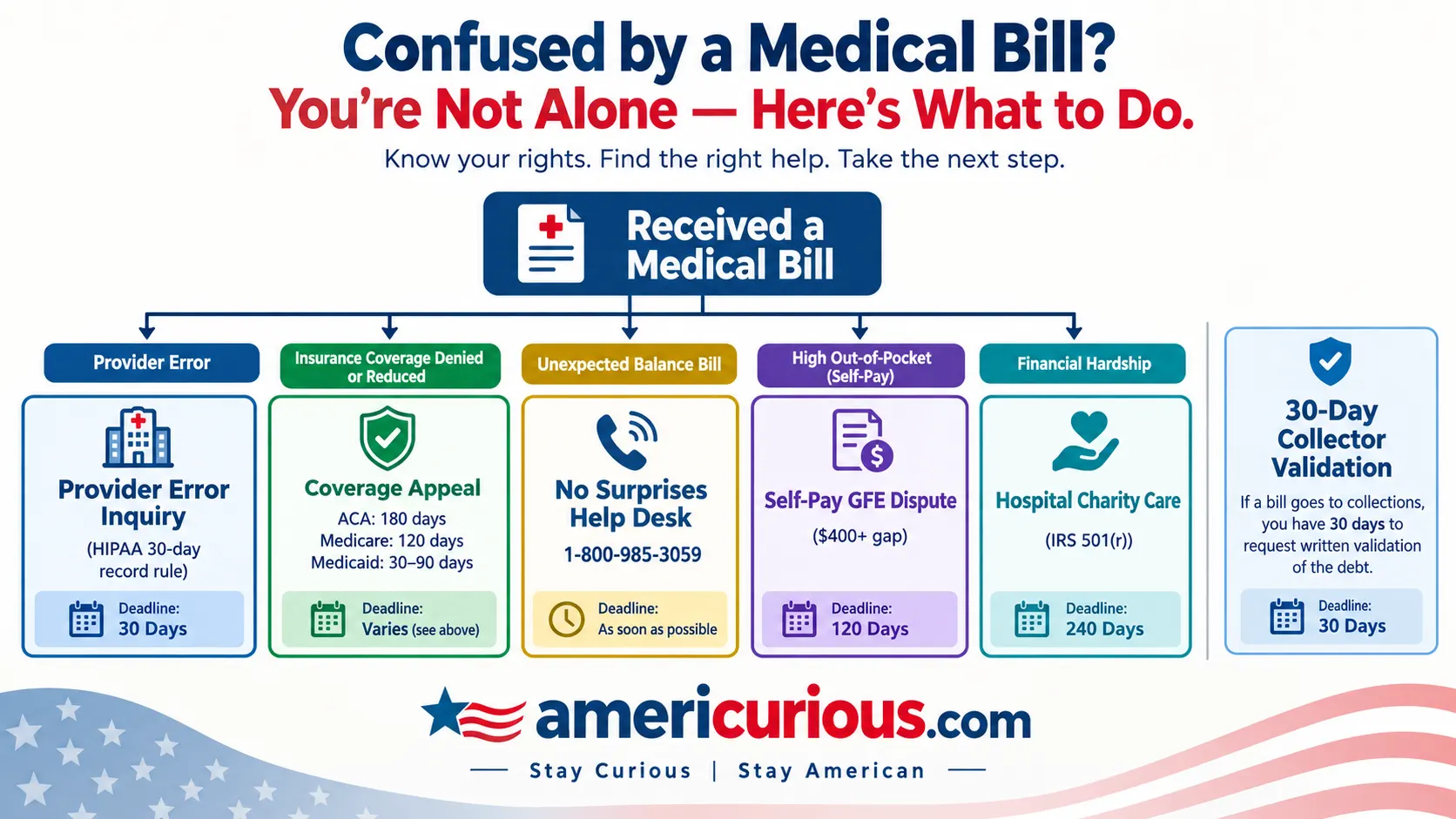
How to dispute a medical bill: check your EOB or MSN, spot errors, choose the right appeal or charity-care route, track deadlines, and handle collections.
Key takeaways
- Read your plan notice first: An Explanation of Benefits (EOB) or Medicare Summary Notice (MSN) shows how your plan handled a claim. Neither notice asks you to pay.
- Pick the matching track: Provider errors, plan appeals, surprise-bill complaints, self-pay Good Faith Estimate disputes, and charity care use separate offices and clocks.
- Confirm holds in writing: A phone call rarely stops due dates on its own. Specific written disputes and complete aid forms can pause certain actions.
- Apply for aid before borrowing: Nonprofit hospitals must post written charity-care rules. Medical credit cards can add steep back interest and end hospital aid options.
- Never skip urgent care: Federal law requires hospital emergency rooms to check and stabilize emergencies even if you owe past bills.
Jordan opens a $3,400 hospital bill and cannot tell if insurance paid, a code is wrong, or another doctor billed separately. Jordan is a fictional composite showing a common U.S. billing problem. Calling the wrong office can waste strict deadlines.
To dispute a medical bill, match an itemized bill against your Explanation of Benefits (EOB), Medicare Summary Notice (MSN), denial letter, or Good Faith Estimate (GFE). Send your dispute to the office in charge: provider billing, plan appeals, No Surprises staff, self-pay review, or charity care. Put every step in writing.
What should I do first after getting a medical bill?
Start by naming what the bill conflicts with. A large balance can come from a coding error, a plan denial, an out-of-network charge, or a valid deductible you cannot afford. Gather the bill and any plan letter you have now, and ask urgent questions before deadlines pass.
| If the problem is… | Start with… | Right next route |
|---|---|---|
| Bill total differs from your EOB or MSN | Itemized bill and the “your share” line on your EOB or MSN | Ask provider billing to explain or fix the gap; check claim status with your plan |
| Private plan, Medicare, or Medicaid denied or underpaid | Written denial letter, EOB or MSN, and appeal steps | File a plan appeal, Medicare redetermination, or Medicaid fair hearing |
| Unexpected out-of-network ER, air ambulance, or in-network hospital bill | Bill, EOB, network status, and any signed consent form | Call your plan or the CMS No Surprises Help Desk (1-800-985-3059) |
| Self-pay bill is $400+ above a written estimate | Written Good Faith Estimate and first bill date | Check federal or state Patient-Provider Dispute Resolution within 120 days |
| Bill is right, yet you cannot pay it | Hospital facility’s written financial-assistance policy (FAP) | Apply for charity care first; negotiate remaining charges or a 0% payment plan |
| Debt collector contacts you | Collector’s written validation notice and 30-day end date | Dispute wrong amounts in writing within 30 days; fix the root bill separately |
Centers for Medicare & Medicaid Services (CMS, 2026) guidance advises checking that listed care matches your visit. If you used coverage, match your EOB’s “your share” line to the bill 1 2.
| Route | Key U.S. deadline | Pauses collection automatically? |
|---|---|---|
| Provider billing-error question | No single federal deadline; check bill due dates and state law | No; ask in writing for a short account hold |
| HIPAA medical and billing record request | Up to 30 calendar days for provider reply (one 30-day written extension allowed) | No |
| Private ACA-covered plan appeal | 180 days from denial for internal appeal; 4 months from final denial for external review | No |
| Original Medicare Level 1 appeal | 120 days from getting your Medicare Summary Notice (MSN) | No |
| Medicaid plan appeal or state fair hearing | Set by state, often 30 to 90 days from notice | No (kept benefits may require repayment in some states if you lose) |
| Self-pay Good Faith Estimate dispute (PPDR) | 120 calendar days from first bill date ($400+ over GFE) | Yes; blocks collections and late fees during review |
| Tax-exempt hospital charity care (IRS 501(r)) | 240 days from first post-discharge bill | Partial; bars lawsuits and credit reporting for 120 days and pauses them once a full form arrives |
| Third-party collector validation dispute | 30 days from getting the validation notice | Temporary; stops collection of the disputed sum until verification arrives |
Is the bill a provider error or an insurance decision?
To tell a clinic billing error from a health-plan decision, lay the bill beside your plan’s claim notice. Private and Medicare Advantage plans send an Explanation of Benefits (EOB). It shows full charges, the allowed amount (plan rate cap), plan pay, and your share 2.
Original Medicare sends a quarterly Medicare Summary Notice (MSN) instead 7. Look for a pending claim, missing plan payment, skipped network discount, double charge, or wrong date. An unfamiliar code is a reason to ask questions before assuming fraud, and CMS (2026) urges calling your plan whenever the bill tops your EOB share 1 2.
Follow these five steps:
- Ask your insurer if the claim is final or still open.
- Compare what the EOB or MSN says you owe with the provider’s balance due.
- Ask the billing desk to file or adjust the claim if plan pay or network rates are missing.
- Ask the clinic to fix coding mistakes and rebill, or start a plan appeal if coverage was denied.
- Write down the date, staff name, call reference number, and promised next step.
One hospital visit often triggers separate bills from the building and outside doctors in emergency care, X-ray, anesthesia, or labs 2. If one office says a charge belongs to another group, get that group’s name and phone number. When a clinic and insurer blame each other, ask your plan rep for a three-way call with billing.
How do I dispute a billing error with the provider?
Call or message the provider’s billing office and ask for an itemized bill. That statement lists each item, service date, price, and Current Procedural Terminology (CPT) code (a five-character service code) 1 3. Match those codes against your visit notes for double charges, canceled tests, or missing chart items, and check the hospital’s online price file (CMS, 2026) 1 3.
Under the federal HIPAA Privacy Rule (45 CFR § 164.524), U.S. Department of Health and Human Services (HHS, 2025) guidance says providers must supply existing medical and billing records within 30 calendar days 4. Providers can take one written 30-day extension and charge small cost-based copy fees, though HIPAA does not force them to write new explanations 1 4. Check your online patient portal first because certified portal downloads are free 4.
Send your dispute through the portal or tracked mail so you have proof of the date. List your account number, visit date, exact code or line item, and matching EOB or chart page. Ask in writing if the office will pause billing and late fees during review, and mark when any hold ends.
If the bill is accurate: Stop arguing over codes. Move straight to a plan appeal, No Surprises check, Good Faith Estimate review, or charity care while windows stay open.
What if insurance, Medicare, or Medicaid denied or underpaid the claim?
Use your health plan’s appeal process when coverage denies or underpays care you think is covered. Follow the written denial letter because a hospital billing clerk cannot overturn a plan rule. Deadlines change based on your U.S. coverage type.
In non-grandfathered private plans under Affordable Care Act rules, HealthCare.gov (2026) gives you 180 days from a denial notice to file an internal appeal (a second review inside the plan) 5. Plans must finish within 30 days before care or 60 days after care 5.
If a private plan still says no on medical judgment, experimental care, or canceled coverage, you have 4 months to ask for an outside external review 6. Reviewers decide in up to 45 days 6. External review is free in the federal system or up to $25 in some state or contracted plans, and grandfathered plans may lack external review 6.
Medicare and Medicaid use separate clocks. In Original Medicare, CMS (2026) gives 120 days from getting your MSN to file a written Level 1 redetermination 7. Contractors decide in about 60 days, and small typos use a simpler claim reopening 7.
Medicare Advantage uses plan appeal notices. Medicaid lets enrollees appeal plan denials and ask for a state Medicaid fair hearing within 30 to 90 days, depending on the state (Medicaid.gov, 2024) 8. Ask before keeping disputed Medicaid benefits during a hearing, since some states bill back kept services if you lose 8.
Send copies of the denial letter, EOB or MSN, chart notes, and a doctor’s letter explaining why care was needed, and keep your originals 5. If waiting could risk your life, health, or recovery, ask for an expedited appeal 5 8. Urgent private-plan reviews take 72 hours to 4 business days, and you can file internal and external reviews together 5 6.
Does the No Surprises Act protect my out-of-network bill?
The federal No Surprises Act blocks surprise balance billing (when an out-of-network provider bills above your plan’s allowed rate) in most employer and individual health plans 9 10. CMS (2026; 2022 fact sheet) states the law covers most emergency visits (including freestanding ERs and covered post-stabilization care) and out-of-network air ambulances 9 10. It also covers out-of-network doctors working inside in-network hospitals, outpatient clinics, or surgical centers 9.
Know what federal No Surprises rules leave out. Ground ambulances are generally excluded unless state law steps in 9. Short-term plans, sharing ministries, fixed-indemnity plans, and normal deductibles fall outside the Act, while Medicare, Medicaid, TRICARE, Indian Health Service, and VA care already ban participating-provider balance bills 9 10 13.
Signing a valid notice-and-consent form before some scheduled or post-stabilization care can waive federal limits 9. Even so, providers cannot use consent waivers for emergency care 9. They also cannot ask for waivers from core support doctors at in-network hospitals, such as anesthesia, X-ray, pathology, neonatology, hospitalists, intensivists, assistant surgeons, and labs 9.
Call your plan or the CMS No Surprises Help Desk at 1-800-985-3059 (or file online) to check a bill 11 12. CMS checks compliance or sends cases to state agencies 12. The Help Desk cannot give legal or medical advice or pay bills 11.
Can I dispute a self-pay bill above my Good Faith Estimate?
Uninsured patients and insured patients who chose self-pay before care can use federal Patient-Provider Dispute Resolution (PPDR) if one provider or facility bills at least $400 above its written Good Faith Estimate (GFE) 13. Under CMS (2026) rules, you must have told the provider up front you would pay without insurance 13. You also need a qualifying GFE (required when booking 3+ business days ahead or upon request) and must file within 120 calendar days of the first bill (or use an approved state process where one applies) 10 13.
Starting PPDR requires copies of the GFE and bill plus a $25 non-refundable fee 13. That fee comes off your balance if you win (or at least $12.50 if you settle early) 13.
While PPDR is open, the provider must pause collection efforts, keep the bill out of collections, and hold off on late fees 13. An outside reviewer can still keep the full charge if unforeseen, medically needed care came up during treatment 13.
You cannot use PPDR after an ER visit, a visit booked under 3 business days ahead without a requested estimate, or an insured claim 13 24. Instead, file a CMS complaint if a required GFE was withheld 12. You can also apply for hospital charity care or ask for a lower price using hospital price data 3 14.
How do I get hospital financial assistance (charity care)?
Ask the hospital billing office for its written financial-assistance policy (FAP), often called charity care, and form 14. Under Internal Revenue Service (IRS, 2026) Section 501(r)(4) rules, tax-exempt nonprofit hospitals must post aid rules for emergency and medically needed care 15. Covered hospitals must cap eligible bills at Amounts Generally Billed (AGB) to insured people and list which doctors in the building are covered 15.
For-profit and public hospitals fall outside IRS Section 501(r), though 20 states set minimum charity-care cutoffs as of 2024 17. Even among nonprofits, rules vary widely. In a 2024 Health Affairs study of 2,989 U.S. private nonprofit acute-care hospitals (2021 AHA survey matched to 2024 Dollar For files), 88.9% listed free-care income limits from 41% to 600% of the federal poverty guideline (median 200%) 17.
About 77.1% of those hospitals listed discounted-care limits up to 1,000% (median 400%) 17. Non-income barriers also show up often. In a 2,277-hospital subset (leaning toward larger systems), 64.0% checked assets, 53.6% asked for tax returns, 46.5% had local residency rules, and 24.9% barred insured patients or gave them different terms 17.
Take these four steps to apply:
- Get the FAP, form, deadline, and list of covered vs. outside doctors 14 15.
- Ask separate ER, X-ray, or anesthesia groups if they honor the hospital’s aid approval 15.
- Ask if pay stubs, benefit letters, or a signed statement work when you lack tax returns 15. IRS rules allow aid based on a statement and forbid denials for papers omitted from the FAP or form 15.
- Keep copies and proof of delivery, and ask how the bill is handled during review 14.
IRS Section 501(r)(6) (2026) bars nonprofit hospitals from extraordinary collection actions (ECAs) for 120 days after the first post-discharge bill and gives 240 days to apply 16. ECAs include lawsuits, wage garnishment, bank levies, liens, credit reporting, certain debt sales, or delaying needed care 16. Bills and collector calls can still arrive before you apply 16.
Sending a complete FAP form within 240 days forces a covered hospital to suspend ECAs, decide in writing, and refund overpayments of $5 or more 16. Approved cases also require reasonable steps to undo credit reporting or judgments 16. If denied, ask for the reason in writing and ask a hospital advocate about appeals or state aid laws 14 26.
What if my medical bill is already in collections?
Read the third-party debt collector’s written validation notice, which federal rules require at first contact or within five days (Consumer Financial Protection Bureau [CFPB], 2024) 19. Congressional Research Service (CRS, 2025) analysis notes the federal Fair Debt Collection Practices Act generally covers third-party collectors rather than hospitals collecting under their own name 20. Mailing a written dispute within the notice’s 30-day window forces a covered collector to pause collection on the disputed sum until it mails verification 19 21.
Verification lets calls restart and cannot fix a hospital error or plan denial 21. Contact the provider or insurer and apply for charity care at the same time, and notify the collector in writing 14 21. CFPB (2024) warns that collectors record calls, so avoid apologizing or saying you owe a disputed debt 21.
2026 credit-report rules: On July 11, 2025, a Texas federal court vacated the CFPB’s January 2025 medical-debt rule before it took effect (CFPB, 2026; CRS, 2025) 20 22. No federal law bans all medical debt from credit reports 20.
By voluntary policy since 2022 and 2023, Equifax, Experian, and TransUnion leave off paid medical collections, unpaid bills under one year old, and unpaid bills starting under $500 20. Unpaid medical collections of $500 or more can still appear after a year 20. Over a dozen states passed reporting bans, yet an October 2025 CFPB rule (90 FR 48710) claims federal credit law overrides state bans, keeping state rules in court disputes 23.
What if the balance is accurate and I still cannot pay?
After checking errors, appeals, and charity care, ask the provider for a lower cash price or an interest-free payment plan 3 24. CMS (2026) notes offices sometimes cut charges or offer payment plans even though no law forces them to 3 24. Share local hospitals’ posted prices when you ask, and get written terms on total balance, monthly pay, 0% interest, fees, and late rules 3.
Think twice before putting a hospital bill on a regular credit card, medical credit card, or loan. CFPB (2023) warns that many medical cards use deferred interest, charging steep back interest if any balance remains when the promo ends or a payment is late 25. Paying a provider with a card or loan also turns medical debt into normal credit debt and ends charity-care and credit-bureau protections 20 25.
Never put off emergency care because you owe money. Under federal emergency-care law (EMTALA) and IRS Section 501(r)(4), hospital emergency rooms must check and stabilize emergencies without asking for pay first 15.
Who can help me dispute a medical bill, and when should I escalate?
Match free help to the office holding your bill:
- Hospital or VA bills: Hospital patient advocates help read bills, get records, and file aid forms. VA medical centers have staff VA advocates (CMS, 2026) 26.
- Private plan appeals: State Consumer Assistance Programs (CAPs) and state Departments of Insurance help with billing questions and appeals 1 5 6.
- Medicare and Medicaid: Call 1-800-MEDICARE, your free State Health Insurance Assistance Program (SHIP), or your state Medicaid office 7 8.
- Chronic or life-threatening illness: The nonprofit Patient Advocate Foundation (800-532-5274) helps qualifying patients. One-time acute bills may fall outside its mission 26.
- Surprise bills or debt collectors: Call the CMS No Surprises Help Desk (1-800-985-3059, 350+ languages). Send collector or credit-report complaints to the CFPB and your state attorney general 11 19 21.
Act fast on court papers: Call local legal aid or a consumer lawyer right away if you get a court summons, lawsuit, wage garnishment, or bank levy notice. Billing calls and plan appeals do not answer a state lawsuit. Missing a court deadline can trigger a default judgment.
Avoid upfront-fee traps. CMS (2026) warns against paying anyone who promises to block surprise bills or keep medical debt off credit reports 26. Under the federal Credit Repair Organizations Act, CFPB (2023) notes credit-repair firms cannot charge upfront fees before finishing work or erase accurate, current credit items 27.
What is a realistic result after disputing a medical bill?
Using the right dispute track can fix a wrong charge, get a claim reprocessed, cut a self-pay bill, secure charity care, or confirm a valid deductible. Reaching the right office gives your case a fair review without guaranteeing a lower balance.
Aid laws help yet have clear limits. A 2026 JAMA Network Open cohort study by Santos et al. compared 33 Oregon counties and 42 nonprofit hospitals with 656 counties and 540 nonprofit hospitals in other Medicaid-expansion states from 2015 to 2022 18.
Oregon’s charity-care law was linked to a 1.67-percentage-point bigger drop in county residents with medical debt in collections from 2019 to 2022 18. Still, the 2022 single-year result was not statistically significant and hospital bad-debt share stayed flat 18. County trends cannot predict one person’s savings, which depend on your plan, hospital rules, and paperwork.
Frequently asked questions
Should I pay a hospital bill before I get my EOB or MSN?
Wait to pay a hospital bill until you match it with your plan’s Explanation of Benefits (EOB) or Original Medicare’s Medicare Summary Notice (MSN), aside from normal visit copays. CMS (2026) notes an EOB shows how a claim was handled; it never asks for money. If a due date comes first, check that your plan got the claim and ask the provider in writing for a short hold.
How do I get an itemized medical bill, and how long does it take?
Call or message the billing office and ask for an itemized statement showing each service date, description, CPT or billing code, and charge. Under the federal HIPAA Privacy Rule (45 CFR § 164.524), covered providers have up to 30 calendar days to supply existing medical and billing records, plus one written 30-day extension. Checking your online patient portal first is free, while mailed copies can carry small cost-based fees.
Can I dispute a medical bill if I have health insurance?
Yes, once you pick the track that fits the problem. Contact the provider’s billing desk if the bill tops your EOB or MSN patient share or lists care you never got. File a plan appeal, Medicare redetermination, or Medicaid fair hearing if coverage denied or underpaid the claim, because the federal Good Faith Estimate dispute process applies only when you paid without insurance.
What is the $400 Good Faith Estimate rule for self-pay patients?
Uninsured patients and insured patients who chose self-pay before care can use federal Patient-Provider Dispute Resolution if one provider or facility bills at least $400 above its written Good Faith Estimate. Under CMS (2026) rules, you must file within 120 calendar days of the first bill and pay a $25 fee, credited back if you win. Providers must pause collections and late fees during review.
Can I get hospital charity care if I have health insurance?
Often yes, depending on the hospital’s written policy. A 2024 Health Affairs study of U.S. nonprofit acute-care hospitals found roughly three in four set the same aid rules for insured and uninsured patients, about 22% used different income or hardship terms, and 3.2% excluded insured patients. Ask the hospital for its policy, check if outside doctors are covered, and apply instead of guessing online.
What should I do if my medical bill is in collections?
Read the third-party collector’s written validation notice right away and note the 30-day dispute deadline. Under CFPB (2024) rules, mailing a written dispute within 30 days forces a covered collector to pause collecting the disputed sum until it sends verification. Verification cannot fix clinic errors or grant aid, so contact the provider or plan and apply for charity care separately, and avoid admitting disputed debt on recorded calls.
Does the CFPB medical-debt rule keep bills off credit reports in 2026?
No. On July 11, 2025, a federal court vacated the CFPB’s January 2025 medical-debt rule before it took effect, leaving no nationwide federal ban. Equifax, Experian, and TransUnion voluntarily leave off paid medical collections, unpaid bills under one year old, and unpaid bills starting under $500, while larger unpaid debts can still appear and state bans face federal preemption challenges.
How long do I have to dispute a medical bill?
Deadlines depend on the dispute route rather than one national clock. Non-grandfathered private plans allow 180 days for internal appeals and four months for external review, while Original Medicare allows 120 days from your MSN. Qualifying Good Faith Estimate disputes allow 120 calendar days, IRS Section 501(r) charity-care rules give 240 days, and collector notices give 30 days to pause collection in writing.
Closing synthesis
Match your itemized bill against your EOB, MSN, denial letter, or Good Faith Estimate so you know who owns the problem. Send a dated written request to the office with power to act, such as provider billing, plan appeals, CMS No Surprises staff, hospital charity care, or a collector. If a charge is right or one track stalls, shift fast to charity care, price negotiation, or a state advocate.
Editorial disclaimer: This article shares general U.S. information on medical billing, insurance appeals, and debt rules as of October 2026. Consult a qualified lawyer, accredited counselor, or clinician for advice on your case.
3. REFERENCES
- Check your medical bill for errors, Centers for Medicare & Medicaid Services (CMS), updated October 6, 2026. 1
- How to read your medical bill, Centers for Medicare & Medicaid Services (CMS), updated October 5, 2026. 2
- Talk to your provider about your medical bill, Centers for Medicare & Medicaid Services (CMS), updated October 5, 2026. 3
- Right to Access and Research (HIPAA Privacy Rule 45 CFR § 164.524 & § 164.501 FAQs), U.S. Department of Health and Human Services (HHS), current guidance checked 2026 (related designated-record-set FAQ reviewed August 11, 2025). 4
- Appealing a health plan decision: Internal appeals, HealthCare.gov (CMS), current federal guidance checked October 2026. 5
- Appealing a health plan decision: External Review, HealthCare.gov (CMS), updated 2026. 6
- First Level of Appeal: Redetermination by a Medicare Contractor, Centers for Medicare & Medicaid Services (CMS), updated March 10, 2026. 7
- Understanding Medicaid Fair Hearings, Centers for Medicare & Medicaid Services / Medicaid.gov, March 2024. 8
- Know your medical bill rights when using insurance, Centers for Medicare & Medicaid Services (CMS), updated October 1, 2026. 9
- No Surprises: Understand your rights against surprise medical bills, Centers for Medicare & Medicaid Services (CMS), January 3, 2022 (foundational fact sheet). 10
- Get help with your medical bill, Centers for Medicare & Medicaid Services (CMS), updated October 1, 2026. 11
- Submit a provider or insurer complaint, Centers for Medicare & Medicaid Services (CMS), updated October 1, 2026. 12
- Dispute a medical bill, Centers for Medicare & Medicaid Services (CMS), updated October 2, 2026. 13
- Apply for medical bill financial assistance, Centers for Medicare & Medicaid Services (CMS), updated October 5, 2026. 14
- Financial assistance policy and emergency medical care policy – Section 501(r)(4), Internal Revenue Service (IRS), reviewed July 3, 2026. 15
- Billing and collections – Section 501(r)(6), Internal Revenue Service (IRS), reviewed July 2, 2026. 16
- Messac L, Janke AT, Rogers LH, et al. “US Nonprofit Hospitals Have Widely Varying Criteria To Decide Who Qualifies For Free And Discounted Charity Care.” Health Affairs, November 2024. 17
- Santos T, Lindrooth RC, Young GJ, Lee SY. “Financial Assistance Policy, Hospital Charity Care, and Medical Debt in Collections.” JAMA Network Open, January 2026. 18
- What information does a debt collector have to give me about a debt they’re trying to collect from me?, Consumer Financial Protection Bureau (CFPB), reviewed January 29, 2024 (modified September 10, 2024). 19
- Schneider KE. An Overview of Medical Debt: Collection, Credit Reporting, and Related Policy Issues (IF12169), Congressional Research Service (CRS), Library of Congress, updated August 29, 2025. 20
- Can a debt collector still collect a debt after I’ve disputed it?, Consumer Financial Protection Bureau (CFPB), reviewed December 9, 2024. 21
- Prohibition on Creditors and Consumer Reporting Agencies Concerning Medical Information (Regulation V), Consumer Financial Protection Bureau (CFPB), issued January 7, 2025; vacated July 11, 2025; page modified February 24, 2026. 22
- Fair Credit Reporting Act; Preemption of State Laws (90 FR 48710), Consumer Financial Protection Bureau (CFPB), Federal Register, October 28, 2025. 23
- Action plan: Medical bill payment options, Centers for Medicare & Medicaid Services (CMS), updated October 2, 2026. 24
- What should I know about medical credit cards and payment plans for medical bills?, Consumer Financial Protection Bureau (CFPB), reviewed May 8, 2023 (foundational current CFPB consumer guide). 25
- Find a patient advocate to help you navigate the healthcare system, Centers for Medicare & Medicaid Services (CMS), updated October 5, 2026. 26
- How can I tell a credit repair scam from a reputable credit counselor?, Consumer Financial Protection Bureau (CFPB), reviewed November 7, 2023 (foundational current CFPB CROA guide). 27