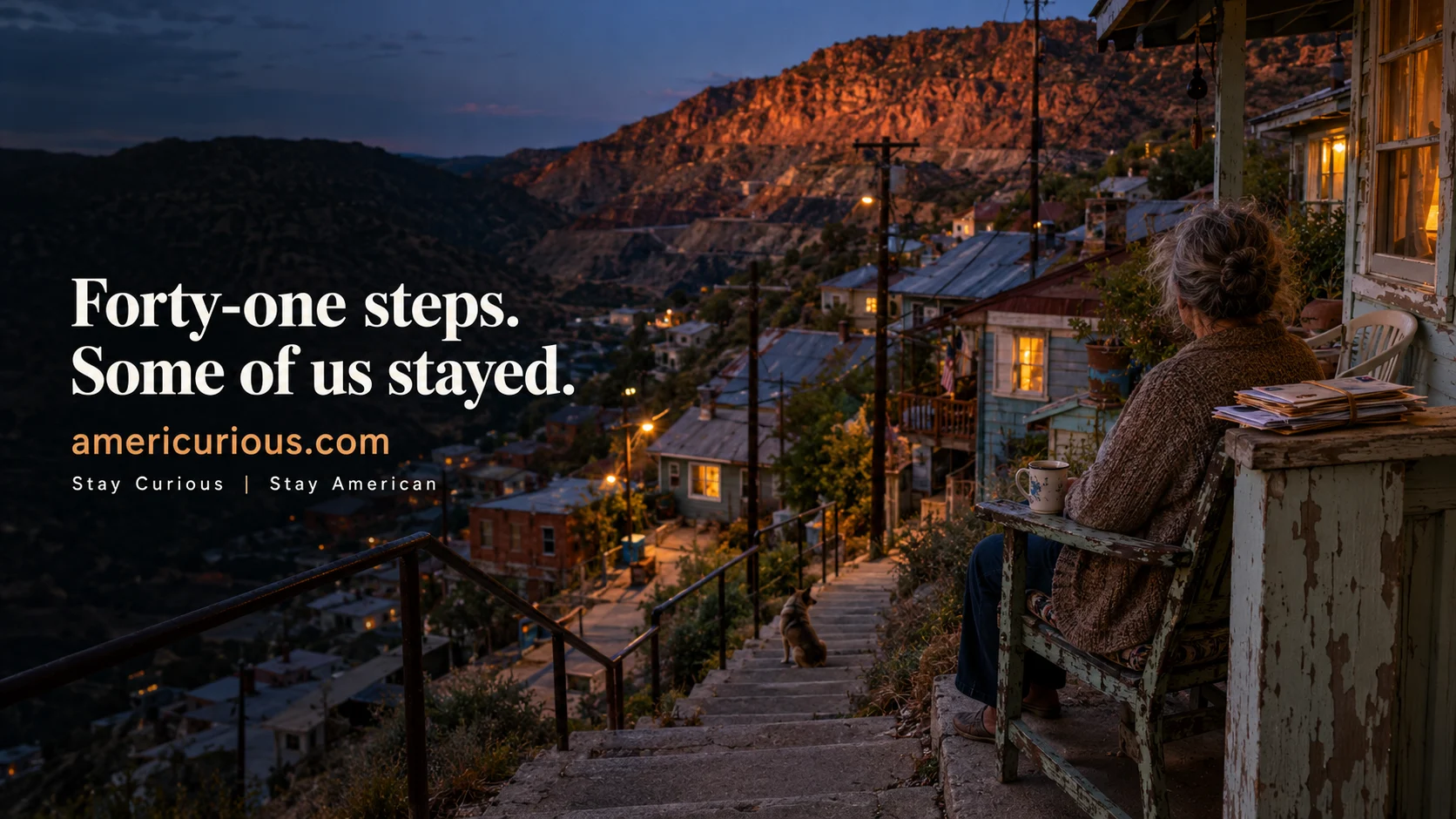
Bisbee, Arizona has 350 staircases, a 1917 deportation, and a 2025 housing emergency. A porch talk on what it costs to stay.
Yoli Ochoa isn’t a real, individually quoted person — they’re AmeriCurious’s researched composite of a Bisbee local, built to carry the town’s real history, food, and voice in the town’s own words.
It’s a little after five on a late-October evening, and the canyon wall across from Yoli Ochoa’s porch has gone the color of an old penny. Her house sits at the top of a concrete staircase, one of the flights the Works Progress Administration poured in the 1930s so people could get up and down these hills. The air is thin and cooling fast, and somewhere below, a screen door slaps shut.
I get to the top winded and trying not to show it.
“Forty-one,” Yoli says, not looking up from the mail in her lap. “Everybody loses count around thirty. You took the Main Street side, so you got the short way.”
“That was the short way?”
“It has the most stairs. Don’t ask me to explain that.” She sets the envelopes on the porch rail. “Streets here follow the canyon, so I give directions in stairs. Somebody wants the library, I say up the steps by the green house, left at the orange cat, then… no, the cat moved. Sit. Sit before you fall.”
I sit. Down the hill, a dog answers a screen door.
I tell her I came for Old Bisbee: the copper, the galleries, the town that came back from the dead after the mines closed.
“Don’t say came back.” She’s smiling, but it’s a dry one. “It didn’t die. People left. Some of us stayed. And it isn’t all galleries. I’m county. Deputy clerk, thirty-one years. Bisbee’s been the county seat since 1929. We took it from Tombstone. They’ve been polite about it for ninety-seven years.”
“I honestly assumed everybody here made art.”
“The county, the schools, the hospital. That’s where the paychecks come from. The art you can photograph.”
Most of what she knows, she says, she knows from paper. One case file, sixteen hundred documents give or take, about a single morning in July of 1917, when a couple thousand deputized men rounded up striking miners, and plenty of men who weren’t striking, marched them to a ballpark, packed them into cattle cars, and left them in the New Mexico desert. Twelve, thirteen hundred, depending on who’s counting.
“Mexican men were the biggest group in every count I’ve seen,” she says. “They’d been shut out of the good underground jobs, you understand. Those went to the Cornish and the Welsh.”
“And who answered for it?”
“Nobody was ever convicted.” She says it flat, the way she’d read out a docket number. “Two hundred and some men were named in the case. It went nowhere. My people were Warren people, and nobody at our table brought up 1917. I learned it from the file. Not from my family.”
A porch light comes on across the way.
“You know the town’s named for a man who never set foot in it?” she says. “Judge Bisbee. Put money into the Copper Queen and never came.”
“You’re kidding.”
“It’s in every book. Look it up.” She shrugs. “I don’t know what it means. It means something.”
I start to ask what the silence at her table was about, but she’s already ahead of me.
“Seventy-five,” she says. “I was ten. The company quit mining here, and my father worked for them, and I’ll leave that for now. Houses went for next to nothing. That’s why the artists came, honestly. Cheap. I’m not mad at them. They fixed up places nobody wanted. It’s the word cheap that circles back around.”
“Meaning the housing.”
“Meaning the housing.” She shifts in her chair. “About nine homes in a hundred are short-term rentals. The mayor said so at a work session, going off the consultant’s count.”
“And the emergency?”
“February last year, the council voted a housing emergency. Unanimous, in this town, which is something. Mostly it’s a letter telling the state to let us run our own zoning.” Down the hill, the dog barks at nothing. “More than half the households here make under fifty thousand, and a house runs around two hundred thousand. My son’s in Douglas now. Rents. Drives in. Mijo grew up on these steps with a grocery bag in each hand, and he can’t afford to live up them.”
She’s quiet for a second. I don’t fill it.
“Have you eaten?” she says finally. “You look like you’ve been fed by a visitor center.”
I admit I came braced for pasties. Cornish miners, Arizona mining towns, the whole—
“Maybe somebody’s grandmother made them,” she says. “I’d have to ask the museum. I didn’t grow up on them and I won’t claim them. What I can tell you is the Breakfast Club on Erie Street. Biscuits and gravy. Go Saturday, early, before the line. And beer, if you want old. A Swiss man put up the first brewery on the Gulch around 1881. Water was scarce. Beer wasn’t.”
“Everybody tells me about the turquoise,” I say.
“Of course they do.” She laughs, finally. “The good stones came out of the Lavender Pit. Late fifties, I think, when they started turning them up. The story is the miners carried them out in their lunch boxes. Nobody’s ever shown me a paper on that.”
“But the pit itself—”
“Named for a man who died the year they named it. 1952. Harrison Lavender. People drive right past the marker.”
She turns a envelope over in her hands. “I like the mine tour guides, I’ll say that. Former miners. They sell the mine back to us in a hard hat and a yellow coat now, and fine, I get it. It’s the word authentic that wears me out. Somebody hung it on this town decades ago, and it never came off.”
“They run a race up these every October,” she adds. “People pay money to do what I do with groceries.”
“Would you ever leave?”
“My son asked me that.” She looks at the stairs. “I asked him where I’d put forty-one steps.”
I take the stairs down slower than I came up and make it to thirty-one before I lose count. Behind me her porch light clicks on, and somewhere below, the dog gets the last word.
Quick Facts
- Population: 4,922 (2020 Census); about 4,957 in the 2024 estimate
- Founded: 1880, named for Judge DeWitt Bisbee, who never visited
- Signature dish: None documented. The local standby is biscuits and gravy at Bisbee Breakfast Club on Erie Street.
- A date to know: July 12, 1917, when roughly 1,200 to 1,300 striking miners and others were forced out of town by a deputized posse
- County seat: Since 1929, when it moved from Tombstone
- A current number: About 9% of the housing stock is in short-term rentals, per the city’s housing consultant (234 listings against roughly 2,600 occupied units)