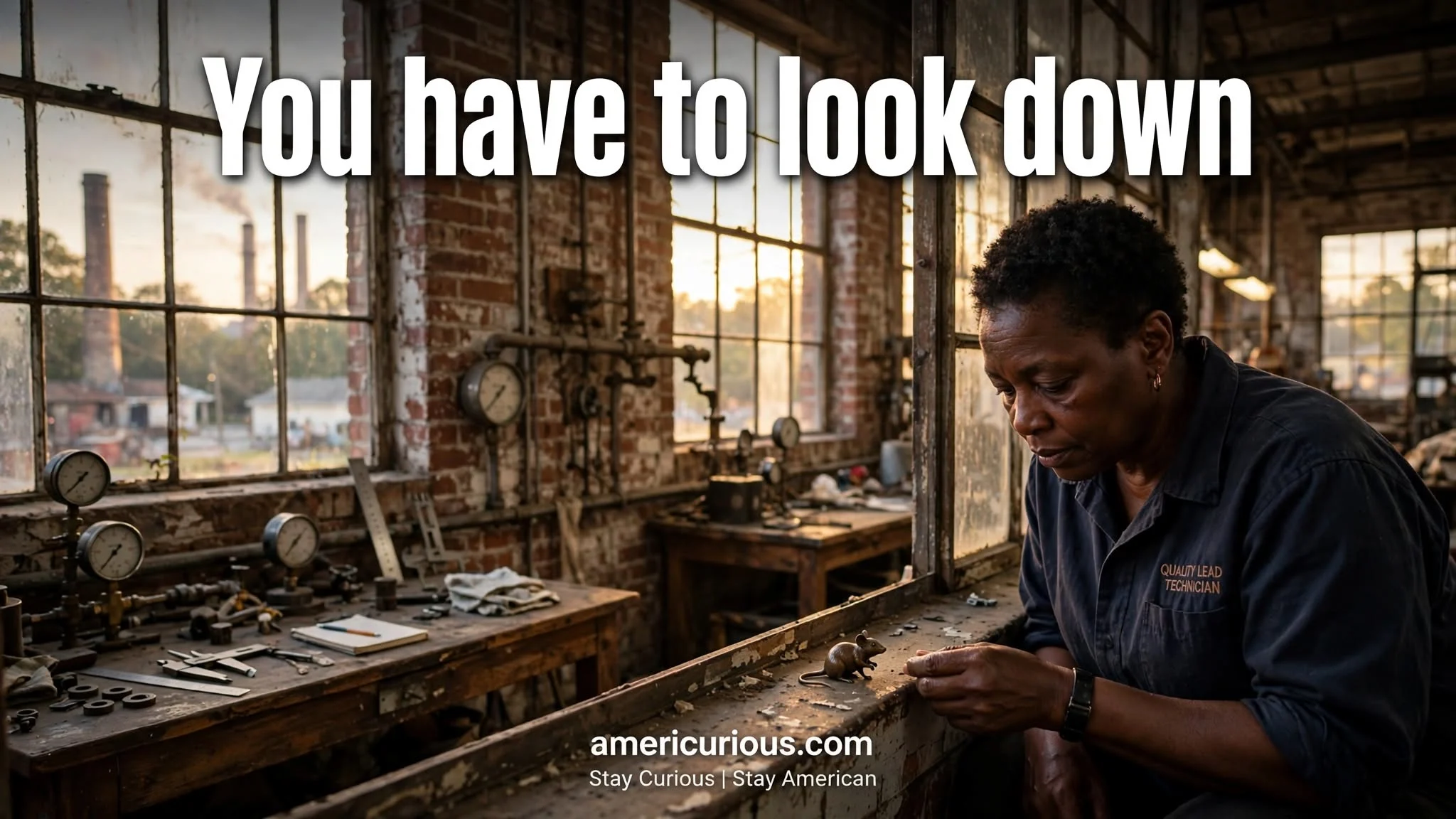
Greenville hid a waterfall under a highway, then found it — and hid nine bronze mice. The rent, though, is harder to find.
Denise Caldwell isn’t a real, individually quoted person — they’re AmeriCurious’s researched composite of a Greenville local, built to carry the town’s real history, food, and voice in the town’s own words.
It’s 3:40 p.m. on the second floor of a converted brick mill off Easley Bridge Road. The air smells like cutting oil and fresh coffee from the break room. Below us, the old Judson Mill windows throw light across a line of inspection tables, and out the far door you can hear Falls Park tourists even though the river is four miles away.
“This is where I tell people I work,” Denise says, tapping a gauge with her knuckle. “Quality lead. Tier-one supplier. We make parts that end up in Greer.” She clips it short. “Tolerances. Paperwork. Training the new folks. Upstate work, you know. You do the job right.”
She’s quiet for a second before she answers the question I didn’t ask yet, about why she stayed.
“My grandma worked at Brandon Mill. She used to say you could hear the looms from the porch and know if somebody was running late. She had that mill-village house — church, store credit, baseball on Saturdays. The baseball part is real. They had whole textile leagues to keep morale up. That’s how Joe Jackson got started, you know? Shoeless Joe. Worked at Brandon when he was seven. Played for the mill team.”
I tell her I thought Shoeless Joe was just a statue for tourists over by Fluor Field.
She looks at me. “He is a statue now. But he was a paycheck kid first. That’s Greenville. We turn the work into a story later. You see his house moved over to the West End, right across from the Drive stadium. They took the whole house apart and put it back together. That’s how much we like to keep things, except houses people actually need.”
We drift because I ask about lunch and she wants to talk about food before rent, which is fair.
“You want to know if Greenville is a foodie town,” she says. “That’s what everybody writes. Euphoria in September, Fall for Greenville in October. And yeah, it’s real. Three days, over two hundred fifty dishes from fifty restaurants down Main. Chefs come in, wine seminars at the Peace Center. That’s new money Greenville.”
She leans back.
“Old money Greenville — and I mean old working money, not fancy — ate chili dogs. Greek families opened diners after the mills. House-made chili on top. You still judge a place by that. If they can’t do a chili cheeseburger right, I don’t trust the shrimp and grits either. That’s Lowcountry coming up here, but we claimed it. Pulled pork, too. Farm-to-table is great, but I grew up meat-and-three. You get your vegetable, your meat, and somebody’s auntie asking if you ate enough. I still need a buggy at the store on Sunday after church, and I don’t go fast.”
I ask if she goes to Fall for Greenville still, and she laughs.
“I do, but I bring my own crew. I grab a few extra plates for second shift. We make a lap, then we get out before parking gets stupid. That’s the honest visitor guide part, right? Crowds, prices, and all.”
I ask what visitors get wrong about downtown, expecting her to talk about Falls Park.
“They think it was always pretty,” she says. “It wasn’t. My mama told me Main Street was a four-lane throughway you didn’t want to walk. Then Max Heller came in, mayor back in the day, said let’s make it two lanes, tree-lined, sidewalk cafes. And the Carolina Foothills Garden Club — women with a plan — they bought twenty-six acres along the Reedy in 1967 when the river was basically a ditch behind factories. They sat on it for years. City finally tore down the Camperdown Bridge in 2002. That was the whole deal. You had a waterfall under a road. We literally paved over a waterfall in the sixties and then spent thirteen million dollars to find it again. That’s not in the brochure.”
She’s talking faster now, then catches herself and goes short again.
“Liberty Bridge. Nice. Good park. Good investment. Private money followed — hundred fifty million right after. But.”
There’s the turn I was waiting for.
“But we had a surplus of cheap housing in 2000. Surplus. Then the report came out — twenty-five hundred affordable units short. And quietly, the houses go. My mama rented near downtown for years. Owner rented it for four hundred bucks to working families. Then he could sell for three times that. So he did. That’s not evil. That’s math. But where do we go?”
I start to say something about growth being good for jobs, and she corrects me before I finish.
“Growth is good for jobs. I have a good job because BMW is in Greer and Michelin has been here since ’84 and GE is here and Prisma is here. I’m not anti-growth. I’m just telling you that between 2000 and 2010 the Black population here dropped eight percent while downtown got whiter. Stone Academy — that magnet downtown — Black kids went from twenty-two percent to sixteen percent in six years. That is my family. That is not a statistic on a pamphlet. When Table 301 says eighty percent of their workers live more than five miles from downtown because they can’t afford it and there’s no bus that runs right, that’s my cousins. And when they say a kid born in the bottom fifth has a four point nine percent chance of getting to the top, that’s not an opinion. That’s mobility data.”
I ask what she does on a day off to not think about rent charts, and she lights up in a different way.
“I hunt mice,” she says.
I must look confused.
“Mice on Main. Nine bronze mice. Tiny. Starting at the Hyatt fountain, going toward the Westin. Artist named Jim Ryan thought of it for his senior project back in 2000, sculptor Zan Wells made them, based on Goodnight Moon. Idea came from a teenager. They’ve been there since 2000 and people still walk right over them. There’s twenty-seven quotes chiseled into the sidewalk too. Everybody misses those. My nephew makes me do the hunt every time. He knows where they all are. I pretend I don’t.”
She grins.
“That is my favorite Greenville thing. Not because it’s big. Because you have to look down. You have to look where you were already standing.”
We talk about the Scottish Games for a minute.
“Gallabrae,” she says. “At Furman. Caber toss, pipe bands, Highland dancing. Greek Festival too — dancing, food. And now we have German engineers, French tire folks, all here for the plants. My line has three languages at lunch. If all y’all come down for it, come early. We all still argue about who makes the best chili dog.”
She stands to cut the lights on the far table, shift almost over.
“My grandma’s loom is gone. Her house is lofts now — The Lofts of Greenville, they call it. But the river is back. I’ll stay long enough to see if the houses come back too. I still call the garden hose a hose pipe and my nephew still laughs at me.”
We walk out past the old smokestacks that didn’t burn down. The parking lot is half full of cars about to start for the commute. Somewhere downtown, a family is crouched by a fountain looking for a mouse the size of a thumb.
- Population: 75,310 (July 1, 2025 estimate); 70,720 in 2020 Census
- Founded: 1797 as Pleasantburg by Lemuel Alston; renamed Greenville in 1831 charter after Vardry McBee purchase
- Signature dish: Chili cheeseburgers and chili dogs from Greek-owned diners / meat-and-three
- Historical date: 1876 Camperdown Mill founded, start of 20-mill Textile Center of the World era; Camperdown Bridge removed 2002 for $13M Falls Park project
- Current stat: 2,500 affordable housing units short despite surplus in 2000; broader market median sale ∼$515,000, 67 days on market; 80% of Table 301 workers live >5 miles from downtown
- Quirky fact: Nine bronze Mice on Main hidden along Main Street since 2000, inspired by Goodnight Moon, created by Jim Ryan and sculptor Zan Wells