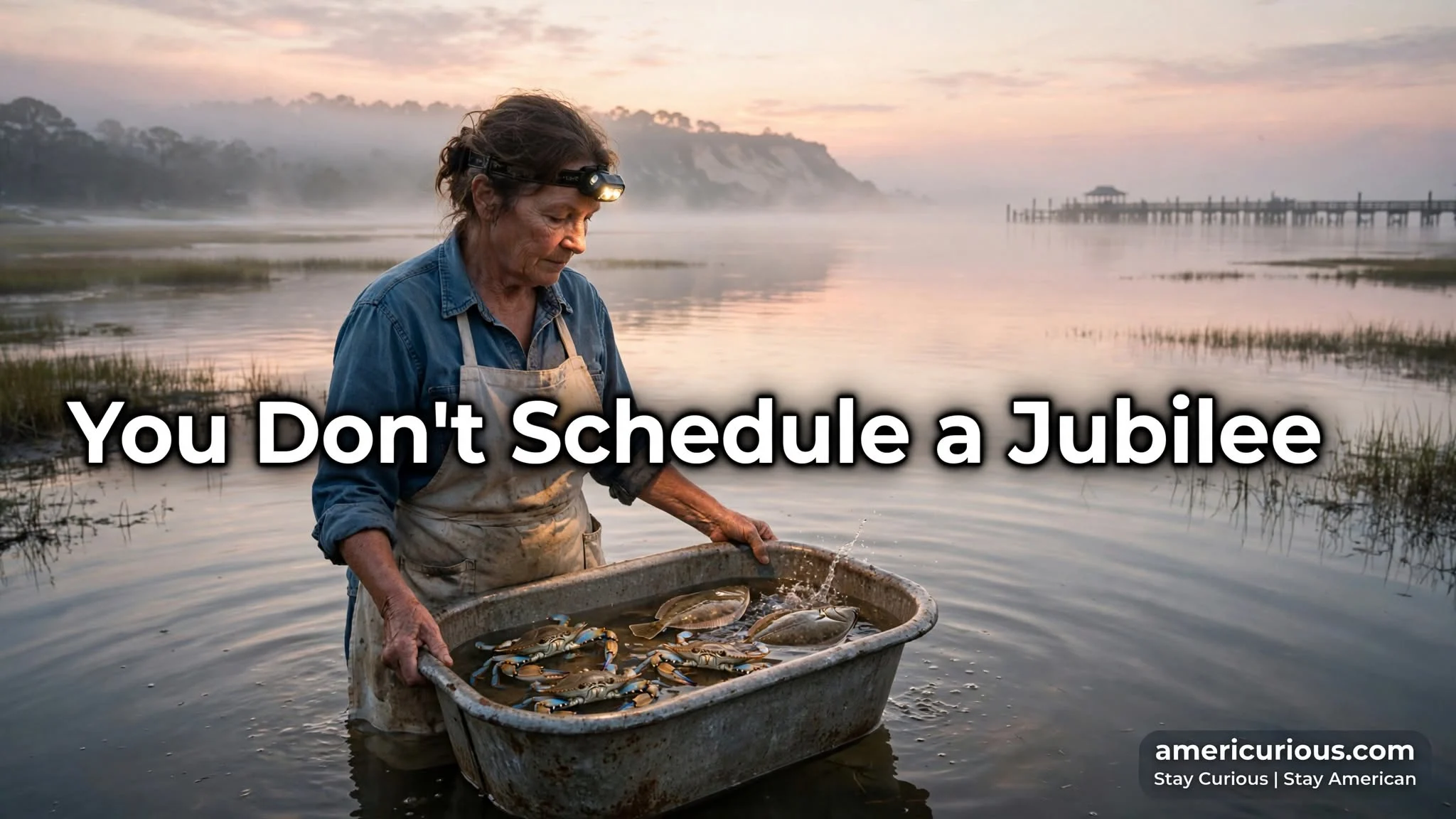
Fairhope, Alabama’s real Jubilee, Single-Tax roots, and a downtown fighting growth — an honest day inside.
Mary Claire Landry isn’t a real, individually quoted person — they’re AmeriCurious’s researched composite of a Fairhope local, built to carry the town’s real history, food, and voice in the town’s own words.
It is 9:15 on a Tuesday on Section Street and the light is already thick. Mary Claire’s gallery smells like paper, fresh coffee from Latte Da next door, and the faint sawdust of a mat cutter. Outside, the median on Fairhope Avenue is absurdly perfect, and a delivery truck is trying to parallel park where it clearly will not fit.
“That one?” she says, nodding at the corner piece. She clips sentences short when she’s in shop mode. “Local. Weeks Bay. He paints on old pier boards. I framed three before Arts & Crafts last year. Sold two during.”
She’s behind the register with a rag and a bottle of glass cleaner, which she uses like a metronome. The shop is small — white walls, a wall of moulding samples, a table of prints that are not trying to be beach art. She has lived in Fairhope since she was eight, moved over from Mobile, which is how she says it.
“I say over the Bay, not across. You learn that first week here,” she says. “My mom would say we were going over the Bay for groceries. Still sounds right.”
I ask what she tells people who have never been here, what Fairhope actually is. She doesn’t give the Chamber answer.
“Well, we were a Single-Tax colony. 1894, twenty-eight folks from Des Moines who followed Henry George. They pooled money, bought Stapleton’s pasture, paid the town taxes off the rent. Idea was you don’t get punished for improving your land. That corporation still exists. Eighteen hundred leaseholds, four thousand acres. People think that’s trivia, but my rent? That lease idea is still in the conversation.”
She pauses to hand a customer a wrapped frame, tells him his wife will pick it up after school pickup.
“Anyway, that utopia story draws a certain type. Then 1907, Marietta Johnson starts the School of Organic Education here. John Dewey wrote about it in Schools of Tomorrow in 1915. No grades. No exams. Just let kids grow. That brought the artists. Anderson, Darrow, Sinclair — all those big names wintered here. So we became an art colony that pretended it wasn’t a resort. Now we’re a resort that pretends it’s still an art colony.”
I laugh and say so it worked, the utopia.
She is quiet for a second before she answers.
“No. That’s the cute version,” she says. “Read the other part. We went from experiment to artists’ colony to affluent suburb of Mobile. White flight after the forties, especially after desegregation. We are still mostly white. And we are still haunted by that. My neighbor’s daddy grew up in the Colony part and he will tell you straight — the ideals were good, the practice was selective.”
She taps the glass. This is where her voice gets slower.
“The struggle now is not whether we grow. It’s how. Last year the city unanimously put a nine-month suspension on high-density residential. Then another 120-day pause. They were talking about cutting downtown height from forty feet to thirty-five. Everybody showed up. Because you can see it. A building sells over here, suddenly your lease is up thirty percent. My landlord got an offer from a group out of Nashville. That’s not a story about a mean landlord. That’s the market.”
I ask if she thinks the moratorium will help.
“Maybe it buys time. But look around. Median’s over three hundred now and nothing new is coming in under it. So who are we building for? Not my frame guy. Not the kid who runs the espresso machine. We had that stretch where people said affordable to live here. That is not true now.”
She circles back, mid-thought, to the customer from earlier.
“His wife — she bought a little bay watercolor for their daughter, lagniappe for the teacher, she said. That’s what we do. An extra mat, an extra print. That’s lagniappe. It keeps people coming back.”
The bell jingles and we both look at the bay light coming through the front door. I ask about food because I’m hungry and because every town in Baldwin County has a strong opinion about shrimp.
“You’re going to get shrimp and grits everywhere. Julwin’s does a good one, and they put Conecuh in it, which is the right move. Conecuh sausage — that’s that smoked sausage from Conecuh County, little sweet, little heat. But the real signature if you live here is more about what you do after a Jubilee.”
I assumed Jubilees happened every summer like clockwork.
“Oh no,” she says, and this is the pushback. She actually laughs. “You don’t schedule a Jubilee. That’s tourist thinking. It’s oxygen. Low oxygen water gets pushed by an east wind, traps the bottom fish against the bluff. Flounder, crabs, eels, shrimp come up gasping into the shallows. Two in the morning, five in the morning. Someone calls someone. You grab a washtub. It’s one of two places in the world this happens — here and Tokyo Bay. My dad woke me at five with a laundry basket. We had blue crab on the porch for a week. If you miss it by twenty minutes, you miss it. Game wardens will ticket you now if you keep undersized stuff, and they should.”
She says the word Jubilee like other people say snow day — part excitement, part obligation.
I ask what keeps her here, given the squeeze.
“Festivals. I hate to say it because it sounds promotional,” she says. “But Arts & Crafts takes over downtown in March. Two hundred plus artists, three hundred thousand people, founded in 1953. That’s our New Year. I don’t say March, I say before Arts & Crafts and after Arts & Crafts. Film Festival in November is the same — four days, you walk to all four venues. Page & Palette is our living room. You can hate the crowds and still love that everyone shows up.”
She wipes the counter again.
“Also that stupid floral clock,” she says. “Thirty feet, North Section and 104, put up in 2013. It’s completely extra. People take pictures of it. I think it’s perfect. That’s Fairhope. Utopian ideas, flower clocks, and a group text that says get down to the pier right now, crabs are in.”
She has to take a call from the middle school — they want frames for the student show before Arts & Crafts. I step out onto Section and the heat hits the flowers head on. Down at the bluff, Mobile Bay is flat as a table, the kind of flat that makes old-timers check the wind and set an alarm.
Quick Facts sidebar
- Population: 22,477 in 2020 Census; city on eastern shoreline of Mobile Bay in Baldwin County
- Founded: November 15, 1894 as Single-Tax colony by 28 followers of Henry George; incorporated April 25, 1908
- Signature dish: Gulf shrimp and grits with Conecuh sausage, plus Gulf Snapper throats and dark-roux Creole gumbo
- Historical date: 1907 — Marietta Johnson founded School for Organic Education, praised in John Dewey’s Schools of Tomorrow (1915)
- Current stat: Arts & Crafts Festival — 200+ artists, ∼300,000 visitors over 3 days each March since 1953; city adopted unanimous nine-month pause on high-density residential in 2023-2024 to study infrastructure