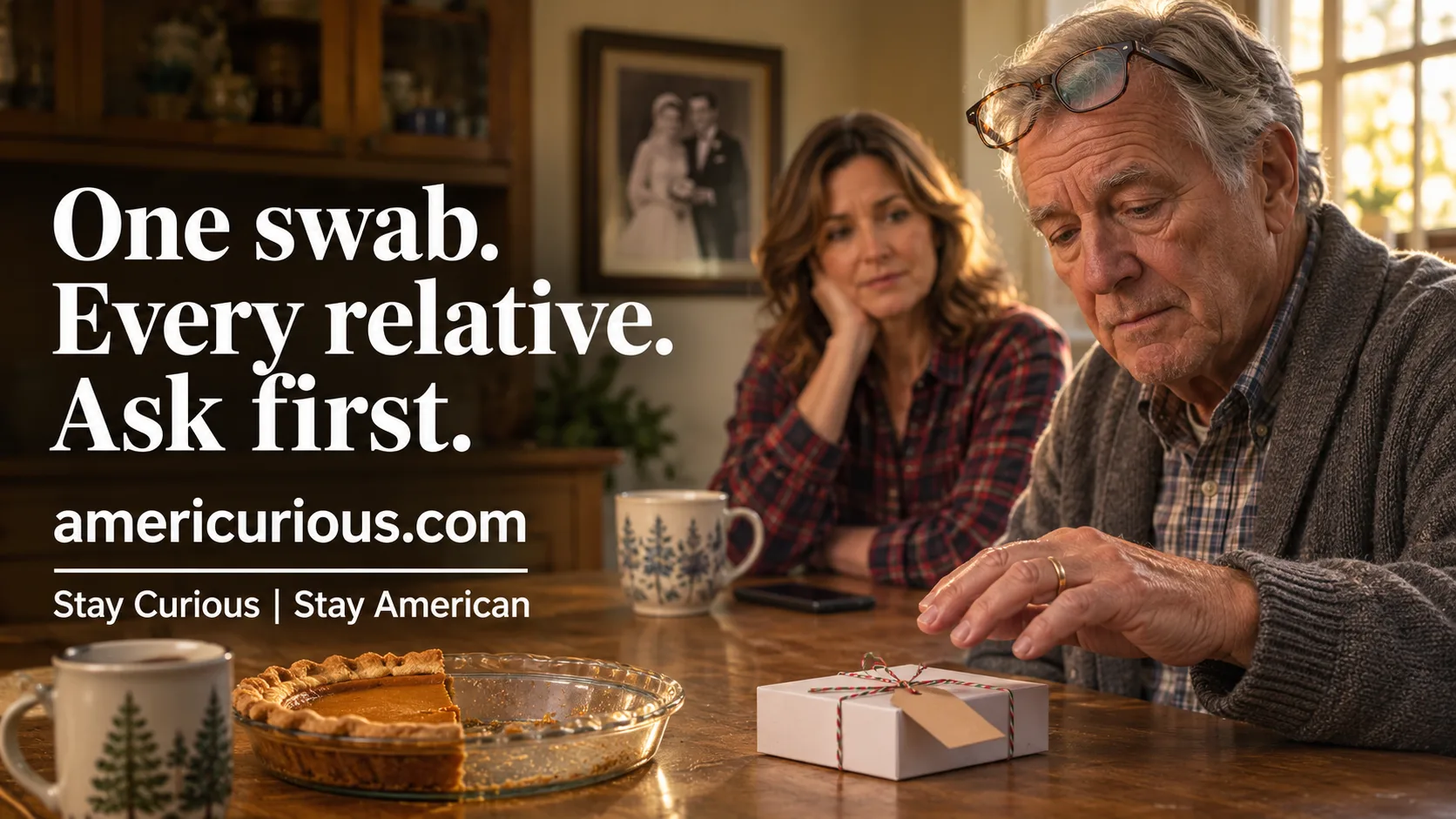
A cousin’s DNA kit can expose your family without your consent. Learn how relative matching works and use a simple 3-step family conversation first.
A 2023 cyberattack breached roughly 14,000 23andMe accounts, yet because the service links DNA relatives, nearly 7 million users’ information was compromised. Millions of people did nothing wrong. They were simply related to someone who was hit.
That ratio is the real story of consumer DNA testing in America. A kit feels like a private purchase, but it works like a disclosure signed on behalf of every blood relative you have.
It’s the Saturday after Thanksgiving, and kits are about to be wrapped. USA Today has already warned that holiday DNA kits from 23andMe and Ancestry can expose family secrets.
Technically, if you’ve never tested, no file carries your name. Functionally, a parent’s or sibling’s kit holds roughly half your DNA, and a first cousin’s holds a readable slice of it.
The Breach That Traveled Through Bloodlines
Passwords change. Cousins don’t.
Most data breaches steal what you own. This one reached what you share.
Genetic data identifies the account holder and also says something about the people they’re related to. Someone with access to your genetic information can make judgments about your biological relatives, too. When 23andMe went bankrupt in 2025, the fate of some 15 million users’ genetic information, and by inference their blood relatives’, was up in the air.
“I never tested” protects you less than you think
Families worry about this more than the companies admit. A common forum question runs: if only my aunts and cousins test, can a half-sibling I’ve never met trace me through them? One member answered yes, noting their mother found a half-sibling by first identifying a paternal uncle.
Most people don’t buy a kit to find strangers. In one survey summary, 87% wanted to learn about their family’s origins, while only 36% wanted to connect with relatives they’d never met. The matching engine finds relatives anyway, whatever you bought the kit for.
The Secret You’re Protecting Has an Expiration Date
Some families are quietly counting on one relative’s refusal to test. A half-sibling nobody mentions, an adoption, a paternity question: the secret survives as long as everyone who could expose it stays out of the database.
That’s a decaying asset. Every cousin who orders a kit shortens its life, and no one holds a veto, because the weakest link sets the timeline.
So the useful question isn’t “will this come out?” It’s who tells it, in what order, and whether the person at the center hears it from family or from an app.
One Colorado woman saw it clearly. After matching with a half-brother she hadn’t known existed, she told her father right away, in case he had submitted a sample from a kit she’d bought him, so he wouldn’t learn it from a cheerful pop-up. She couldn’t change the discovery, only the delivery.
You Might be Interested in This Article…
Guilt Spending Money on Yourself When Your Family Needs You
Your Delete Button Covers Your Account and Nothing Else
What deletion does
23andMe lets customers delete their accounts along with their information. If you’ve tested, you should consider it.
Deletion is account by account, though. Clearing your record doesn’t clear your relatives’ records, or the matches and family trees they’ve already built.
The bankruptcy stress test
The 2025 bankruptcy showed what happens to family data when a company fails. Twenty-seven states and DC sued in bankruptcy court to block the sale of genetic data without customer consent. Their argument was that the data is immutable and affects people related to a customer and their descendants.
They didn’t get a veto. The court rejected the states’ objections to the transfer, though a negotiated agreement between the states and the buyer still protects consumer data and can’t be changed. The states won guardrails, not a stop sign.
Part of the problem is a drafting loophole. As of May 2025, nineteen states had comprehensive privacy laws, and all carved bankruptcy transfers out of their definition of “sale,” which neutralizes the right to opt out.
Your zip code sets the rules
Protection depends on where you live. Illinois requires written consent before genetic data is transferred, while many other states have no genetic-specific privacy rules. At least 14 states have passed laws on direct-to-consumer genetic testing in the past five years, but that’s a patchwork, not a standard.
Federal law doesn’t fill the gap. HIPAA and GINA focus on health care and don’t fully cover companies like 23andMe.
The Co-Signer Problem
When you co-sign a loan, you don’t get the money, you don’t set the terms, and the lender can call you when something goes wrong.
Your relatives’ DNA kits put you in that seat. You didn’t choose the company, read the consent form, or pick the day the results landed, yet your exposure depends on all of it. The consent form binds the person who clicks. The family absorbs the consequences.
A family is a pool of co-signers with no administrator. Any member can add to the shared record, and nobody can lock it or answer for what it shows.
That reframes the gift. A kit under the tree is a co-signature collected at a holiday gathering, when no one wants to be the person who objects.
It also helps explain a survey finding worth taking seriously. People who tested for specific reasons reported less regret than those who tested out of general curiosity. A survey can’t prove cause, but a gifted kit is curiosity with no stated reason, so a gift sits in the higher-risk group.
A Quarter of Testing Families Found Someone New
Surprises aren’t rare. YouGov reported in January 2025 that 25% of Americans who had tested, or had an immediate family member test, found close relatives they hadn’t known about. A large Baylor College of Medicine study likewise found that such discoveries are common and can have far-reaching consequences.
Reported cases show how differently they land:
- Boundaries. One woman connected with a half-sister who soon began asking for money, and she cut off contact. Shared DNA created a relationship, not a debt.
- Refusal. After a single phone call with a newly found relative, one man deleted his test, and his lawyer sent a “discontinuance of contact” letter. The same source notes there’s often another relative in the family who’s open to contact.
These are anecdotes, not statistics. They share a pattern: the discovery did less damage than the surprise around it.
Seekers Want Medical History. The Found Want Their Lives Back.
Both sides have a point, and the platforms hand both the same message box.
People who learn of an unexpected parent often want health information most. In coverage of the “not parent expected” community, members say they want medical history to live their lives better and don’t think that’s too much to ask. One author in that community calls withholding medical history cruel.
The relatives who get found may have built a life on a different story. An unannounced match request can feel like an ambush, even when the sender means well.
After the results arrive, the companies step back. In a 2024 Genetics in Medicine study, people who made these discoveries asked testing companies to link to support groups and family trauma counseling. Support has come from users, such as one woman who started a Facebook group for “NPE” discoveries when she found no support groups.
The Family Consent Protocol: Ask, Agree, Respect
Asking first won’t make a secret safe, since you can’t veto a cousin’s kit. What asking does is turn a secret into a managed disclosure. Three moves do that.
1. Ask the person with the most to lose, and make “no” free
Start with your oldest or most private relative. Try: “I’m thinking about a DNA test. Is there anything you’d want me to know first? You don’t need to explain a no.”
Their answer tells you whether a surprise is likely and how they’d want to hear it.
2. Agree on the order of disclosure
Decide before the swab:
- A parent hears from you before any match list does.
- No screenshots go to the family chat.
- One person fields new-match messages.
A plan made in calm weather beats a decision made at midnight in front of a shocking result.
3. Respect the refusal, in both directions
If a relative declines, treat it as information, not an obstacle. If a newly found relative declines contact, do the same. Genealogy writers advise being kind and respectful and leaving the door open in case they change their mind.
Print This Before You Wrap the Kit
A DNA kit looks like a gift for one person. In practice it’s a decision for a whole family, made with one signature.
You can’t stop relatives from testing or force the law to catch up. You can have one conversation before the swab, plan the order of disclosure, and honor the relative who says no.
The one-page “Before You Gift a DNA Kit” family conversation guide and bring it to the next family table.
Before you gift a DNA kit
A kit is one person’s purchase and the whole family’s data. Take ten minutes at the table before anyone opens the box.
You’re in the database already. A parent’s or sibling’s kit holds about half your DNA, even if you never test.
Deleting only goes so far. Deleting an account clears that account, not relatives’ results or family trees.
Rules depend on your state. Genetic privacy laws vary, and a company sale or breach can reach whole families.
Ask the person with the most to lose
Start with your oldest or most private relative. Make “no” free: nobody has to explain it.
Agree on the order of disclosure
Decide now, in calm weather, not at midnight in front of a surprising match.
- A parent hears any big news from us before they see a match list.
- No screenshots of results go in the family chat.
- One person handles new-match messages:
- If a surprise turns up, we tell this person first:
Respect every no
A refusal is information, not an obstacle, and that goes both ways.
- A relative who declines to test isn’t pressed, guilted, or asked again at dinner.
- A newly found relative who declines contact gets a kind reply and an open door, not follow-ups.
- Anyone who tests knows account deletion covers only their own account.
Fourteen thousand accounts exposed seven million people. Your family can see it coming.