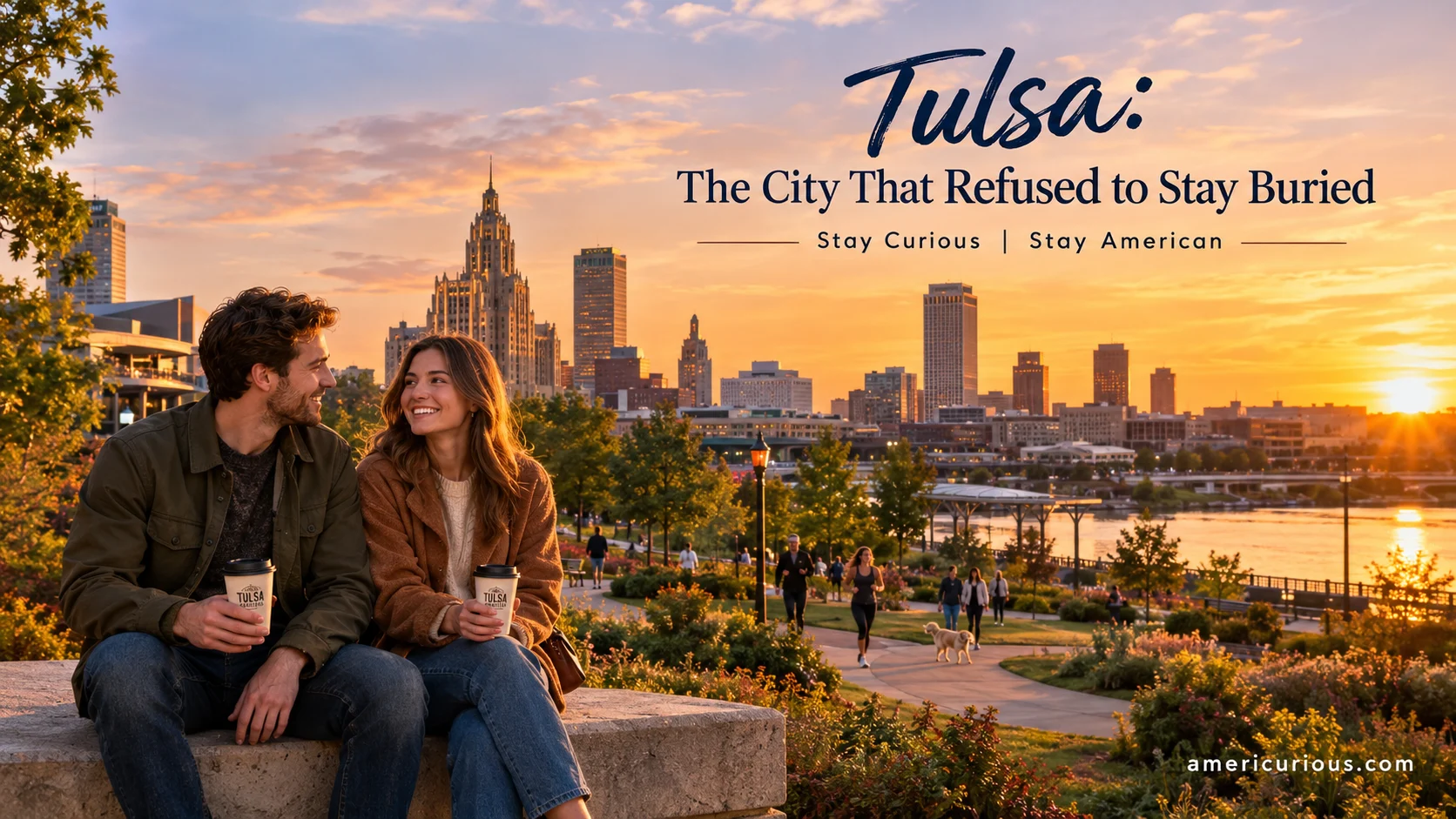
Discover Tulsa’s Art Deco skyline, Greenwood Rising, and best BBQ. This complete city guide covers neighborhoods, logistics, and hidden gems for your perfect Oklahoma trip.
Tulsa City Guide: The Complete Explorer’s Manual
📌 At a Glance Tulsa doesn’t just hide its history; it builds on it. Born from a chaotic 1900s oil boom that funded a stunning Art Deco skyline, and shaped by the profound tragedy and resilience of the 1921 Greenwood District massacre, this mid-size Oklahoma city has quietly engineered a massive cultural renaissance. Today, anchored by the world-class Gathering Place park and a fiercely independent food scene, Tulsa offers an unpretentious, deeply welcoming experience that completely shatters Midwest stereotypes.
🧭 The Lay of the Land (Neighborhood Guide)
Tulsa is sprawling and car-centric, but its distinct districts offer concentrated pockets of culture. Base yourself strategically to minimize driving.
- Downtown & the Deco District: The historic heart, defined by 1920s skyscrapers and pedestrian-friendly blocks. This is the best base for first-timers wanting walkable access to major museums and high-end dining.
- Where to Stay: Historic luxury. The Campbell Hotel (approx. $200–$350/night) offers restored Art Deco opulence, while The Mayo Hotel (approx. $180–$300/night) provides classic, old-money elegance.
- Tulsa Arts District: Located just north of downtown, this is the epicenter for nightlife and contemporary galleries. Converted warehouses and brick-paved streets give it a gritty, electric energy.
- Where to Stay: Boutique and design-forward. The Ambassador Hotel (approx. $160–$280/night) anchors the district with sleek, modern rooms.
- Brookside: A historic, highly walkable neighborhood south of downtown. Centered around East 15th Street, it is lined with mature trees, local boutiques, and excellent cafes, offering a charming, village-like feel.
- Where to Stay: Upscale suburban-adjacent hotels and charming bed-and-breakfasts (approx. $130–$220/night).
- River Parks & South Tulsa: Centered around the Arkansas River and the massive Gathering Place park. It is highly family-oriented and focused on outdoor recreation.
- Where to Stay: Reliable national chains and extended-stay suites catering to families (approx. $110–$180/night).
🏛️ Deep Roots: History & Heritage
Tulsa’s past is a study in contrasts. The 1900s oil discoveries turned the city into the “Oil Capital of the World,” funding an architectural boom that left behind one of the highest concentrations of Art Deco buildings in the U.S. Yet, this era of immense wealth was starkly divided by race. The 1921 Tulsa Race Massacre, in which a white mob destroyed the prosperous Black neighborhood of Greenwood (“Black Wall Street”), remains a pivotal, somber chapter in American history.
- Historic Landmarks: The Boston Avenue Methodist Church is a National Historic Landmark and a masterpiece of Gothic-terra cotta Art Deco design. The Philtower Building showcases the opulent corporate style of the oil barons. For Route 66 nostalgia, the Cain’s Ballroom (where Bob Wills pioneered Western Swing) is a must-see.
- Religious & Spiritual Sites: Beyond Boston Avenue, the First Presbyterian Church features intricate tilework and a stunning sanctuary. When visiting, be respectful of service times; both churches welcome self-guided tours during non-service hours, but modest dress is required.
🎨 Creative Pulse: Arts & Culture
Tulsa’s cultural scene is heavily subsidized by private philanthropy, resulting in institutions that rival those in much larger cities.
- Museums & Galleries: The Philbrook Museum of Art is housed in a 1920s Italianate villa surrounded by formal gardens, featuring exceptional Native American art. The Gilcrease Museum holds a massive collection of American West and Indigenous art. The Woody Guthrie Center offers a deeply moving, interactive look at the iconic folk singer. Crucially, Greenwood Rising is not a passive museum; it is an immersive, heavy, and ultimately hopeful reckoning with the 1921 Race Massacre, designed by the same team as the National Museum of African American History and Culture.
- Modern Attractions: The Center of the Universe is a quirky, free acoustic anomaly where your voice echoes back to you strangely while blocking out surrounding noise—a fun, bizarre roadside stop.
- Festivals & Events: The Tulsa State Fair (late Sept/early Oct) is a massive regional draw. MayFest (May) is a premier arts and crafts festival, and Global Day (June) celebrates the city’s diverse cultures. During the holidays, Christmas on the River transforms the riverfront into a dazzling light display.
🍽️ The Culinary Map: Food & Nightlife
Tulsa’s food scene balances heavy, comforting Route 66 classics with a rapidly growing farm-to-table movement.
- Local Dishes & Street Food: You must try an Oklahoma Fried Onion Burger, where thick-sliced onions are smashed directly into the patty to create a lacy, caramelized crust; Joe’s Classic in the Blue Dome District is the local legend for this. For BBQ, Burn Co. BBQ offers award-winning, slow-smoked meats. For a taste of Indigenous heritage, seek out frybread and Indian tacos at local powwows or specialized Native-owned food trucks. The Tulsa Farmers Market (Saturdays at Kendall-Whittier) is excellent for fresh, local street food.
- Coffee Culture: Magnolia’s in Brookside is an iconic, bustling local coffeehouse with a massive patio. Chalkboard Coffee in the Arts District offers excellent single-origin pours in a minimalist setting.
- Fine Dining & Local Restaurants: Jun offers innovative, globally inspired fine dining. Grayton provides upscale, seasonal American cuisine. For casual nostalgia, Taco Bueno (invented in Tulsa) is a local fast-food staple.
- Nightlife & Entertainment: The Tulsa Arts District is the hub for evenings. The Vanguard and Mercury Lounge are the premier venues for indie and rock. Cain’s Ballroom remains a legendary, intimate venue for touring acts. For cocktails, The Polynesian offers a retro tiki experience, while The Lobby at The Campbell Hotel provides sophisticated drinks in a stunning Art Deco setting.
🌲 Into the Wild: Outdoors & Adventure
Tulsa has aggressively transformed its natural assets, particularly the Arkansas River corridor, into a massive outdoor playground.
- Parks & Scenic Lookouts: The Gathering Place is the undisputed anchor of the city. This 100-acre riverfront park features world-class playgrounds, trails, and gardens. The Gathering Place Towers offer excellent panoramic views of the river and skyline. Mohawk Park, one of the largest municipal parks in the U.S., offers dense woodlands and the Oxley Nature Center, which is fantastic for wildlife viewing.
- Wildlife & Nature: The Tulsa Botanic Garden (just south in Oakhurst) features beautiful themed landscapes. The Oxley Nature Center offers guided walks and excellent birding along the river.
- Adventure & Sports: The Arkansas River is highly accessible. The River Zone at River Parks offers rentals for kayaking and stand-up paddleboarding. The River Parks Trail system boasts over 40 miles of paved, multi-use trails perfect for cycling.
- Agri-Tourism: While Oklahoma’s climate precludes tropical plantations, local agri-tourism is thriving. 385 Cider in Tulsa offers a great local taste of regional orchard harvests. For wine, take a short drive to explore the broader Oklahoma Wine Trail, which features local tasting rooms highlighting native grape varietals.
🛍️ Markets & Mindfulness: Shopping & Wellness
- Shopping & Local Crafts: Cherry Street (15th Street) is a historic, tree-lined district packed with independent boutiques and antique shops. Utica Square is an upscale, open-air shopping center. For authentic Native American crafts and jewelry, the galleries at the Philbrook Museum and specialized shops in the Blue Dome District offer high-quality, ethically sourced pieces.
- Wellness & Relaxation: The Spa at The Campbell Hotel provides luxurious, full-service massages in a historic setting. For holistic wellness, Yoga on the Ave in Brookside offers drop-in classes. Float Tulsa provides sensory deprivation float therapy. The expansive, quiet trails of the Gathering Place also serve as a fantastic, free space for outdoor mindfulness.
🤫 Insider Secrets: Hidden Gems & Local Vibe
- The Vibe: Tulsa’s atmosphere is defined by “Tulsa Nice.” It is unpretentious, deeply welcoming, and surprisingly cosmopolitan. Locals are proud of their city’s renaissance and eager to share its hidden depths.
- Hidden Gems: Seek out the Living Arts center to watch local artists blow glass. Drive past the Meadow Gold sign at sunset; this massive, historic neon sign is a beloved Route 66 landmark that looks spectacular illuminated against the twilight sky. For a quiet, reflective moment, visit the Peace Wall in the Greenwood District, a solemn and beautiful memorial to the victims of the 1921 Race Massacre.
🧳 The Logistics Blueprint (Practical Information)
- Best Time to Visit: Spring (April to May) and Fall (September to October) offer mild temperatures and beautiful foliage. Summers (June to August) are brutally hot and humid, frequently exceeding 95°F (35°C). Winters are generally mild but can feature occasional ice storms.
- Where to Stay: Base yourself in Downtown for luxury and walkability, the Arts District for nightlife, or Brookside for a local neighborhood feel. Budget travelers will find the best rates in South Tulsa.
- Getting Around & Clustering Strategy: Tulsa is sprawling. Tulsa Transit operates a bus system, but it is not conducive to tourist hopping. Rideshare apps (Uber/Lyft) are abundant and practical. Pro-Tip: Cluster your activities by neighborhood to minimize driving. Do Downtown/Deco District on Day 1, Arts District/Brookside on Day 2, and River Parks/Gathering Place on Day 3.
- Arrival Connection: Tulsa International Airport (TUL) is 7 miles southeast of downtown (a 15-minute drive). There is no airport train; the fastest way downtown is via Uber/Lyft (approx. $15–$25).
- Local Know-How:
- Tipping: Standard U.S. rates: 18–20% at restaurants, $1–$2 per drink at bars.
- Cash vs. Card: Cards are accepted almost everywhere, including small cafes via mobile readers. Carry a little cash for tips.
- Dress Code: Generally casual, but locals dress up slightly for nice dinners. Smart casual is a safe bet for evening dining. Modest dress is required for active religious sites.
- Safety: Generally safe for tourists in the main districts. Practice standard awareness: lock your car and don’t leave valuables visible.
Tulsa is a city that rewards curiosity. It asks you to look past the stereotypes, sit with its complex history, and experience the genuine warmth of a community that has rebuilt itself into something extraordinary. Book your flight, pack for layered weather, and come see the city that refused to stay buried.
📚 Sources & Verification Notes
- Visit Tulsa (visittulsa.com): Official destination marketing organization; used for neighborhood overviews, festival dates, and general attraction info.
- Greenwood Rising & Philbrook Museum of Art (philbrook.org): Official museum websites; used for historical context, exhibition details, and visiting guidelines.
- Tulsa Transit (tulsatransit.org): Official city transit authority; used to verify the lack of light rail and the nature of the bus network.
- Tulsa International Airport (flytulsa.com): Official airport authority; used for arrival logistics and distance to downtown.
- Gathering Place (gatheringplacetulsa.org): Official park website; used for park features, acreage, and activity details.
- Verification Note: Prices for hotels and dining are approximate and reflect rates as of early 2025; they are subject to seasonal fluctuation. Event dates shift slightly year to year and should be confirmed on the official Visit Tulsa calendar prior to booking. All mentioned businesses and attractions were verified as active and open as of early 2025.