The hidden human cost of unpaid family caregiving in America — and one mother’s struggle to find herself again
The morning that belongs to everyone but her
It is 7:49 in the morning.
The school run should be one of the most ordinary parts of family life. Children need to get dressed, breakfast needs to be finished, backpacks need to be found, and somebody inevitably cannot locate a shoe. Parents hurry. Children hesitate. The clock keeps moving.
But for Annie Morgan, a mother in Rancho Cordova, California, even getting her daughter into the family minivan can become an exhausting physical undertaking.
In a scene documented by The Washington Post in May 2026, Annie guides her eldest daughter, Ava, toward the vehicle. Ava is thirteen, nearly as tall as her mother, and living with Angelman syndrome, a rare genetic neurological condition that affects communication, intellectual development, movement and balance.
The morning initially goes well. Then Ava becomes distressed. She cries, pushes against the car seat and moves unpredictably. Annie has to secure the seat belt, protect herself from blows and keep her daughter safe. She remains calm, repeating instructions and reassuring Ava.
Six minutes pass.
Eventually, everyone is in the vehicle.
The school morning can continue.
For another family, six difficult minutes might be remembered as an unfortunate start to an otherwise ordinary day. For Annie, moments like this are part of a much larger responsibility that begins before sunrise and frequently continues long after the children have gone to bed.
The minivan is not simply transportation. It is one small piece of an intricate system of care that she must keep functioning.
There are medications to prepare, appointments to coordinate, prescriptions to obtain, communication equipment to understand, school concerns to address and unexpected problems to resolve.
And there are two younger children, a marriage, a household and a person named Annie who has a life of her own.
That last part is easy to overlook.
In America, millions of people are doing something similar: organizing their lives around the needs of someone they love, providing assistance that would otherwise require professional workers, and absorbing responsibilities that rarely appear in official employment statistics.
They are parents, adult children, spouses, siblings and relatives.
They are the country’s largely invisible caregiving workforce.
Their work is indispensable. Their exhaustion is often private. And their own lives can become increasingly difficult to recognize.
Before she became everybody’s caregiver
Annie Morgan was not always the person whose day revolved around appointments, medication schedules and accessibility problems.
Before caregiving became the organizing principle of her life, movement was central to her identity.
Dance shaped her childhood. She moved between ballet, jazz and tap, eventually joining her high-school dance team. During her senior year, she auditioned for the Oakland Raiders cheerleading squad.
The audition itself has the texture of a young woman’s ordinary determination. She remembers stopping at Safeway to buy false eyelashes and finding a dress at Forever 21 before entering a room filled with women who appeared considerably more polished than she felt.
She made the team.
For two seasons, she cheered professionally.
It was a life containing ambition, physical expression and the excitement of discovering what might come next.
Then she became pregnant with Ava. Her relationship with Ava’s father ended, and the responsibilities of single motherhood began.
When Ava was around eighteen months old, Annie noticed something alarming while driving home from visiting a friend. Her daughter was unusually still in her car seat. Annie pulled off the freeway and rushed her to an emergency room.
Ava had experienced a seizure.
Further medical investigation led to the diagnosis of Angelman syndrome.
The condition would shape nearly every aspect of Ava’s development and create lifelong support needs. Annie sought specialists, followed emerging research and pursued a clinical trial involving gene therapy. The hoped-for transformation did not arrive.
As Ava grew older, the distance between the future Annie had imagined for her daughter and the reality of their circumstances became more difficult to ignore.
The story of a family receiving a diagnosis is often presented as a single dramatic moment: before the diagnosis, uncertainty; after the diagnosis, a new reality.
But for many parents, the consequences unfold over years.
The diagnosis is followed by decisions about schooling, therapy, medical care, equipment, accessibility, finances and the future. Each new stage of a child’s development can introduce another set of questions.
The child grows older. The care requirements change. The parents grow older, too.
The responsibilities do not necessarily diminish.
For Annie, the challenge was not simply learning how to care for Ava. It was discovering how much of her own life would have to be reorganized around doing so.
Care to Read?
Sandwich Generation Survival Guide: 25% of Us Start at 34 and the $1,000 Fix
The invisible second shift
Annie eventually married Daniel Morgan, a personal trainer who had shown patience and kindness toward Ava. They built a family together and welcomed two more children, Brody and Naomi.
Daniel shared the caregiving responsibilities, but his work for California’s housing department increasingly required travel.
The family received some support through Medi-Cal and other state programs, including limited weekend care and financial assistance. It was valuable, but insufficient to remove the pressure from their everyday lives.
The result was a household in which ordinary activities required extraordinary planning.
Leaving home could involve preparing for several possible emergencies. Eating at a restaurant could require monitoring Ava’s movements, anticipating distress and watching the reactions of strangers.
Gradually, remaining at home became easier than managing the unpredictability of going out.
Annie’s days developed a relentless rhythm.
She frequently woke before five in the morning. She prepared food and medication, dealt with paperwork and helped Ava get ready for school. Once the school drop-off was complete, another working day began: prescription calls, therapy appointments, specialist follow-ups, equipment problems and school communications.
A broken wheelchair could mean an afternoon dealing with insurance.
An unexpected problem at school could eliminate the rest of the day’s plans.
By evening, the household still required attention. There were meals, children, routines and preparations for the following morning.
This is the part of caregiving that conventional discussions about family responsibility often fail to capture.
It is not only the time spent physically helping someone. It is the time spent thinking about what that person might need next.
A caregiver must anticipate problems before they occur. They must remember details, coordinate different professionals, communicate information and make decisions in situations where the consequences can be serious.
This work continues mentally even when the caregiver is not physically performing a task.
A parent can be sitting at a kitchen table while simultaneously thinking about an upcoming medical appointment, a prescription renewal, a school communication, an insurance authorization and whether an assistive device is functioning properly.
The body may be resting.
The responsibility is not.
For people outside this world, a caregiver’s day can look deceptively empty. They may not be commuting to an office or attending conventional meetings. They may not have a recognizable job title.
But an absence of visible employment does not mean an absence of work.
In fact, caregiving can demand a combination of practical, administrative, physical and emotional abilities that would be divided among several paid professionals in another setting.
The difference is that the family member is expected to make the entire arrangement work.
And the person doing that work often has no reliable way to clock out.
America is running on an invisible workforce
Annie’s experience is not an isolated family story.
According to the 2025 Caregiving in the U.S. report from AARP and the National Alliance for Caregiving, approximately 63 million American adults provided ongoing care to an adult or child with a complex medical condition or disability during the preceding year.
That is roughly one in four adults.
The number represents an increase of approximately 20 million caregivers over a decade.
More than half of caregivers are women, and caregiving frequently overlaps with paid employment, parenting and other household responsibilities.
The report also describes a workforce carrying substantial emotional and physical pressure. Some caregivers provide more than forty hours of care each week. Others have been performing these responsibilities for years.
Nearly one in four report social isolation.
These numbers should change how caregiving is understood.
It is tempting to regard family care as a private matter, something that happens within the boundaries of individual households. But the cumulative contribution of these families is enormous.
Hospitals can discharge patients who still need assistance at home. Older people can remain in their communities because relatives help with daily activities. Children with disabilities can participate in family and community life because someone coordinates their care.
The healthcare system does not operate independently of families.
It depends on them.
When a relative prepares medication, assists with mobility, coordinates appointments, manages communication with professionals or provides continuous supervision, that work supports a much larger care infrastructure.
If every hour of family care had to be purchased from a professional provider, the financial implications would be extraordinary.
Yet much of this labor remains outside conventional measures of productivity.
A caregiver may perform essential work every day without receiving a conventional salary, building a retirement account or progressing professionally.
Society benefits from the work while the caregiver absorbs much of its personal cost.
That is not merely a family problem.
It is an economic and social-policy problem.
When love becomes an economic responsibility
There is another dimension of caregiving that is rarely visible in photographs of devoted parents and grateful children.
Money.
Caregiving is often described in the language of love, sacrifice and family responsibility. Those words are important, but they can obscure the financial realities.
Medical equipment costs money. Transportation costs money. Specialized food, supplies and accessibility modifications cost money. Professional assistance costs money. Even the seemingly ordinary expenses of maintaining a household can become more complicated when one member requires extensive support.
Then there is the income that disappears.
A caregiver who cannot accept a promotion, work full-time, travel for employment or pursue additional qualifications may experience a financial loss that extends far beyond the present month.
A career interruption can affect future earnings, retirement contributions, professional relationships and long-term economic independence.
The person may be performing valuable work while becoming less financially secure.
Research published by AARP on October 28, 2026, provides a striking picture of the economic pressure faced by family caregivers.
Its national study of 2,538 adults caring for adult relatives or friends found average annual out-of-pocket caregiving expenditure of $11,508. That represented approximately 31 percent of household income.
Almost nine in ten surveyed caregivers reported paying some expenses themselves.
The study found that household and housing expenses accounted for 42 percent of caregiving expenditure, while medical expenses accounted for another 29 percent.
The economic consequences were not limited to immediate spending. Caregivers reported reducing retirement contributions, drawing on savings, borrowing money and changing their working arrangements.
These figures require an important qualification: the AARP study focused on people caring for adult relatives or friends. They should not be treated as an estimate of Annie’s expenses or the cost of caring for a child with Angelman syndrome.
But they demonstrate the broader economic mechanism.
When family members provide care, they often pay twice: first through direct expenses, and again through the opportunities and financial security they surrender.
The second payment is harder to see.
It may appear years later as a smaller retirement account, a lower lifetime income, fewer professional opportunities or an inability to save for emergencies.
A person may not recognize the full financial cost while making each individual decision.
One missed workday seems manageable. One additional medical expense seems unavoidable. One abandoned course of study appears temporary.
But these decisions accumulate.
Eventually, what began as a series of individual family choices can become a long-term economic condition.
The price of being available
There is a particular cruelty in the expectation that caregivers should simply become better at managing their time.
People advise them to rest, exercise, seek help and make space for themselves.
Such advice is not necessarily wrong. But it can be profoundly incomplete.
Time management cannot manufacture affordable respite care.
A positive attitude cannot repair a broken wheelchair.
A meditation routine cannot guarantee that a medical appointment will be available when needed.
And a caregiver cannot always leave a vulnerable person simply because someone has recommended taking an afternoon off.
The problem is not always an individual’s inability to maintain balance.
Sometimes the system has been designed around the assumption that somebody in the family will absorb whatever work remains.
The United States has spent decades moving away from the institutional confinement of people with disabilities and toward greater participation in family and community life.
That transformation has an important moral foundation. People with disabilities deserve dignity, relationships, choices and the opportunity to live in their communities.
But community-based care requires actual community-based infrastructure.
It requires accessible services, trained workers, reliable respite arrangements, adequate funding, transportation, behavioral support, appropriate schools and a system families can navigate without becoming full-time administrators.
When those services are insufficient or fragmented, the work does not disappear.
It moves into the household.
And within the household, it often lands disproportionately on women.
The result is a contradiction at the heart of modern caregiving: society recognizes the value of keeping people at home and in their communities, but the people making that possible can be left struggling to maintain their own lives.
The night the burden became impossible to ignore
By 2023, Annie’s responsibilities had expanded beyond her immediate household.
Her mother was hospitalized with an infection. Her uncle had suffered a heart attack. Annie was caring for her three children while also helping other relatives manage the practical necessities of illness.
The responsibilities accumulated.
Daniel began asking healthcare professionals what concrete assistance could be provided to Annie.
The answers tended to return to familiar recommendations: she should rest, take care of herself and make time for personal well-being.
But Daniel wanted something more practical.
Who, he asked, takes care of the caregivers?
The question exposes a problem much larger than one family’s circumstances.
Healthcare systems are accustomed to identifying the needs of patients. They are less consistent at recognizing the needs of the people providing care outside professional settings.
A relative may be physically exhausted, financially strained and emotionally overwhelmed, yet the immediate clinical focus remains on the person receiving treatment.
The caregiver is present, but not necessarily recognized as someone who also needs support.
Annie and Daniel experienced nights when the children were asleep and the couple retreated to a bathroom at the far end of their home. They sat on the floor, held each other and cried.
Annie also described frightening thoughts while driving, thoughts that reflected a desperate wish to escape an existence that felt unsustainable.
The distinction matters.
Her experience should not be reduced to a dramatic anecdote about a mother reaching breaking point. It reveals what can happen when responsibility becomes continuous and meaningful support remains inadequate.
It also challenges a familiar cultural assumption: that the depth of a person’s love can somehow compensate for the absence of resources.
Love may explain why somebody continues.
It does not make endless responsibility harmless.
A haircut, a small act of control
In November 2023, Annie walked into the bathroom and shaved off her long brown hair using Daniel’s clippers.
It was a sudden, personal decision.
The action did not alter Ava’s medical condition. It did not create additional caregiving hours, resolve insurance problems or guarantee a more secure future.
But Annie later described the gesture as something that gave her a sense of control.
That detail is revealing because caregiving can gradually reduce the number of decisions that feel entirely one’s own.
Schedules are shaped by appointments. Sleep is interrupted by another person’s needs. Financial decisions are influenced by medical expenses. Work opportunities must be evaluated according to whether the household can manage without the caregiver’s presence.
Even leisure can become conditional.
The ability to decide something simply because you want to do it can begin to feel unusually precious.
For Annie, reclaiming that small measure of control became part of a longer process of rediscovering herself.
She sought therapy, although she found it difficult to explain the complexity of her daily circumstances.
Eventually, she returned to something that had once been central to her identity.
Dance.
Finding the woman inside the caregiver
Annie began taking poms, jazz and funk classes in Sacramento.
She danced at home with her children, playing music and moving through the hallway.
She described dancing as a way of showing up for her younger self.
It is a beautiful idea, but it is also a practical one.
She was not abandoning her daughter or pretending the caregiving responsibilities had disappeared. She was creating a small space in which her identity could exist independently of those responsibilities.
Other changes were modest.
She warmed her pillow before bed. She established a skincare routine. She made room for gardening and home projects. She simplified her younger children’s schedules, discovering that unstructured afternoons could be enjoyable for them.
These decisions did not amount to a dramatic transformation.
They were small acts of reclaiming time, preference and personal attention.
That distinction is important because the commercial language of self-care often suggests that well-being can be purchased through products, vacations, subscriptions and carefully planned routines.
For someone with substantial caregiving responsibilities, such advice can feel disconnected from reality.
Sometimes the problem is not that a caregiver has forgotten to buy the right candle or schedule a massage.
The problem is that the caregiver does not have anyone available to take over.
Self-care cannot replace social support.
It cannot substitute for trained assistance, affordable respite or a healthcare system that treats family caregivers as people with needs of their own.
But personal rituals can still matter.
A dance class may not solve the structural problem. It can remind a person that their identity extends beyond the problem.
A garden may not change the future. It can create a small experience of pleasure in the present.
A quiet evening may not eliminate responsibility. It can make room for something other than responsibility.
For Annie, returning to dance was not a return to her former life.
It was an attempt to carry something of that life into the one she now had.
The power of being seen
In April 2026, Annie posted a video documenting an ordinary school-morning routine with Ava.
While Annie was braiding her daughter’s hair, Ava suddenly threw her head backward and struck her mother in the face.
Annie recoiled, then continued.
She addressed the camera, acknowledging that sometimes a parent can give everything they have and still experience a difficult morning.
The video eventually attracted approximately 7.7 million views and more than 228,000 likes, according to the Washington Post.
The response came from people who recognized something they had rarely encountered in public representations of family life.
Caregiving is often shown through carefully framed photographs: a parent holding a child, a spouse helping a partner, a smiling family celebrating a milestone.
Those images can be sincere. They can also be incomplete.
They rarely capture the interrupted mornings, the physical strain, the unpredictable behavior, the paperwork, the uncertainty or the moments when the caregiver needs to step away and breathe.
Annie’s video offered a glimpse of that less polished reality.
People who had experienced similar situations responded with recognition.
For them, the value of the video was not simply that it showed a difficult moment. It demonstrated that such moments could be discussed without pretending that love made them easy.
Social media did not provide the family with a new care worker or solve its financial challenges.
But it reduced one particular burden: the feeling of being unseen.
That recognition matters.
Isolation is not always the absence of people. Sometimes it is the feeling that nobody around you understands the reality of your life.
A caregiver can be surrounded by family members, professionals and well-meaning friends while feeling that the central experience of their day is invisible.
Seeing another person describe something similar can create a sense of belonging.
It can also help challenge the expectation that families should present an endlessly positive picture of disability and care.
Honesty is not a failure of love.
The future nobody can schedule
There is one question that continues to hang over Annie’s family.
What happens when the parents can no longer provide the care?
Ava is growing older. Her support needs will continue to shape her life. Her parents are also growing older, and the family must think about a future that cannot be organized entirely around their present capacity.
Annie has wondered about the role her younger children might eventually play in their sister’s life.
It is a difficult question for any family caring for someone who will need substantial assistance throughout adulthood.
Parents want their children to love one another and remain connected. But they may also worry about placing responsibilities on siblings that those siblings did not choose.
The future involves questions about supported living, financial planning, guardianship, health services, community participation and long-term continuity of care.
These are not questions that can be answered by devotion alone.
They require dependable institutions, trained professionals, financial resources and a society willing to recognize that disability support does not end when childhood does.
For many families, planning for the future is not simply about money or accommodation.
It is about trust.
Who will know how the person communicates?
Who will understand their preferences?
Who will notice when something is wrong?
Who will protect their dignity and independence?
And who will support the family members who have spent years making those things possible?
These questions reveal why caregiving should be considered a matter of public infrastructure rather than exclusively private responsibility.
What would it mean to care for the caregivers?
The national evidence points toward several practical areas for reform.
First, respite care must become more accessible and dependable. Families need the ability to step away from caregiving responsibilities without compromising the safety of the person receiving care.
Second, financial support must reflect the economic reality of family care. Tax relief, appropriate compensation programs, affordable home-care services and protection against catastrophic out-of-pocket expenses can help prevent families from sacrificing their long-term security.
Third, workplaces must recognize that caregiving responsibilities do not disappear during working hours. Flexible scheduling, paid family leave and job protection can make the difference between remaining employed and leaving a career.
Fourth, healthcare professionals and service providers should recognize caregivers as participants in the care process who may themselves need education, training, emotional support and practical assistance.
Finally, long-term planning must begin before a family reaches crisis.
A system that responds only when a caregiver becomes overwhelmed is a system that has waited too long.
These are not abstract policy concerns.
They determine whether a mother can attend a class, whether a spouse can maintain employment, whether an older adult can remain safely at home and whether a family can imagine a future without constant fear.
The 2025 AARP and National Alliance for Caregiving research found widespread support among caregivers for measures such as tax credits, paid leave and programs that compensate eligible family caregivers.
The need is not mysterious.
The challenge is building the political, financial and institutional commitment to respond.
The people who should not have to disappear
There is a tendency to describe family caregivers as extraordinary people.
They are called selfless, courageous, devoted and inspiring.
Sometimes those descriptions are deserved.
But they can also conceal an uncomfortable expectation: that people who love their families should be willing to sacrifice almost anything.
A mother should be available.
A daughter should step in.
A spouse should manage.
A sibling should help.
And if the responsibilities become overwhelming, the individual should somehow find a way to become more resilient.
The problem with this expectation is that it turns devotion into an unlimited resource.
Human beings do not have unlimited physical energy, emotional capacity, money or time.
Caregivers need sleep. They need relationships that do not revolve around medical appointments. They need financial security, professional opportunities, friendships, privacy and moments when nobody needs anything from them.
They need to be able to imagine a future for themselves.
None of this diminishes the importance of the person receiving care.
In fact, sustainable caregiving requires that the caregiver remain a person rather than becoming an endlessly available service.
Ava deserves dignity, safety, communication, opportunities and a life that is not defined solely by her disability.
Annie deserves those things, too.
She deserves to dance without having to justify the time. She deserves to develop interests, pursue ambitions and experience the ordinary pleasure of making decisions for herself.
She deserves to be recognized not only as Ava’s mother, but as an individual whose life has value beyond the assistance she provides.
Perhaps that is the central lesson of her story.
The question is not whether families should care for one another. Human connection and mutual responsibility are essential parts of a decent society.
The question is why so much of that responsibility is allowed to fall on individual households without adequate support.
A country cannot celebrate family caregiving as the foundation of its healthcare system while treating the people who perform it as an afterthought.
It cannot depend on unpaid labor and then act surprised when caregivers become exhausted, financially insecure or isolated.
And it cannot ask people to devote their lives to keeping others safe while ignoring what happens to their own lives in the process.
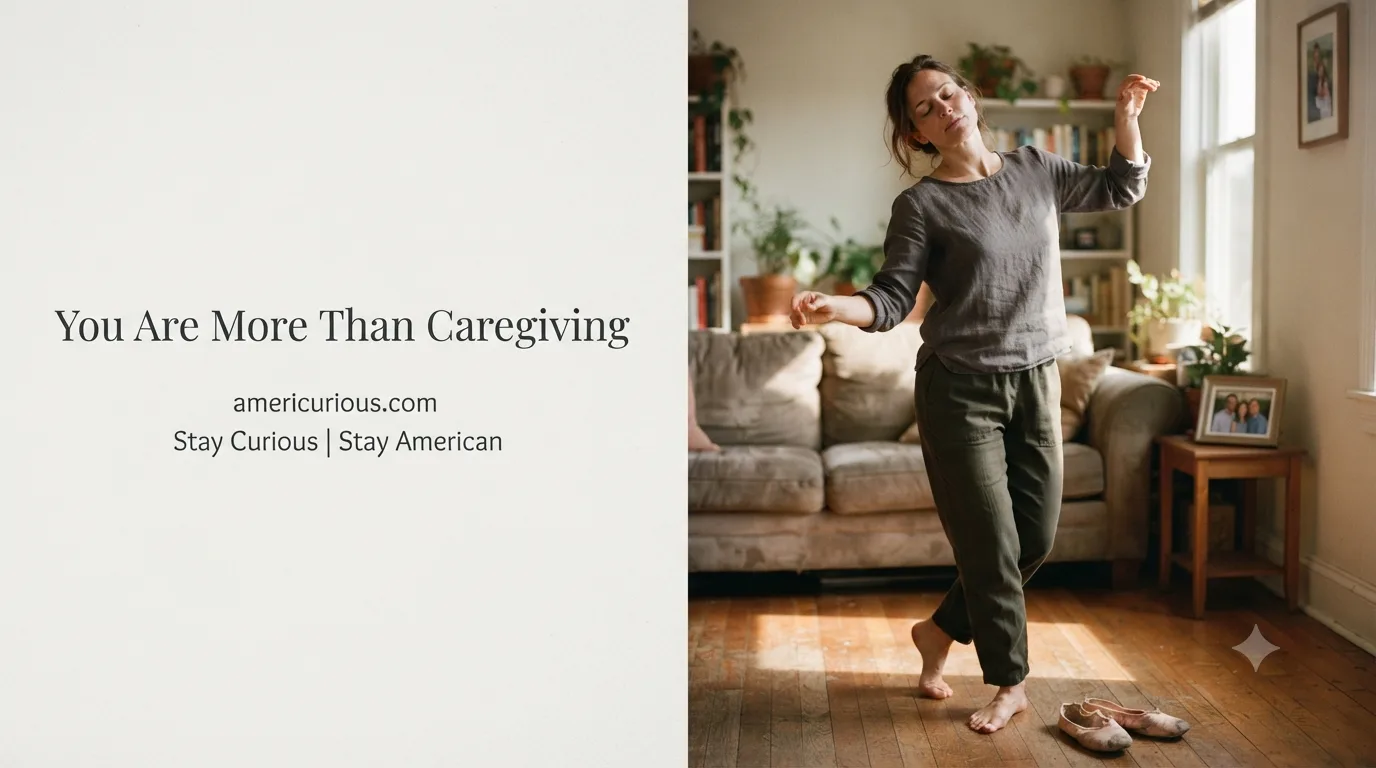
Annie’s return to dance offers a small but meaningful image of what reclaiming oneself can look like.
Not a miraculous escape. Not a perfect balance. Not the disappearance of responsibility.
Just a woman finding her way back to movement, music and a part of herself that had been waiting.
Millions of caregivers may need something much larger than a dance class. They need practical help, financial protection, reliable services and institutions that recognize their contribution.
But they also need permission to remain whole human beings.
Because the people who care for everyone else should not have to disappear in order to prove how much they love them.
And the measure of a caring society should not be how much sacrifice it can extract from its families.
It should be how well it cares for the people doing the caring.
Editorial note: This article draws on publicly available reporting about Annie Morgan and national caregiving research. It is not based on a new interview with the Morgan family. National financial expenditure figures cited in the article refer to AARP’s study of caregivers of adults and should not be interpreted as Annie Morgan’s personal expenses.