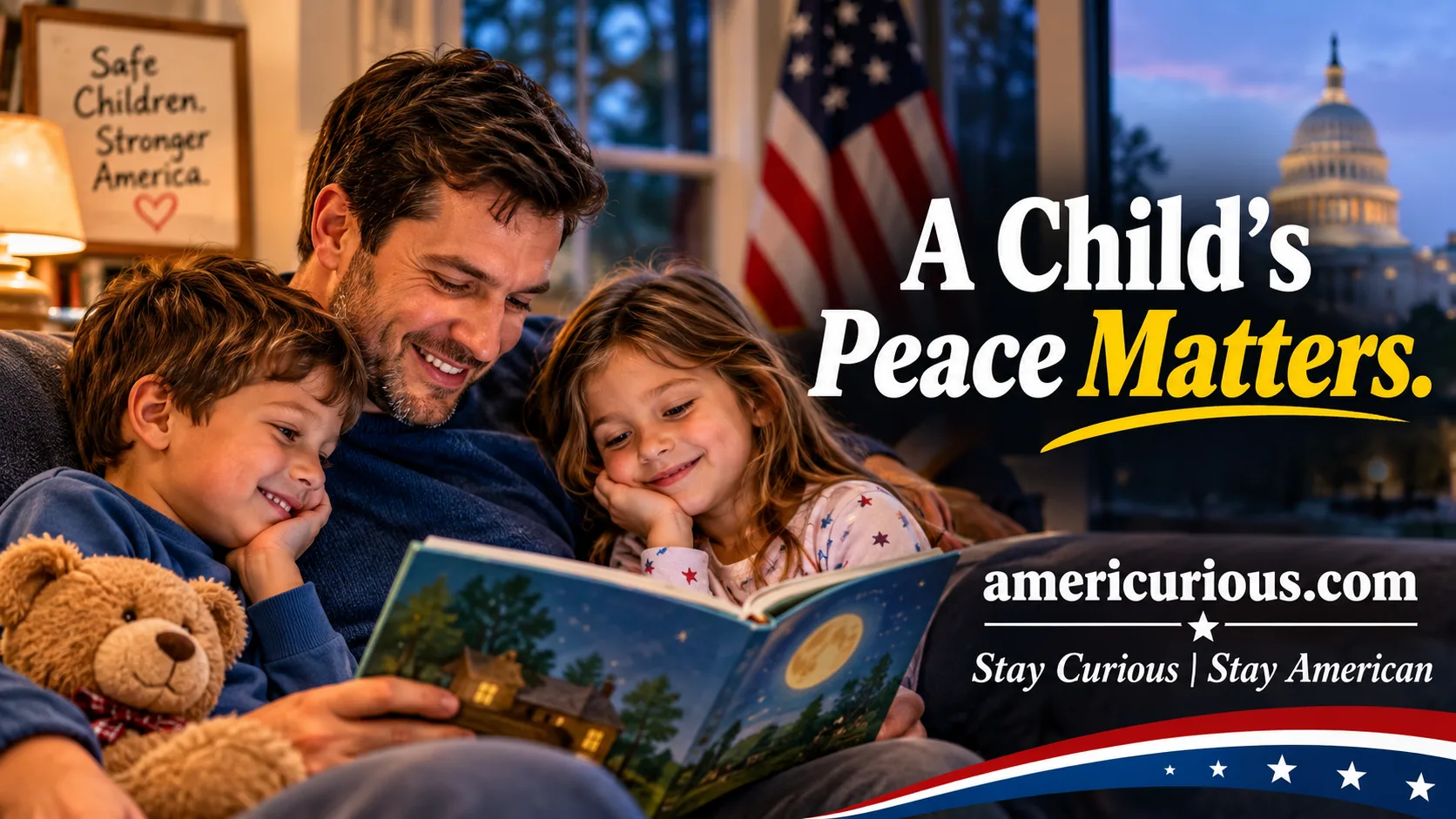
Every child deserves a childhood defined by safety, reassurance and the freedom to grow—not by the conflicts, resentments and battles of the grown-up world.
There is something extraordinary about the way children experience the world.
A child can find happiness in a cardboard box, excitement in a walk through the neighborhood and comfort in the familiar sound of a parent’s voice. Their concerns are beautifully uncomplicated. They want to play, discover, ask questions, make friends and know that someone will be there when they need help.
For a young child, the world is largely understood through the people they trust.
A parent’s embrace means safety. A familiar bedtime routine means reassurance. A promise that everything will be all right can make even the most frightening moment feel manageable.
Children do not begin life understanding political disagreements, ideological divisions, professional rivalries or public controversies. They do not know why adults sometimes dislike one another or why disagreements become bitter.
They simply depend on adults to make their world safe.
And that dependence comes with a responsibility we should never take lightly.
The conflicts adults create should not become children’s burdens
Adults have complicated lives. We disagree about politics, religion, social values, personal decisions and the direction society should take.
Sometimes those disagreements are passionate. Sometimes they become deeply personal. Occasionally, they develop into hostility that affects relationships, reputations and entire communities.
But there must be a boundary.
Children should never become instruments of adult disagreements.
They should not be made to carry the consequences of their parents’ public identities, professional positions, personal disputes or political affiliations. They should not be exposed to intimidation, humiliation or hostility simply because of circumstances they cannot understand and situations they did not create.
A child is not responsible for a parent’s opinions.
A child is not responsible for a family’s public profile.
A child is not responsible for the disagreements adults have with one another.
Yet children can become the most vulnerable people caught in those disagreements.
That is precisely why adults must recognize where their responsibilities begin and where their disagreements must end.
Care to Read?
Man-Child Husband? 7 Signs You’re Managing, Not Married, and How to Reset
The emotional world of a child is more fragile than we sometimes realize
Consider a young child who suddenly finds familiar routines disrupted.
Perhaps a parent is absent. Perhaps unfamiliar adults arrive with difficult questions. Perhaps the child notices anxiety in the faces of people who usually provide reassurance.
The child may not understand what is happening.
They may not understand the circumstances, the reasons or the adult conversations taking place around them.
But they can recognize that something feels different.
Children are still learning how to understand emotions, uncertainty and unfamiliar experiences. They depend on adults to help them interpret the world.
This is why the way adults handle conflict matters so much.
Something that appears to be an ordinary dispute between grown-ups can become an overwhelming experience for a child who lacks the emotional tools to understand it.
We should be careful not to assume that children are unaffected simply because they cannot explain what they are experiencing.
Their need for security deserves attention even when they cannot articulate it.
A parent’s greatest responsibility is not to win every battle
Parents naturally want to defend themselves, protect their reputations and stand up for what they believe is right.
Those instincts are understandable.
But parenthood also requires recognizing that not every disagreement deserves to enter the family home.
There are battles that adults must resolve without making children participants.
There are accusations that should be handled through appropriate institutions rather than public intimidation.
There are differences of opinion that should never become excuses for cruelty.
And there are moments when the most important thing a parent can do is put aside the noise of the outside world and make a child feel secure again.
A child does not need a parent who wins every argument.
A child needs a parent who provides consistency, patience, affection and reassurance.
That is not a small responsibility. It is one of the most important responsibilities an adult can accept.
You Might be Interested in this Post?!
What parents should know about Section 530A, Form 4547, and the age-18 handoff before opening a Trump Account for their child in 2026
Protecting children should never be a political position
One of the most important principles of a decent society is that children’s well-being should not depend on the opinions, affiliations or public standing of their parents.
It should not matter whether a family is politically conservative or progressive.
It should not matter whether parents are famous or unknown, wealthy or struggling, religious or nonreligious.
It should not matter whether we agree with their decisions or disagree with their beliefs.
Children deserve protection regardless.
This principle does not mean shielding children from legitimate safeguarding procedures or preventing authorities from investigating genuine concerns. Protecting children also requires responsible institutions, careful investigations and appropriate accountability.
But it does mean rejecting malicious conduct, intimidation and the deliberate misuse of systems intended to protect vulnerable people.
The distinction matters.
Institutions created to safeguard children must be able to do their work without being exploited to settle adult disputes.
And children should never be treated as convenient instruments in conflicts that have nothing to do with their own actions.
What kind of world are we preparing for the next generation?
Perhaps the most important question is not what today’s disagreements will decide.
It is what children will learn from watching the adults around them.
Will they learn that disagreement can exist alongside respect?
Will they see adults resolving conflicts without humiliating one another?
Will they discover that differences in identity, background and belief do not cancel out someone’s humanity?
Or will they grow up believing that hostility is normal, that cruelty is acceptable and that people can use whatever power they possess to hurt those connected to someone they dislike?
The example adults set today becomes part of the world children inherit tomorrow.
We cannot promise them a life without disappointment, disagreement or difficult experiences.
But we can demonstrate that kindness is possible even when opinions differ. We can show them that justice does not require cruelty, that disagreement does not justify intimidation and that personal dignity should never become conditional.
Most importantly, we can refuse to make them carry burdens that belong to adults.
Let childhood remain childhood
Imagine a world in which every child can concentrate on the things that should occupy childhood.
Learning something new.
Making an unexpected friend.
Laughing at something silly.
Asking endless questions.
Feeling excited about tomorrow.
Falling asleep knowing that the people they love are nearby and that they are safe.
These are not extravagant privileges. They are ordinary elements of a healthy childhood.
And protecting them is a responsibility shared by parents, families, communities, institutions and society as a whole.
We may never agree on every political question. We may never see eye to eye on every social issue. Our differences will continue to shape public conversations and private relationships.
But surely there is something on which we can agree:
Children should not have to pay the price for conflicts they did not create.
They deserve a world in which adults can disagree without becoming cruel, defend their convictions without abandoning compassion and pursue justice without forgetting humanity.
The next generation is watching how we treat one another.
Let us give them something better to remember.
Let us give them a childhood, not a battlefield.