Feeling lost in your 20s? You’re not behind — you’re tired. A story-led, evidence-backed guide for the high-functioning 20-something who did everything right.
A story-led, evidence-backed guide for the 20-something who did everything right and still feels like he’s failing.
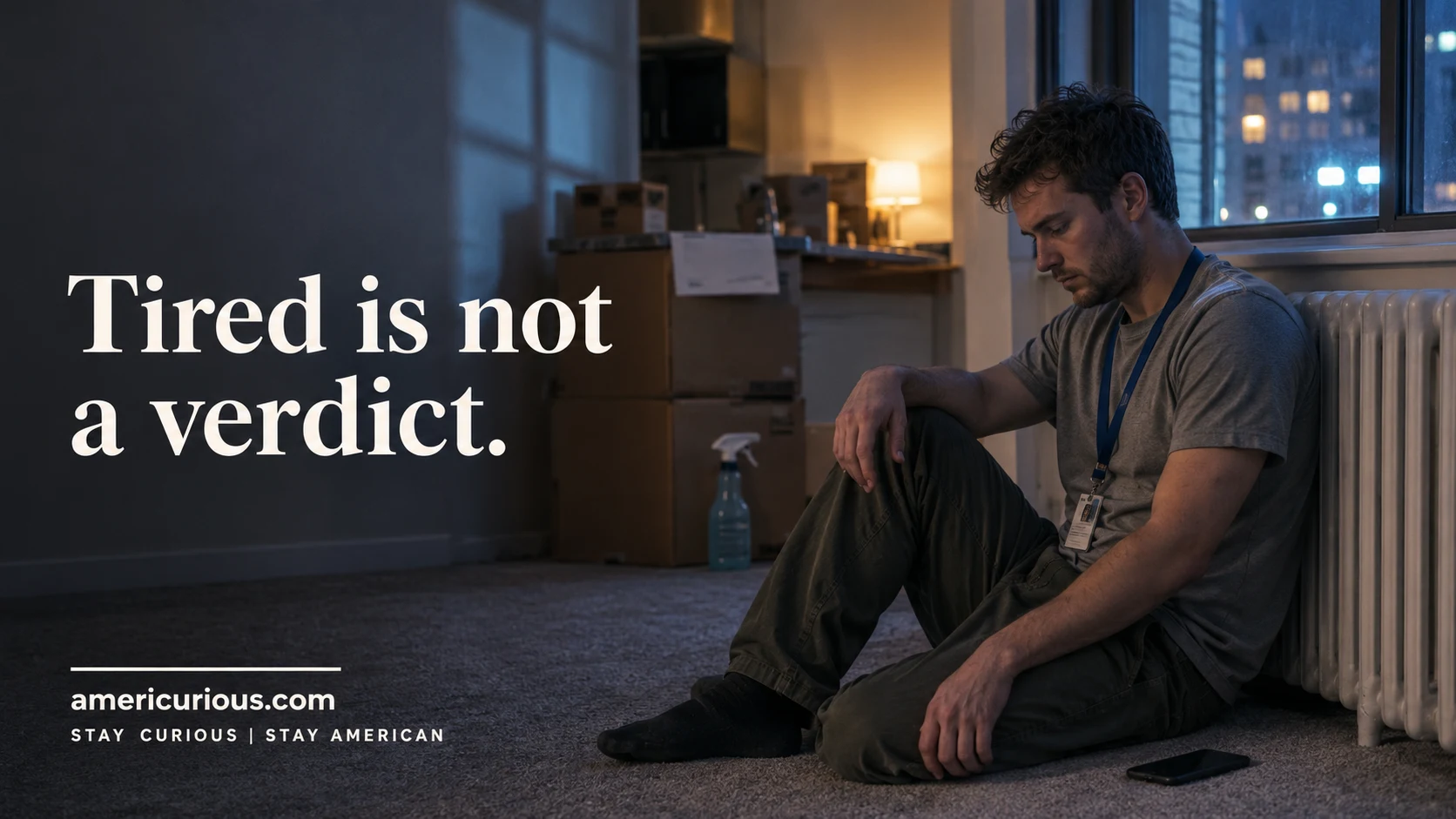
I was 26 the first time I sat on the floor of an apartment I couldn’t afford and felt nothing.
The radiator made a sound like a distant train. The phone was face down on the carpet. The apartment smelled like new carpet and the lemon cleaner the landlord used.
The lease was in a drawer. The job was on a lanyard around my neck. I had done everything right. I had the degree, the title, the salary, the city.
I had a mother who called every Sunday to ask if I was eating. I had a girlfriend who wanted to know when we were going to look at rings.
I didn’t answer the phone. I didn’t turn on the lights. I sat there until the radiator stopped.
That was the first time I understood that “making it” and “feeling like yourself” are two different things.
If you’ve been searching “feeling lost in my 20s” at 1 a.m. with a good job and a bad feeling, stay with me.
📌 The short answer
No, you’re not behind. You’re not broken. You’re in a developmental window that 40% to 77% of young adults experience, and it is common.
The feeling of being lost is often a sign that your old map doesn’t fit your new life. The fix is not a new job or a new city; it’s a new relationship with your own direction.
Here’s what helped me: a 10-minute “enough” inventory, one conversation I was avoiding, and one rest appointment. That’s it. That’s the plan.
📊 Ten-second poll — be honest
Which sentence sounds most like you right now?
- A. “I did everything right and still feel behind.”
- B. “I have a good job and no idea why I feel empty.”
- C. “I’m the strong one, and I’m tired.”
- D. “I don’t know what I want, and I’m scared it’s too late.”
Keep your letter. If you picked B or C, this was written for you.
🧭 You’re not lost. You’re between maps.
The old map was simple. School. Degree. Job.
Marriage. House. It worked for a while. Then it stopped fitting.
You did everything the map said. You got the degree. You got the job. You moved to the city.
You got the title. You got the paycheck. You got the girlfriend or the boyfriend or the dog or the apartment. You got the thing you thought you wanted.
And then you sat on the floor of the apartment and felt nothing.
Maybe you’re the one with the $60,000 job and the sister who calls you crying. Maybe you’re the one who grew up dirt poor. Maybe your mother was more of an army general than a loving parent. Maybe you worked at 17 and gave every paycheck to bills.
Maybe you’re the one who built a business and watched it fail and went back to a factory for 11-hour shifts. Maybe you’re the one who got the job in the new city and left the small town and still doesn’t know why he feels like a fraud.
You’re in good company.
A 2025 study of more than 2,200 young adults across eight countries found that 40% to 77% of them had experienced a quarter-life crisis. The common ingredients were not exotic: career transitions, financial difficulties, study stress, family conflict. The feelings were not exotic either: anxiety, worry, low mood, emotional numbness, and negative self-evaluations like feeling like a failure or feeling worthless.
Read that last part again. Feeling like a failure is a symptom of a developmental stage. It is common.
The Harvard Making Caring Common project surveyed young adults 18 to 25 and found that 58% had experienced little or no meaning or purpose in the previous month. Half said their mental health was negatively influenced by “not knowing what to do with my life.”
You’re not behind a hidden schedule. Nobody showed you the schedule.
The Bureau of Labor Statistics puts median tenure for workers aged 25 to 34 at 2.7 years. The overall median is 3.9 years.
You’re not supposed to have it figured out by 26. You’re not even supposed to have it figured out by 30.
| What the research says | The number | Why it matters |
|---|---|---|
| Young adults who experienced a quarter-life crisis | 40–77% | It’s a stage, not a flaw. |
| Young adults who lacked meaning or purpose | 58% | You’re not the only one. |
| Young adults who said “not knowing what to do with my life” hurt their mental health | 50% | The feeling is real. |
| Median tenure for workers aged 25–34 | 2.7 years | You’re not supposed to have it figured out by 26. |
| Young adults 18–25 who had a major depressive episode | 15.9% | This is common, and it’s treatable. |
Sources: BPS / Regent’s University London (2025); Harvard Making Caring Common (2023); BLS (2024); SAMHSA (2024).
🪜 The $60k problem
Here’s the part nobody tells you about making it.
You can get the job. You can get the title. You can get the salary. You can move to the new city.
You can buy the thing at Trader Joe’s that your mother used to buy. You can put the $60,000 in the bank and look at the number and feel nothing.
I know because I did a version of it.
I had a job that paid $58,000 and a lease that cost $1,450 and a phone that wouldn’t stop lighting up with my mother’s name. I had a girlfriend who wanted to know when we were going to look at rings. I had a therapist who asked me what I wanted. I didn’t have an answer.
I tried to fix it with a new job. I got the new job. I felt the same.
I tried to fix it with a new city. I moved to the new city. I felt the same.
I tried to fix it with a new relationship. I got the new relationship. I felt the same.
The problem wasn’t the job. The problem wasn’t the city. The problem wasn’t the relationship. The problem was that I had been running so long that I didn’t know what I was running toward.
I hadn’t had a break since I was 17.
I was the guy who gave advice about purpose while eating a gas-station hot dog in his car. I was the guy who had a good job and a bad habit of disappearing into his phone. I was the guy who didn’t call his mother back for three weeks because he didn’t want to tell her he was tired.
That’s not a hero. That’s a person.
Maybe you’re the one with the $60,000 job and the sister who calls you crying. Maybe you’re the one who sends her money and listens to her cry and feels guilty because you can’t fix her. Maybe you’re the one who has a girlfriend who makes more than you and wants to travel every six months while you want to save and invest. Maybe you’re the one who has friends with master’s degrees and houses and a highlight reel that makes you feel like you’re falling behind.
You’re not falling behind. You’re carrying something.
The $60,000 is real. The job is real. The new city is real. But the feeling that you’re a fraud is also real.
It doesn’t go away because the number goes up.
If this is the part where you feel seen, stay here. I wrote about a similar feeling in Is It Too Late to Change Careers at 35? No — But Don’t Start Over. Different story, same fog.
“I’m 26 but I’m at a place where I’m too young to feel this tired and exhausted from life.”
That’s from a reader’s post. It might also be the thing you said to yourself last night.
💻 Why “follow your passion” is bad advice for you
The internet has a lot of advice for you. Follow your passion. Quit your job. Travel.
Start a business. Find your why.
Most of it is written by people who have a safety net.
You don’t have a safety net. You have a job, a sister, a girlfriend, a budget, and a therapist. You have people who depend on you. You have a life that doesn’t fit on a vision board.
Passion is a feeling. Direction is a decision.
You don’t need a lightning bolt. You need a Tuesday.
Here’s what helped me: I stopped waiting to feel passionate and started paying attention to what I kept doing when nobody was watching. I noticed that I kept reading about the same three things. I noticed that I kept volunteering for the same kind of work. I noticed that I kept having the same conversation with different people.
The overlap was a direction. It wasn’t a passion. It was a pattern.
Here’s the small version you can do tonight: write down three things you would do even if no one paid you. Write down three things you would stop doing if no one judged you. Write down one thing you want to be true about your life in five years. The overlap is a direction.
You don’t need to know what you want to do with your life. You need to know what you’re willing to do next.
📝 The 10-minute “enough” inventory
Here’s the exercise that stopped the bleeding for me.
I did it in a parking lot outside a Chipotle. I had a gas-station hot dog in one hand and a phone in the other. The parking lot smelled like rain and fry oil. I was 26 and I was tired.
I wrote down five things I had that I would have wanted at 18. I wrote down three things I was doing that I didn’t want to do. I wrote down one thing I was willing to stop doing. I wrote down one thing I was willing to start.
It took ten minutes. It didn’t fix my life. It stopped the bleeding.
Here’s the small version you can do tonight:
- Write down five things you have that you would have wanted at 18.
- Write down three things you’re doing that you don’t want to do.
- Write down one thing you’re willing to stop doing.
- Write down one thing you’re willing to start.
That’s it. That’s the exercise.
The point is not to make a gratitude list. The point is to see what you have without pretending you’re fine. You’re allowed to be tired and still have enough. Both are true.
🫱 A note on “enough”
“Enough” is not a slogan. It’s a number. It’s the number that lets you stop running for a minute and look around. You don’t have to be happy with the number. You just have to see it.
📞 The conversation you’re avoiding
There’s a conversation you’re not having.
Maybe it’s with your sister. She calls you crying. You send her money. You listen.
You try to fix her. You feel guilty because you can’t.
You don’t say the thing you’re actually thinking: I’m tired too. I don’t know how to help you. I’m scared that if I stop being the strong one, everything will fall apart.
Maybe it’s with your girlfriend. She wants to travel every six months. You want to save and invest.
You don’t say the thing you’re actually thinking: I want to travel with you. I also need to feel like we’re building something. I’m scared that if I say that, you’ll leave.
Maybe it’s with your therapist. She asks you what you want. You don’t have an answer.
You don’t say the thing you’re actually thinking: I don’t know what I want. I’ve never been allowed to want anything.
The “lost” feeling is often an unspoken conversation.
Here’s what helped me: I had the conversation I was avoiding. It didn’t go perfectly. It went.
Here’s the small version you can do tonight: send one text. Not a paragraph. One sentence.
“I’m not trying to fix you. I’m trying to be your brother. Can I listen for ten minutes?”
Or: “I want to travel with you. I also need to feel like we’re building something. Can we make a budget that includes both?”
You can’t fix your sister. You can’t make your girlfriend want the same things. You can only tell the truth and let the other person respond.
🛋️ Rest is not a reward
You think rest is a reward for finishing.
You think you’ll rest when you get the next promotion. You think you’ll rest when you pay off the debt. You think you’ll rest when your sister is okay.
You think you’ll rest when your girlfriend stops wanting to travel. You think you’ll rest when you figure out what you want.
You’re never going to figure out what you want if you don’t rest.
The U.S. Surgeon General’s 2023 advisory on loneliness found that about one in two U.S. adults report measurable levels of loneliness. Loneliness increases the risk of premature death by 26%. Social isolation increases it by 29%.
The advisory compares the mortality impact to smoking up to 15 cigarettes a day.
Don’t feel guilty. Put rest on the calendar like a meeting.
Here’s what helped me: I scheduled one “non-productive” hour a week. I didn’t call it self-care. I called it a meeting with myself.
I put it on the calendar. I didn’t cancel it.
Here’s the small version you can do tonight: put one hour on your calendar next week. Not a workout. Not a side hustle. Not a “growth” hour.
One hour where you do something that doesn’t produce anything. A walk without a podcast. A phone call with someone who isn’t a project.
A nap. A shower. A sit on the floor.
Rest is not a reward for finishing. It’s a requirement for continuing.
The exhaustion has a name. Some people call it quiet cracking. I call it the cost of being the strong one for too long.
🗓️ What to do on Monday
You don’t need a five-year plan. You need a next Tuesday.
Here’s the plan I used. It’s a small step. It won’t cure anything.
- The 10-minute “enough” inventory. Five things you have. Three things you don’t want to do. One thing you’ll stop. One thing you’ll start.
- The conversation you’re avoiding. One text. One sentence. One honest thing.
- One rest appointment. One hour. On the calendar. Not cancelled.
That’s it. That’s the plan.
I’m not going to tell you to quit your job or move to a new city. I’m not going to tell you to follow your passion. I’m not going to tell you that everything happens for a reason.
I’m going to tell you to do one small thing this week. Not because it will fix everything. Because you deserve a Tuesday that feels like yours.
🆘 When it’s more than a quarter-life crisis
Here’s the part where I have to be honest.
If you’re feeling hopeless. If you’re not sleeping. If you’re not eating. If you’re having panic attacks.
If you’re thinking about hurting yourself. If the “lost” feeling lasts more than a few weeks and affects your daily life. This is not a quarter-life crisis. This is a medical issue.
The 2024 National Survey on Drug Use and Health found that 15.9% of U.S. adults aged 18 to 25 had a major depressive episode in the past year, compared with 8.2% of all adults. 33.2% had any mental illness.
The CDC’s National Center for Health Statistics found that in 2022, anxiety and depression symptoms were most common among younger adults. This is a public health reality. It is common.
This is common. It’s treatable. It is not your fault.
If you’re in crisis, call or text 988 (Suicide & Crisis Lifeline). Call 1-800-662-4357 (SAMHSA National Helpline).
Tell a friend. Tell a doctor. Tell someone.
A blog post can’t replace therapy. It can be a hand on the shoulder.
I’ve been in therapy. It didn’t make me a different person. It made me a person who could survive being myself.
❓ FAQ
Is it normal to feel lost in your 20s?
Yes. The 2025 global study found that 40% to 77% of young adults across eight countries self-reported a quarter-life crisis. It’s a developmental stage. It is common.
How long does a quarter-life crisis last?
Research suggests one to two years, but active engagement — self-reflection, support, small steps — tends to shorten it. Avoidance tends to lengthen it.
Should I quit my job and travel?
No, not as a plan. Travel can be a reset, but it doesn’t solve the underlying direction problem. If you have obligations, a job, or people who depend on you, a trip is not a strategy. A small next step is.
What if I don’t have a passion?
You don’t need one. Passion is a feeling; direction is a decision. Use the “values, not passions” exercise. Choose a direction based on what you’re willing to do next, not what you’re waiting to feel.
How do I stop comparing myself to people on social media?
The comparison is a design feature. You are not flawed. Limit the input. Use the “enough” inventory.
Remember that you’re seeing finish-line photos, not the whole race.
I wrote about the mechanics of the feed in How to Stop Doomscrolling: Yoga’s 2,000-Year-Old Answer to the Infinite Feed.
When should I see a therapist?
If you’re hopeless, not sleeping, not eating, thinking about hurting yourself, or if the “lost” feeling lasts more than a few weeks and affects your daily life. The SAMHSA data says 15.9% of 18–25-year-olds had a major depressive episode; this is common and treatable. Call or text 988 if you’re in crisis.
What if I’m the strong one and I don’t know how to ask for help?
Start with one person. Use the script: “I’m not trying to fix you. I’m trying to be your brother/friend/partner. Can I listen for ten minutes?” You don’t have to be fixed to be helped.
🌅 The same apartment, a different Tuesday
I’m still in the apartment. The radiator is still making that sound. The phone is still face down on the carpet.
But I’m not sitting on the floor anymore. I’m at the kitchen table. I have a cup of coffee. I have a list of five things I have that I would have wanted at 18.
I have a text I sent to my sister. I have an hour on my calendar next week that doesn’t produce anything.
I’m still tired sometimes. But I’m not lost. And neither are you.
You’re not behind. You’re just tired. And tired is not a verdict.