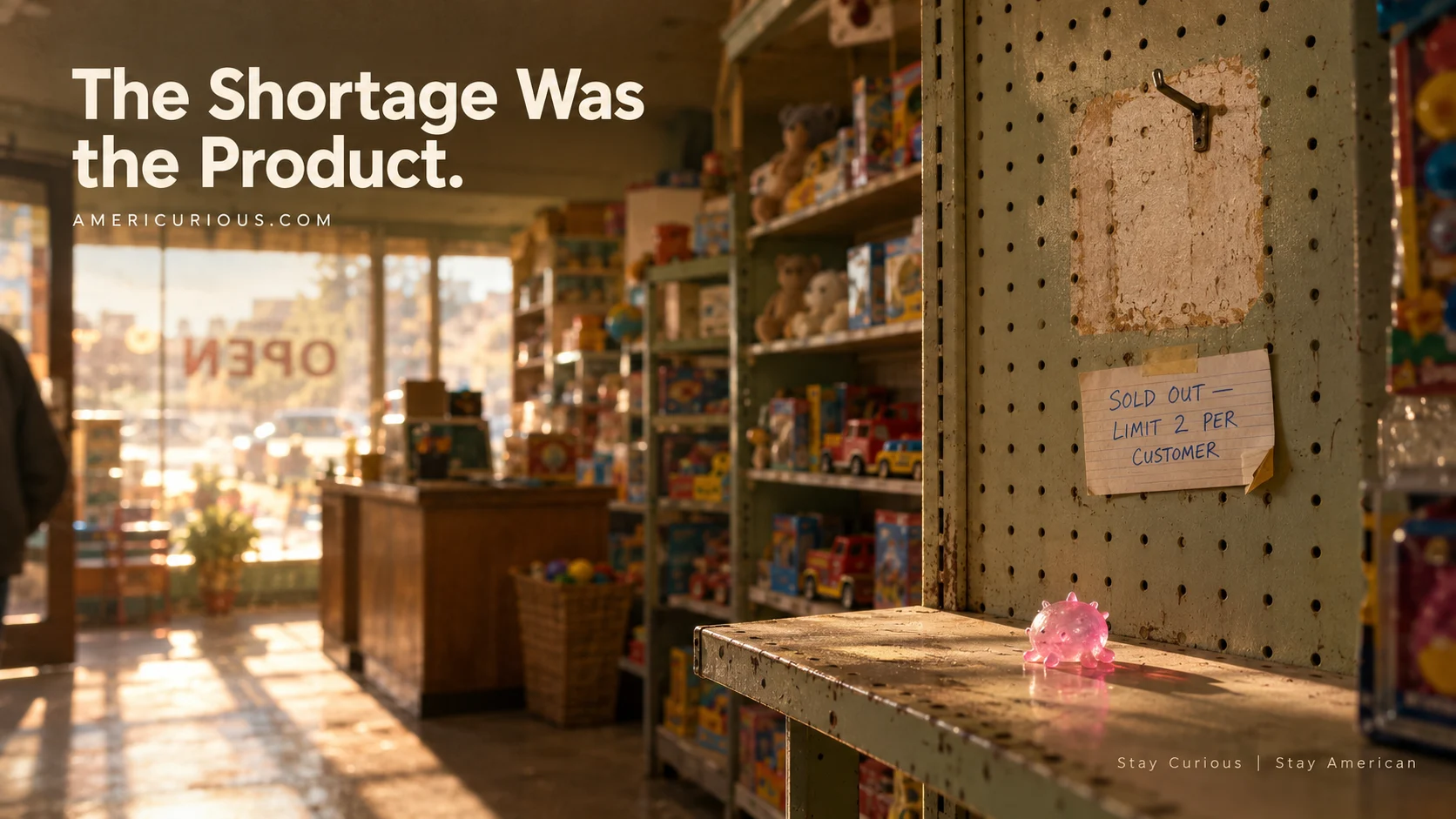
The squishy toy craze made NeeDoh the hardest $5 item in America. Inside the NeeDoh shortage and the scarcity pattern behind it.
Quick answer:
NeeDoh, a palm-sized squishy toy made by Massachusetts-based Schylling, has become the most fought-over cheap object in America this year, with squishy-toy sales quadrupling to roughly $297 million in the first half of 2026. The product itself is nearly a decade old. What changed was scarcity — real supply shortfalls colliding with social video, resellers, and store purchase limits — which turned a $5 impulse buy into a hunt, and occasionally a scuffle in a grocery aisle.
Somewhere in Washington County, a grown adult recently got into it with another grown adult over a four-dollar-and-ninety-nine-cent glow-in-the-dark ghost.
That is not a metaphor. In early October, Aldi rolled out a limited Halloween line of NeeDoh squishies — Glowy Ghosts and Jack-Glow Lanterns, in stores only, capped at four per customer. Shoppers reported some locations cleared out within minutes of unlocking the doors. A day later, video circulated of a confrontation in a Washington County store, reported locally and picked up by CBS News Pittsburgh. A toy store owner in Northbrook, Illinois told reporters she once found roughly 200 people waiting outside for a shipment, with accusations of line-cutting and arguments over numbered spots.
Let’s be precise about what’s being fought over: a small rubbery ball or cube filled with a dough-like compound. You squeeze it. It slowly returns to its shape. That’s the entire product.
What’s actually happening
NeeDoh isn’t new. Schylling launched the line in 2017, as the fidget-toy wave was building, and it sat on gift-shop shelves for years as a quiet seller. Then, according to reporting, momentum built around the 2025 holiday season, when a NeeDoh advent calendar became hard to find. By early 2026 the line had become the center of the broader squishy category.
The numbers are not vibes. Circana data reported by CNBC in late August showed U.S. squishy-toy sales reaching about $297 million from January through June 2026 — roughly four times the year-earlier figure — with unit sales up nearly 200% to 58.6 million. Schylling CEO Paul Weingard told The Atlantic in April that the company went through about three times its 2025 inventory in the first three months of 2026, and that he’d characterize the surge as tenfold. Business Insider reported the same year-of-inventory-in-nine-weeks figure in April. That same Circana checkout data is useful for puncturing one assumption: about 60% of NeeDoh purchases were parents buying for children, and about 18% were adults buying for themselves.
Supply has partly recovered. Independent restock trackers counted hundreds of individual NeeDoh listings returning to stock in a single week in late October — but almost entirely at Amazon and Target, and rarely the specific variant a given kid has decided they need. The chase has narrowed rather than ended.
Care to Read?
Best Affordable U.S. Cities to Live and Work in 2026
Why now is the interesting part
Three things had to line up, and only one of them is about the toy.
The object had to be cheap enough to be an impulse and varied enough to become a collection. At roughly $5 to $7 retail, NeeDoh clears the threshold where a parent says yes without a conversation. But the line runs dozens of variants, seasonal drops, and limited editions. Cheap plus completionist is the oldest formula in American retail. It’s the entire business model of the trading card aisle.
The shelf had to stop being the storefront. Circana’s social commerce tracking found TikTok Shop now accounts for about 1% of total U.S. retail sales and 3% of e-commerce, with toys, hobbies, and collectibles its third-largest category. A marketing professor told NBC Select that NeeDoh’s rise looked like slow-burn virality — many small creators compounding rather than one blockbuster post. That’s a meaningfully different mechanism than the 1996 toy panic, when a single segment on a morning show could empty a warehouse.
A parallel infrastructure had to exist to convert scarcity into sport. By late October, there were at least three independent sites doing nothing but watching NeeDoh listings and pinging strangers when one restocks. That’s the tell. When an unofficial tracking layer forms around a $5 object, the hunt has become the product. The same layer formed around Labubu in 2025, and around sneakers and console launches before that.
Here’s the catch: scarcity in 2026 is partly real and partly performed. Schylling genuinely underestimated demand — a Lunar New Year factory shutdown landed at the worst possible moment. But once resale listings hit four times retail, and once retailers learned that a purchase limit generates a line, scarcity starts feeding itself. A limit of four per customer doesn’t just ration stock. It tells every shopper in the building that this is worth wanting.
The pattern you’ll notice
America runs this ritual roughly every decade: Cabbage Patch Kids in 1983, Tickle Me Elmo in 1996, Beanie Babies, Hatchimals in 2016, Squishmallows, Labubu last year. The object changes. The staging doesn’t. A cheap, visible, slightly absurd item becomes a social credential among children; adults do the queuing, the reselling, and the shouting; the whole thing resolves in twelve to eighteen months; and a year later the same item sits in a clearance bin, which is exactly where NeeDoh’s holiday stock was before any of this started.
What makes this cycle worth watching isn’t the toy. It’s the fairness theater around it. Store purchase limits, numbered spots in line, “one per customer,” the teenager at the register absorbing abuse for a policy she didn’t write — these are small civic dramas about access. Watch how Americans behave when a thing is scarce and cheap and everyone can see who got one. It’s the most honest window into our assumptions about fairness that retail offers, and it costs $4.99.
It’s also worth noting what the frenzy has dragged in. In October, federal regulators announced a recall of about 37,000 water-bead squishy toys from a different importer over ingestion hazards — not NeeDoh. Counterfeit NeeDohs have become a genuine problem, with South Carolina authorities reporting more than $214,000 in counterfeit goods seized from a Greenville mall in August. A proposed class action filed in July alleges some NeeDohs can rupture after heat exposure and cause burns; that is an allegation in pending litigation, not a finding, and Schylling’s product pages already warn explicitly against heating, freezing, or microwaving the toys — a warning the company has also applied publicly to the social videos that encouraged it. The pattern is familiar all the same: viral demand outruns quality control and invites fakes.
The part that outlasts the toy
Every one of these cycles gets explained as consumerism run amok, and that’s too easy. Something real is being purchased here. A squishy is a tiny, screenless, silent regulation device — you squeeze it in a classroom or a car and your body settles. In a year when the toy industry’s growth came disproportionately from buyers over twelve, and when adults made up a third of that growth, the demand for a tactile object that does nothing useful is not irrational. It’s a small rebellion against a culture that has moved nearly every form of comfort onto a glass rectangle.
That’s the durable insight, and it will hold after NeeDoh cools. The next object is already being manufactured somewhere. It will cost around five dollars, it will come in a variant you can’t find, a store will ration it, and adults will behave badly in public over it. What consistently works — for the manufacturer, the retailer, and the platform — is not making a better toy. It’s making a legible shortage.
The toy was never the point. The shortage was.