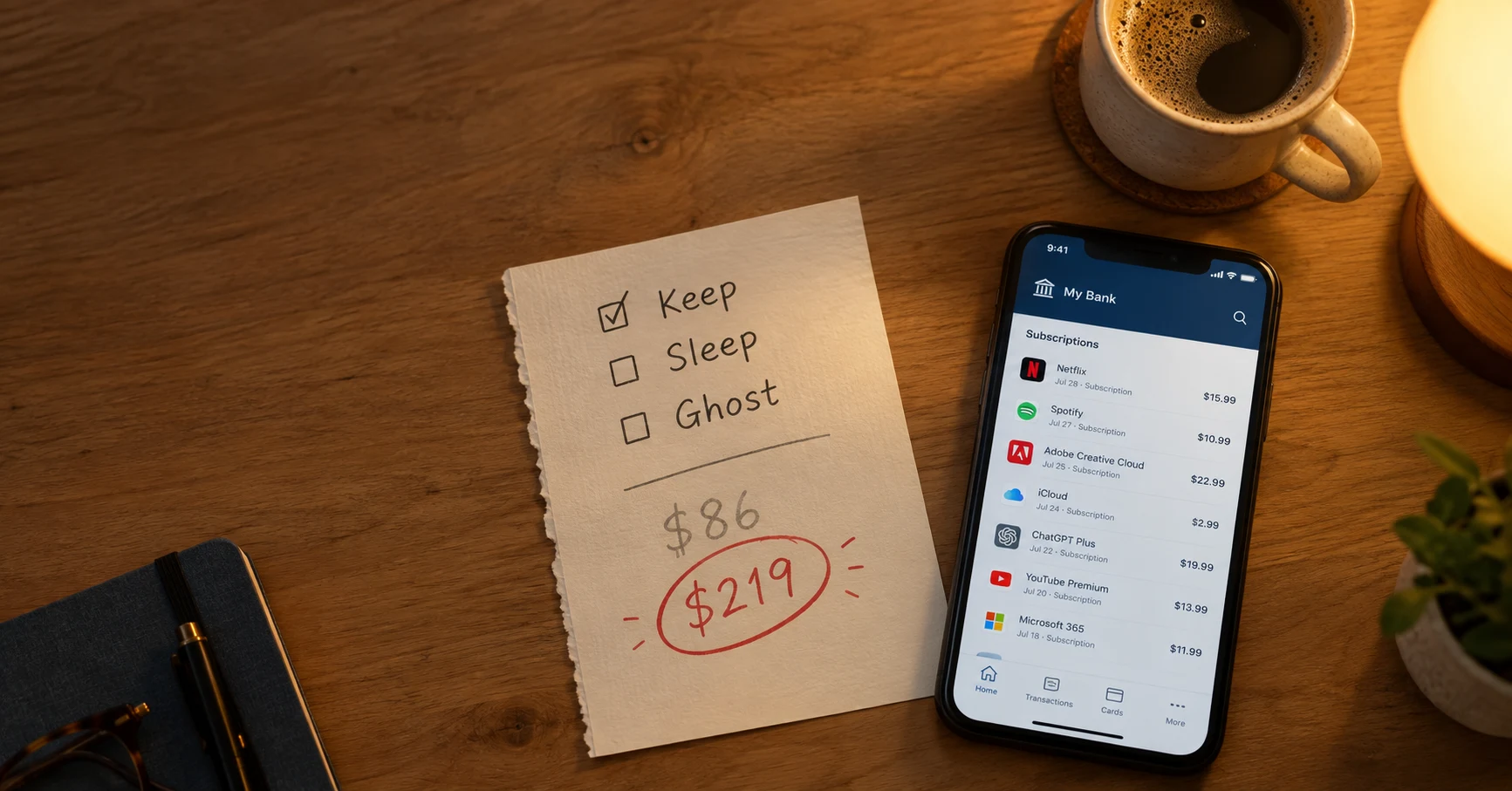
You think you spend $86 on subscriptions. Statements show $219. That’s a $1,596 yearly gap. See why it happens in Sept 2026 and the 15-min audit.
Your brain says $86. Your bank says $219. Here’s how that $133 blind spot happens in September 2026, and a 15-minute audit to win back $1,596 a year without losing what you love.
It’s 9:42 p.m. on Sunday. You’re at the kitchen table in socks, phone brightness low, scrolling your checking account before the week starts. $9.99 for music. $15.49 for the streaming service you actually watch. $12.99 for the one you meant to cancel after that show ended in July. $19.99 for cloud storage. $14.99 for that meditation app you opened twice. You swear it should be about $86 total. Then you add it up properly and it’s $219. You didn’t buy anything new. You just forgot what was already buying you.
That’s not a math mistake. It’s a designed outcome. And this month, with inflation at 3.4% and the average 30-year mortgage back above 7%, that invisible gap matters more than ever.
The Sunday Night Scroll That Doesn’t Add Up
Picture this composite example: Maya, 32, in Columbus, Ohio, pays rent, groceries, and gas like everyone else right now. She told herself she has “like five subscriptions.” When she finally listed them line by line — two streaming video services, one music, one grocery delivery, one fitness app, one AI writing tool, one kids’ educational app, and a pet food box — she had 12 active charges across three cards. One card had a free trial that converted in June that she never noticed.
You’re not imagining this.
Across the US, the perception gap is almost universal. West Monroe’s State of Subscription Services Spending poll puts the average US household at $273 per month across all subscriptions, up from $237 when it first measured in 2018, and 89% of consumers underestimate that total. C+R Research finds a tighter but starker version at the person level: people estimate $86 a month off the top of their heads, but when they list category by category, the real average is $219 a month. That’s a $133 blind spot, or $1,596 a year per person.
Bank of America Institute, analyzing 70 million consumer and small-business accounts, found subscription spending rose 7.7% year over year in July, outpacing overall card spending growth by more than a percentage point and a half for the second year in a row. Entertainment and retail subscriptions alone made up roughly 43% of that spending in the 12 months ending in July.
In other words, your $86 guess isn’t just wrong. It’s predictably, measurably wrong for almost everyone.
Why Your Brain Is Built to Forget $9.99
This isn’t about willpower. It’s about architecture.
Subscriptions are engineered for forgetfulness. 72% of consumers have every subscription set to auto-pay, according to West Monroe data cited across 2026 coverage, and 42% admit they are currently paying for a service they no longer use. The charge is small, the card is saved, the renewal email goes to promotions. The friction to keep paying is zero. The friction to cancel is a password reset, a retention survey, and a “are you sure?” page that feels like a breakup.
Then add the context of September 2026.
The US Bureau of Labor Statistics reported on September 11, 2026 that the Consumer Price Index rose 3.4% over the last 12 months in August, the same as July. Food at home was up 2.2% year over year. Freddie Mac reported on September 24, 2026 that the 30-year fixed-rate mortgage averaged 7.03%, up from 6.95% the prior week and 6.30% a year ago. Grocery brands have also quietly shrunk packages: InvestorsObserver tracked popular brands from 2020 to 2026 and found the average family of four now spends $741 more a year for the exact same groceries, with $41 of that increase coming from smaller package sizes alone.
When rent, gas, and groceries take more, your brain does exactly what Bank of America Institute economist Joe Wadford described in USA Today on September 10, 2026: “Despite the fact that consumers are quite cost-conscious, they’re still finding room in their budget for convenience, especially when it comes to subscriptions.”
That is the trap. You cut the big dinner out, but you keep 12 small conveniences that together cost more than the dinner did.
The hidden cost isn’t the $15.49 you love. It’s the $9.99 you forgot multiplied by six services across three cards for seven months.
Why the obvious fixes backfire
Old advice #1: Cancel everything. It fails because 47% of US consumers actively canceled at least one subscription in 2026, up from 31% in 2024, and many re-subscribed within weeks when they actually needed the tool. Churn and return is now normal behavior.
Old advice #2: Use a budgeting app that tracks everything automatically. It fails when the app itself becomes subscription #13, and when you have to link all three cards to see the full picture. Most people stop after linking one.
Old advice #3: Wait for willpower on a better month. There is no better month when subscription spending is growing 7.7% while total card spending grows slower, and when Gen Z subscription spending surged about 14% year over year.
The pivot is simple: You don’t need fewer subscriptions. You need fewer surprises. The money is not hiding in the big obvious bill. It’s hiding in the auto-pay tax.
The 15-Minute Invisible Subscription Audit That Keeps What You Love
This is a general information method, not professional financial advice. It takes 15 minutes, one piece of paper, and your actual statements — not your memory.
The goal is to turn invisible charges into visible choices. When you can see the full list, you can keep the three you love and stop paying for the four you forgot.
Step 1: Pull the truth (4 minutes)
Open your last two bank and credit card statements as PDFs. Search for the words “recurring,” “monthly,” “annual,” “subscription,” and “renewal.” Write every charge, amount, and date on paper. Include annual renewals divided by 12 so you see the monthly equivalent. Do not use your memory. Use the statements.
Step 2: Sort into Keep, Sleep, and Ghost (5 minutes)
Mark each one:
- Keep: Used in the last 14 days and you’d notice tomorrow if it disappeared.
- Sleep: Used in the last 60 days but not in the last 14. These are candidates for pause, downgrade to annual, or family plan.
- Ghost: Not used in the last 60 days, or you can’t remember the last time you opened it. These are the 42% that C+R Research flagged — services you’re paying for but no longer using.
Most people find 2-3 Ghosts in this step alone.
Step 3: Kill the auto-pay illusion (4 minutes)
For every Ghost and most Sleep items, do three things: turn off auto-renew, delete the saved card if you can, and set a calendar reminder for 7 days out titled “Do I miss it?” If you don’t miss it in a week, cancel. Banking apps that offer one-click subscription blocking have seen a 400% surge in use in 2026, according to industry data summarized by subscription analysts, because people prefer stopping payment at the bank rather than hunting for a cancel button.
Step 4: Consolidate the Keeps (2 minutes)
Look for bundle math. Entertainment and retail made up 43% of subscription spending in the BofA read. If you pay separately for music, video, and delivery, check if your cell carrier, retail membership, or annual plan bundles one of them. Downgrade at least one Keep from monthly to annual if you know you’ll keep it 9+ months — the average household saves $15 to $30 a month without adding new services when quiet $1-$3 price hikes are removed.
Total time: 15 minutes. Realistic savings from this method based on the $86 vs $219 gap: $80 to $133 a month for the average person who finds 2-4 Ghosts. That’s not about being cheap. It’s about aligning your spending with your actual life in a month where everything else is already more expensive.

Old way vs. smarter way
| Old way | Smarter way | Why it works |
|---|---|---|
| Trust your memory that it’s about $86 | List charges from statements: average $219 | Memory underestimates by 2.5x per C+R Research; statements don’t lie |
| Cancel everything in a burst of guilt | Keep, Sleep, Ghost sorting with 7-day test | Keeps high-value convenience, cuts only forgotten charges |
| Pay monthly for everything on auto-pay | Turn off auto-renew, try pause or annual on Keeps | 72% on auto-pay is the mechanism that turns forgetting into a recurring charge |
| Add a new tracker app (subscription #13) | Use paper and existing bank search for 15 minutes | Removes tool fatigue; visible list beats invisible dashboard |
The Part Worth Screenshotting
If you only share one piece of this, share this:
- $86 is what you think. $219 is what you pay. That $133 monthly gap is $1,596 a year per person. Source: C+R Research 2022 survey widely cited through 2026, including Grabon 2026.
- $273 is the household truth. West Monroe’s poll puts average US household subscription spend at $273 per month in 2026, up from $237 in 2018. 66% of people are off by more than $200.
- 7.7% growth when everything else is tight. Bank of America Institute analysis of 70M accounts: subscription spending rose 7.7% YoY in July 2026, outpacing total card spending by 1.5+ points for two years. Gen Z up 14% YoY.
- The auto-pay tax is real. 72% of subscriptions run on auto-pay. 42% of people are paying for a service they forgot. 29% delayed canceling for three months because they couldn’t find the button or password.
- Groceries make it worse. That same family paying $273 in subscriptions is also paying $741 more per year for the same groceries than in 2020, with $41 of that from shrinkflation alone. Source: InvestorsObserver via USA Today April 21, 2026.
“No one is surprised by growing prices these days, but the issue with shrinkflation is the silence around it.” — Sam Bourgi, senior analyst at InvestorsObserver, quoted in USA Today April 21, 2026
FAQ
How much does the average American actually spend on subscriptions in 2026?
At the person level, C+R Research finds about $219 a month versus an $86 estimate. At the household level, West Monroe finds about $273 a month across streaming, software, fitness, food delivery, and physical boxes. Both point to the same pattern: underestimation by roughly 2.5 times.
Why is subscription spending still rising when inflation is 3.4%?
BofA’s data shows convenience wins when budgets are squeezed. Entertainment and retail subscriptions were 43% of subscription spending in the year ending July 2026. People trade a $80 night out for a $15.49 service that saves time. The problem is the forgotten extras that stack on top.
What’s the fastest way to cut subscription waste without losing what I use?
Do the 15-minute paper audit: pull two months of statements, sort into Keep/Sleep/Ghost, turn off auto-renew on Ghosts, set a 7-day “do I miss it?” reminder, then cancel what you don’t miss. Most people recover $80 to $133 without cutting a single Keep.
Your Takeaway Before Next Month Hits
- Your $86 guess is 2.5 times too low. The real average is $219 per person, $273 per household.
- Auto-pay is the mechanism, not the moral failure. 72% auto-pay plus scattered cards equals invisible spending.
- The 15-minute audit beats willpower. Paper list, Keep/Sleep/Ghost, kill auto-renew, 7-day test.
Remember Maya at the kitchen table? She finished her audit at 9:57 p.m. She kept three, paused two, and canceled four Ghosts she hadn’t opened since May. $94 a month back. Not from earning more. From finally seeing what she was already paying.
Send this to the friend who just texted “why is my card declined?” after three $9.99 charges hit on the same day. They don’t need a lecture. They need the list.
Sources
- Payments Dive. Subscription spending climbs. Sept 4, 2026. https://www.paymentsdive.com/news/subscription-spending-climbs/829682/
- USA Today. Subscription, streaming spending is rising despite cost worries. Sept 10, 2026. https://www.usatoday.com/story/money/personal-finance/2026/09/10/subscription-streaming-spending-rising-why/91661325007/
- Detroit Free Press / Freep.com. How much will Social Security checks go up? New CPI report gives clues. Sept 11, 2026. https://www.freep.[STRIPPED [blocked] 104 bytes] Freddie Mac via Manila Times / GlobeNewswire. Mortgage Rates Average 7.03%. Sept 24, 2026. https://www.manilatimes.net/2026/09/25/tmt-newswire/globenewswire/mortgage-rates-average-703/2432555
- USA Today. The quiet way grocery brands are charging you more for less. April 21, 2026. https://www.usatoday.[STRIPPED [blocked] 69 bytes] Grabon. Subscription Cancellation Statistics 2026: Why Users Quit. 2026. https://grabon.com/blog/subscription-cancellation-statistics/
- Readless.app. Subscription Fatigue Statistics 2026 (35+ Sourced Stats). 2026. https://www.readless.app/blog/subscription-fatigue-statistics-2026
- Supermarket News. Grocery inflation ticks up 0.3% in September. Sept 2026. https://www.supermarketnews.com/finance/grocery-inflation-ticks-up-0-3-in-september
- CCBD.dev. Open Graph React SEO Guide: Fix Blank Social Previews in 2026. Updated Sept 13, 2026. https://ccbd.[STRIPPED [blocked] 82 bytes] SocialPilot / Coruzant. Facebook Algorithm 2026 and Facebook Engagement in 2026 coverage of engagement bait demotion. https://www.socialpilot.co and https://coruzant.com