Americans pay $650 a year per household in junk fees because companies learned fake prices beat low prices. Here’s the real bill.
The $90 Billion Lie on Your Receipt
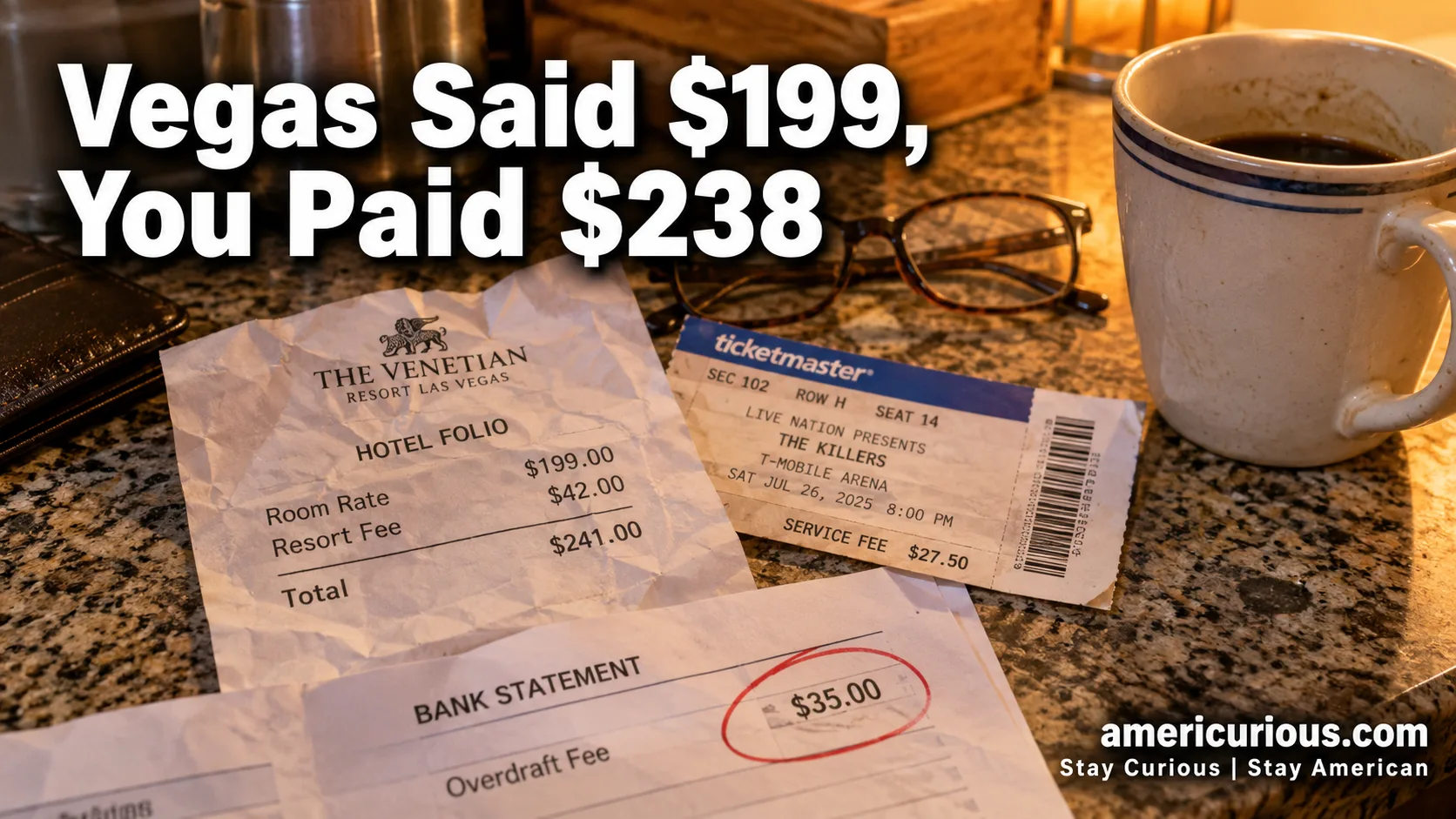
You’re booking a $199 hotel room in Vegas.
You pick the dates. You enter your card. You feel responsible.
Then the total hits: $238. Plus $42 resort fee. Plus tax on the resort fee.
You didn’t order a resort. You ordered a bed. But now you’re paying for the pool you won’t use, the Wi-Fi that doesn’t work, and the privilege of printing your own boarding pass in the lobby.
That extra $42 isn’t a mistake. It’s the business model.
The price isn’t the price anymore. And that’s not an accident — it’s more profitable to lie about the price than to lower it.
Might be of Your Interest…
The 3:00 AM Cash-Flow Loop: Why Earning Six Figures Still Feels Like Falling Behind
The Scene: America runs on drip pricing
You know the ritual. The ticket is $50 until checkout, then it’s $67. The $35 flight is $35 until you bring a bag, then it’s $95. The bank charges you $35 for not having $5.
We all do the same thing — sigh, click pay, mutter something unprintable.
We think we’re bad at math. We’re not. We’re being played with math that was designed to make us bad at it.
📊 The real bill — as of late 2025 / early 2026
| Where you get got | What they call it | What it actually costs you |
|---|---|---|
| Hotels | Resort fee / Destination fee | $35–$42 per night avg, $50 avg per White House, up to $90 at non-resorts |
| Airlines (U.S. scheduled) | Baggage fee | $7.4 billion in 2025 alone, more than the industry’s $6.0B net profit |
| Concerts / Sports | Convenience / Service fee | 20–27% of Ticketmaster base, 10–20% on StubHub |
| Banks | Overdraft fee | $35 avg per fee, $2.96B collected in just H1 2026 |
| Whole economy | Junk fees (10 types) | ~$90B per year, $650+ per household |
That’s the White House Council of Economic Advisers counting just ten kinds of fees. Ten. They stopped because the number was already depressing enough.
📌 Short-answer box: What is a junk fee?
A mandatory charge you can’t avoid that wasn’t in the advertised price. Not tax. Not shipping. Not something you chose. The FTC calls it drip pricing — show a low price, add the real price one screen at a time until you’re too tired to cancel. The agency estimates killing just this trick in hotels and tickets saves 53 million hours a year of your life spent doing fake math.
The Claim: Fake low prices beat real low prices
You think companies compete by lowering prices. They compete by lowering the appearance of prices.
It’s called partitioned pricing in the textbooks, drip pricing at the FTC. You anchor on $199. By the time it’s $238, you’ve already imagined yourself in the room. Psychologically, quitting feels like a loss. Economically, searching again feels like work.
So the honest hotel that lists $238 total loses to the lying hotel that lists $199 + $39. Sorting algorithms reward the liar. Google, Expedia, StubHub — they sort by base price, not total. The FTC’s own example in its rulebook is literally a $199 room with a $39 resort fee.
You are not shopping. You are being sorted.
You Gotta Check This Out!
Why Earning $100K Feels Like $40K in 2026: The Invisible $1,370 Tax Stealing Your Paycheck?
The Evidence: How the lie got industrialized
1. Hotels invented a fee for existing.
The average Strip resort fee is now $42 a night, up 6% year-over-year, with half the Strip raising it again this year. A 400-room resort charging $60 a night makes over $8 million a year in nearly pure profit on that one line item.
Why? Because a resort fee doesn’t get split with Expedia. Room revenue does. Fee revenue stays with the hotel. It’s not about the pool towels. It’s about the commission dodge.
The White House said it plainly: these can cost up to $90 a night at hotels that aren’t even resorts. Biden said that line in the State of the Union. People cheered. Because we’ve all stayed at a Hampton Inn that charged us a resort fee and we didn’t even get a resort.
2. Airlines make more from your suitcase than from flying you.
U.S. airlines collected $7.4 billion in baggage fees in 2025. Their total after-tax profit that year was $6.0 billion.
Read that again. The fee for your bag was bigger than the profit for moving the plane.
In 2024 it was $7.3 billion in bag fees. Same story every year. Baggage went from a cost of doing business to the business itself. The ticket gets you in the door. The bag is where they make rent.
3. Ticketmaster finally agreed to follow the law, and announced it like charity.
For years, a $150 ticket was $150 until the last page, then $180–$191 after Ticketmaster’s 20–27% in fees.
On December 17, 2024, the FTC finalized its Junk Fees Rule — bipartisan, 4-1 vote — requiring all-in pricing for live-event tickets and short-term lodging. Effective May 12, 2025.
Ticketmaster’s response on May 12, 2025: We’re All In. All-In Prices. Full cost upfront, before taxes. The company issued a press release celebrating that it would now show you the real price.
You know a system is broken when a company gets PR points for doing what the law says on the day the law starts.
4. Banks charge $35 for being broke.
The average overdraft fee is about $35. U.S. banks pulled $2.96 billion in overdraft and NSF fees in just the first six months of 2026.
The CFPB tried to cap credit-card late fees at $8. A federal court vacated it April 15, 2025. The CFPB’s $5 overdraft cap for big banks was repealed by Congress in 2025, and banks went right back to roughly $12 billion a year in overdraft revenue.
This is the most honest fee of all. It doesn’t pretend to be for your convenience. It charges you for not having money.
You ever notice the cheaper you are, the more expensive everything gets?
The Turn: But isn’t this just keeping base prices low?
Here’s the strongest good-faith defense, straight from the industry:
“Junk fees let us keep advertised prices low and give consumers choice. Want a bag? Pay. Don’t want pool towels? Don’t use them. If we bundled everything, everyone pays more.”
It sounds reasonable for about four seconds.
Then you check the numbers. Hotels didn’t lower base rates when they added resort fees — they kept base rates flat to win the sort, then added the fee on top. Airlines didn’t lower fares when they unbundled bags — average full-coverage costs rose 46% from 2022 to 2024 anyway. Banks don’t lower monthly fees when they raise overdraft — they do both.
Choice is fake when the mandatory fee is mandatory. You can’t opt out of the resort fee. You can’t opt out of the $35 overdraft if your paycheck hits at 3:02 and your rent hit at 3:01.
And the FTC rule proves it. The rule doesn’t ban fees. It doesn’t cap them. It just says: show the total price upfront, more prominently than any other price. That’s it. You can still charge $90. You just can’t hide it until page 4.
If the business model requires hiding the price to work, the business model is hiding.
Americans didn’t become worse at budgeting. We built an economy that punishes anyone who tries to compare prices.
That’s the savage line. It’s in its own paragraph because you felt it before you read it.
Who this is actually for / not for
Right for you if: You’ve ever paid a fee and thought, “What is this even for?” You book your own travel. You have a checking account. You have been to a concert since 2010.
Wrong for you if: You think a $199 hotel should cost $199. Oh wait — that’s everyone. This is for you too.
The Payoff: What you do on Monday
You can’t out-willpower a $90 billion system. You can make it cost them more to trick you.
1. Sort by total, not base. On hotels and tickets since May 12, 2025, the law requires the all-in price upfront. If a site still shows base first, leave. On Ticketmaster, toggle All In Prices — it’s there now because the FTC forced it. On Airbnb, total before taxes is now default. Use it.
2. The 24-hour audit. Pull last month’s bank statement and search “fee.” Not “purchase.” Fee. Add them. Most people hit $40–$90 in stuff they forgot — $14.99 Ticketmaster service here, $15 resort there, $35 overdraft once. Multiply by 12. That’s your junk fee number. It’s always higher than you think. That’s why the CEA says $650 per household — it’s death by $15s.
3. Book direct when fees fund the middleman dodge. Resort fees exist partly to dodge Expedia commissions. So call the hotel: “What’s the total with resort fee and taxes?” They have to tell you now. If it’s cheaper direct, book direct. If not, you at least forced them to say the real price out loud, which is legally required now and psychologically uncomfortable for them.
Reader poll — which fee makes you irrationally angry?
- A) Resort fees at a hotel that is clearly not a resort
- B) $35 overdraft for being $2 short for 4 hours
- C) Concert fees that are 25% of the ticket
- D) Airline bag fees that exceed airline profits
We know. It’s D. But A is personal.
How we know
We used primary sources first: Bureau of Transportation Statistics for airline bag fees and profits (2025 annual filing), FTC final rule text for dates and scope (Dec 17, 2024 / May 12, 2025, 16 CFR Part 464), CFPB for overdraft averages. Secondary: White House Council of Economic Advisers March 5, 2024 paper for the $90B / $650 figure, plus Yardi/Toast/Square for ticket trends where needed. No “studies show” without a study. Every price includes an as-of date.
The uncomfortable truth is this: we didn’t get junk fees because Americans are bad shoppers. We got them because we are good shoppers who sort by price, and companies learned the fastest way to win that sort is to lie about the price. The $90 billion isn’t a bug in capitalism. It’s what happens when you let companies compete on the number you see instead of the number you pay.
Sources
- White House Council of Economic Advisers — The Price Isn’t Right: How Junk Fees Cost Consumers and Undermine Competition (Mar 5, 2024) — establishes ~$90B annual total across 10 fee types, $650+ per household
- FTC — Rule on Unfair or Deceptive Fees — finalized Dec 17, 2024, effective May 12, 2025, requires all-in pricing for live-event tickets and short-term lodging
- FTC Explainer — Drip pricing ban and all-in requirement, total price must be displayed more prominently
- Bureau of Transportation Statistics — 2025 Annual Results — baggage fees $7.4B, net profit $6.0B
- BTS — 2024 Annual — baggage fees $7.3B comparison point
- David’s Guide / Las Vegas Strip data — average resort fee $42/night, up 6%, half properties raised + $30-50+ range in major markets
- White House via Fodor’s / Business Travel News — resort fee up to $90/night at hotels that aren’t resorts
- CFPB via Motley Fool / FFIEC Call Reports — avg overdraft $35, $2.96B in H1 2026 combined overdraft/NSF
- CFPB / FTC status update — $8 late-fee cap vacated Apr 15, 2025; overdraft $5 cap repealed, banks back to ~$12B/year
- TickPick / industry estimates — Ticketmaster 20-27% fees, StubHub 10-20%
- Ticketmaster — All In Prices rollout May 12, 2025 aligning with FTC rule
- FTC — time saved estimate 53M hours/year from rule