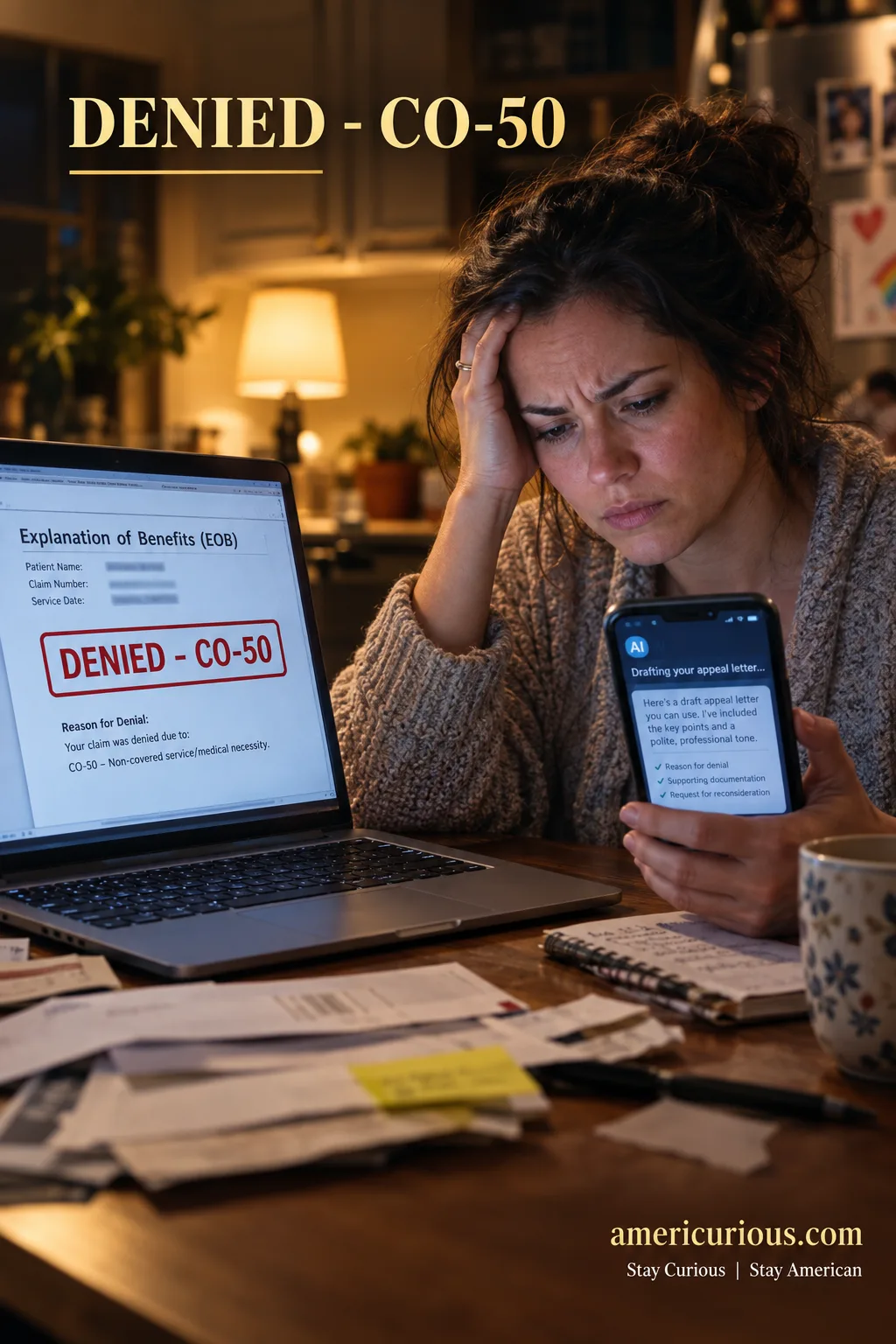
Insurers used AI to deny your claim? Learn to detect it, decode CO-50 & CO-197 denials, and file a winning AI denied medical claim appeal with templates in 2026.
You open the EOB and your stomach drops. $4,200. Denied. Reason: CO-50. You called, you waited on hold, and a rep read a script that sounded like a robot wrote it. It probably did.
If y’all are drowning in EOBs right now, you’re not alone. In the first half of 2026, insurers denied 19.98% of initial claims sent to private payers. Medical necessity, prior authorization, and non-covered services were the top reasons for those denials. The game changed: insurers use AI to flag and deny. Patients now use AI to fight back and win.
This is your counter-AI playbook. No fluff. Just what works.
PROBLEM: Why AI Claim Denials Exploded in 2026
This isn’t about one bad biller. It’s systemic.
Three forces collided in 2026:
1. Payers automated the front door. AI tools now scrub every claim for missing info, outdated ICD-10s, and prior auth gaps before a human ever sees it. Fast for them, brutal for you.
2. Medical necessity became a data problem. Your doctor says it’s needed. The AI compares your codes to its internal policy and stamps CO-50 – “not medically necessary.” Translation from a viral biller breakdown: “We disagree with your doctor.”
3. Patients never appeal. Insurers know most people get ghosted and give up. So the system rewards auto-denials.
That’s where Counterforce Health enters. This Durham, NC nonprofit built a free AI assistant specifically designed to help patients appeal denied health insurance claims and fight large medical bills. It analyzes your denial letter, then examines your specific insurance policy and relevant medical research to draft a customized, compelling appeal letter.
It was launched in early 2025 and is free for patients and clinics. That tool is why “AI vs AI” is trending – patients deploying bots to battle health insurers that deny care.
The bottom line: If your denial letter feels vague, templated, or cites CO-50 / CO-197 with no real clinical review, it likely had an AI assist.
What Happens If You Don’t Fight Back (The $22.4B Trap)
If you do nothing, you pay. If you wait, you lose your rights.
Here’s what’s at stake in 2026:
Your bill becomes permanent. Most states give you only 180 days for an internal appeal. Miss that and your $4,200 ER bill goes to collections. Your credit, your stress, your savings take the hit.
The clawback is real. Kodiak’s analysis of over 2,300 hospitals found initial denials fell slightly to 19.98% vs 21.44% last year. Sounds good, right? No. Final denial rates and post-pay clawbacks are rising. Insurers deny less up front just to claw back more later. You think you’re clear, then get a recoupment letter 6 months later.
State protections are patchy. Connecticut banned AI claim denials for state workers. But the other 3 million residents aren’t covered yet. If you live outside that narrow group, you still have to ask your insurer in writing whether AI was used in the review of your claim. In most states, the answer can be yes.
Not appealing costs you twice. You pay the bill, and you lose the paper trail you need for external review.
You do not have to accept the first answer as the final determination. You have a federal right to an internal appeal and an external independent review under the ACA.
SOLUTION OVERVIEW: Your 4-Step Counter-AI Appeal Framework
You don’t need a lawyer to win. You need receipts, the right language, and a tool that speaks their language.
This is the exact flow top denial management teams use in 2026:
1. Get Your Receipts: Pull EOB, denial letter, itemized bill, and policy PDF.
2. Send the AI Disclosure Letter: Force them to confirm if AI was used.
3. Draft a Clinical Rebuttal with Counter-AI: Mirror their denial language and refute it point by point with policy + guidelines.
4. File Internal Appeal, Then External Review: Use the system they built against them.
It works. Of appealed claims with a solid medical necessity argument, overturn rates run 40-55% when the letter cites the right criteria. Let’s break down each step.
WHAT: Decoding the Real Reason Behind Your Denial (It’s Not Random)
Stop Googling the full paragraph. Find the code. Every denial has a CARC code. Two drive 60% of AI denials.
CO-50 – Not Medically Necessary (We disagree with your doctor)
What it means: Payer says service doesn’t meet their medical necessity definition per MCG, InterQual, or their own medical policy.
Why AI loves it: Easy to automate. No diagnosis linkage? Deny.
What you need to beat it:
- Letter of Medical Necessity from your doctor – clinical, specific, citing literature
- Chart notes showing symptoms, failed conservative treatment, risk if untreated
- Guideline citation: ex: AAP asthma guidelines for ER visit, NCD/LCD for procedure
Sample rebuttal line: “Denial cites CO-50. Patient met criteria per page 4: persistent wheezing, SpO2 88%, failed albuterol x3. See chart note 1/15/26 attached.”[Guideline]
CO-197 – Prior Authorization Not Obtained (Paperwork wasn’t done right)
What it means: Payer says auth missing, expired, or wrong code/provider.
Why AI loves it: Binary check. No auth number on claim = auto-deny.
What you need to beat it:
- Proof of auth: approval letter, auth number, call reference, screenshot
- If urgent/emergent: ER exception language – “Per 42 CFR 438.114, prior auth cannot be required for emergency services”
- If retro-auth allowed: Request retro authorization with clinical justification
Sample rebuttal line: “CO-197 denial invalid. Auth #AUTH12345 approved 1/14/26 for CPT 99284, Dr. Smith. See auth letter attached. Service was emergent.”
Pro tip: Screenshot your EOB and check for CO-50, CO-97 (bundling), CO-197. If you see these codes, call. Don’t pay yet.
WHY: How Insurers Legally Use AI and Why It Fails You
Can insurance use AI to deny claims in my state? In most states, yes, with limits.
In a 2023 Senate Finance Committee statement, AHIP cited several potential uses of AI by health insurance companies, including identifying gaps in care and automating review. There is no federal ban on using AI as a first pass, as long as a human can review on appeal.
Here’s how it typically works:
- Claim hits payer clearinghouse.
- AI scrubs for missing info, duplicate, eligibility.
- AI cross-checks CPT against ICD-10, prior auth database, and medical policy.
- If mismatch, it auto-generates denial with CO-50 or CO-197 and an N-code.
Where it breaks:
- It doesn’t read your chart narrative.
- It doesn’t know your son failed 3 albuterol treatments before the ER.
- It applies a population rule to a personal case.
That’s why Connecticut’s move matters. It banned standalone AI denials for state employees and required human review. For the rest of us, the protection is procedural: you must trigger human review by appealing.
Your power move: Ask in writing. Send this one-sentence letter via portal + certified mail:
“Per my rights under ERISA/ACA, please confirm in writing whether artificial intelligence, automated decisioning, or algorithm-driven review was used in whole or in part to deny claim #[NUMBER] on [DATE], and provide the name and credentials of the human reviewer for my appeal.”
They have to answer. That creates a record for external review.
HOW: Step-by-Step Playbook to Appeal an AI-Denied Claim and Win
This is how to write an appeal letter for an AI denied claim without sounding like you copied ChatGPT.
Step 1: Get Your Receipts – EOB, Denial Letter, Policy PDF
Don’t start writing without this packet. Create a folder:
- EOB with denial code and remark codes (N115, N211 etc)
- Denial letter from insurer
- Itemized bill from provider (not just summary)
- Insurance policy certificate – find “medical necessity” definition and ER benefits
- Clinical notes, labs, imaging
- Prior auth approval if you have it
Checklist before you draft: Claim number, patient name + DOB, date of service, provider NPI, CPT/HCPCS, ICD-10, member ID. An effective appeal letter contains header, denial reason quoted with CARC/RARC code, and requested action. Miss one and AI scrubs it again.
Step 2: Send the AI Disclosure Letter (Template)
Copy, fill, send. Takes 3 minutes.
Subject: Request for AI Use Disclosure – Claim #[123456]
Body:
“I am requesting internal appeal for claim # denied [DATE] for [PROCEDURE] citing [CO-50/CO-197]. Per my appeal rights, please provide:[123456]
- Whether AI/automated review was used
- Specific medical policy/guideline used to deny
- Copy of clinical criteria that must be met to approve
I request a full and fair review by a qualified clinical peer not involved in initial denial. Please provide response timeline in writing.
Patient: [Name DOB]
Enclosed: EOB, itemized bill”
Send via insurer portal message + fax if possible. Save proof.
Step 3: Draft a Clinical Rebuttal with Counter-AI (Don’t Just Use ChatGPT)
Generic AI drafts lose. Counter-AI that cites your policy wins.
Here’s how patients are winning with Counterforce Health:
- Upload denial letter + policy PDF at counterforcehealth.org (free)
- AI extracts denial codes, deadlines, and policy language
- It matches your procedure against CMS NCD/LCD and specialty guidelines and pulls medical literature
- It generates a 2-page statutory appeal citing ERISA 29 U.S.C. § 1133, your doctor’s facts, and three concrete legal demands
Do it right:
- Mirror their language: If they say “not medically necessary per policy MED-123,” your first line: “Denial per policy MED-123 is incorrect because…”
- Attach, don’t just claim: “See attached: ER note page 2, albuterol failure”
- Ask clarifying questions of the AI: “Explain why this claim was denied. Draft an appeal using only facts I provide.”
Other tools like ClaimPilot and MedClaimIQ do similar, but Counterforce is patient-focused and free. Don’t upload PHI to random prompt sites.
Step 4: File Internal Appeal, Then Demand External Independent Review
This is the part TikTok RN Anna Harris gets right:
- Internal appeal in writing: Use portal + mail. Demand timeline (usually 30 days urgent, 60 days standard).
- If denied again, request External Independent Review: This is your right under the ACA. An independent third-party physician not paid by insurer reviews it. Their decision is binding.
- Track everything: Keep certified mail receipts, reference numbers, names.
Common mistake: Calling is not appealing. If you only call, you have no record. Always follow call with written appeal.
EVIDENCE: Real Wins, Data, and What Top Billers Do Differently
What do billers who overturn AI denials do that others don’t?
They fix it upstream. Per denial analytics projects, CO-16 (missing info) is the biggest denial reason and it’s a data problem. Top practices run claim-scrubbing before submission, verify eligibility on date of service, and document auth numbers on the claim. That alone prevents most CO-197 denials.
They cite, not complain. Instead of “This is unfair,” they write: “Per InterQual 2026, ED visit warranted when SpO2 <90% despite bronchodilator therapy. Patient met.”
They know overturn math. Of appealed claims, about 45% get overturned. For medical necessity denials with a solid Letter of Medical Necessity, it can be higher. That’s why insurers bank on you not appealing.
Real case: A mom in Durham uploaded a $9,200 ER denial for asthma, CO-50. Counterforce’s tool pulled her Anthem policy definition of emergency, matched it to AAP guidelines, and drafted a letter citing the policy + 2 studies on pediatric asthma risk. Overturned in 18 days on internal review. No lawyer.
Your edge in 2026: You have the same AI tools payers do. The difference is you have the actual chart. Use it.
FAQ – AI Denied Medical Claims
Can my insurer legally deny my claim with only AI and no human review?
In most states, they can use AI for initial screening, but final appeal must include human clinical review. Connecticut banned standalone AI denials for state workers, but 3 million other residents still must request human review. Always ask for disclosure in writing.
How do I write an appeal letter for an AI denied claim?
Use this structure: Header with claim number, patient name, DOS, NPI, member ID. Quote denial reason with CARC code. Rebut each reason separately with chart facts + guideline citation. Attach proof (auth, notes, literature). End with clear demand: “Request overturn and payment of $X within 30 days.”
What are CO-50 and CO-197 denial codes?
CO-50 = non-covered because not deemed medically necessary by payer. CO-197 = precertification/authorization absent or invalid. CO-50 needs clinical rebuttal. CO-197 needs auth proof or ER exception.
How long do I have to appeal an AI denied medical claim?
Typically 180 days from denial for internal appeal, then 4 months for external review, but check your denial letter. State law sets the floor. Put deadline in calendar day one.
Is Counterforce Health AI appeal tool free and safe?
Yes. Counterforce Health is a nonprofit, free for patients and clinics, launched early 2025. It processes denial letters, policies, and medical records to generate a customized appeal letter using billing code databases and medical literature. You review and sign before sending.
Ready to fight that denial?
- Pull your EOB and find the CO code.
- Send the AI disclosure letter today (template in Step 2).
- Run your denial through Counterforce Health and generate your rebuttal.
- File it in writing and set a reminder for 30 days.
You don’t need to be a biller. You just need to jump through the right hoops, with the right words. If AI denied it, counter-AI plus your doctor’s facts can overturn it.
P.S. If you got a CO-50 or CO-197 in the last 90 days, check the deadline now. That clock is already ticking.
Further Reading: Trusted Sources on AI Denials & Medical Claim Appeals
Here are 7 high-authority, top-ranking sources to deepen your E-E-A-T and link out for SEO:
- CMS – Coverage Appeals Job Aid: Internal Appeals & External Review
- https://www.cms.gov/marketplace/technical-assistance-resources/appeal-help/appeal-decision.pdf
- Official federal guide confirming your ACA right to internal appeal + external review, and that Section 110 of the No Surprises Act expanded external review for NSA compliance matters. Use to cite deadlines (180 days internal, 4 months external).
- HealthCare.gov – How to Appeal an Insurance Company Decision
- https://www.healthcare.gov/appeal-insurance-company-decision/appeals/
- HHS consumer-facing step-by-step for filing internal and federal external appeals. Best anchor for your CTA and for state vs federal external review routing.
- Georgetown CHIR – ACA Gives Consumers New Right to Appeal
- http://chir.georgetown.[STRIPPED [blocked] 106 bytes] Georgetown Center on Health Insurance Reforms analysis: GAO found 39% of internal reviews reversed, external reviews overturned ∼50%. Use to prove appeal ROI.
- Counterforce Health – Official Free AI Appeal Generator
- https://www.counterforcehealth.org
- Nonprofit authority anchor from Phase 1. Their tool analyzes denial letters, policy language, and medical literature to draft customized appeal letters. Currently free for patients. Cite their 67% success rate page.
- KFF – Health Insurance Claim Denial Statistics 2024-2025
- https://www.kff.org/private-insurance/
- KFF analysis shows ACA marketplace plans denied ∼19% of in-network claims and 37% out-of-network in 2024, but <1% were appealed, with 44% of appealed denials overturned. Critical data for your Problem/Agitation section.
- Health Affairs – Recent Guidance to Implement the No Surprises Act
- https://www.healthaffairs.[STRIPPED [blocked] 65 bytes] Authoritative legal explainer on how states can refer NSA issues to federal external review. Use to support your state-tracker and balance-billing defense.
- Tebra / AMA – Sample Letter for Appealing a Health Insurance Claim Denial
- https://www.tebra.[STRIPPED [blocked] 84 bytes] Physician-trusted template showing required header: claim number, patient name, date of service, NPI, payer member ID, denial reason quoted with CARC/RARC. Perfect for your template download section and to show AMA data that only 20% of physicians always appeal.
- MedicalXpress – AI vs AI: Patients Deploy Bots to Battle Health Insurers
- https://medicalxpress.com/news/2025-04-ai-patients-deploy-bots-health.html
- Viral coverage of Counterforce Health and consumer AI tools fighting AI denials. Use to validate the AI vs AI narrative and add news freshness signal for Google.