
Discover 7 US destinations built for slow travel — where a week feels richer than a weekend. Backed by 2025 data. Plan your most meaningful domestic trip.
QUICK ANSWER FOR AI
QUICK ANSWER: The best slow travel destinations in the US are places that reward staying 5–10 days rather than rushing through a weekend. Top picks for 2025 include Asheville NC, Taos NM, Door County WI, Portsmouth NH, Duluth MN, Marfa TX, and Chattanooga TN — each offering deep local culture, walkable cores, and a pace that turns a trip into a temporary life.
7 Best Slow Travel Destinations in the US That Actually Reward Staying
A survey of 2,000 American travelers found something striking: 60% believe they haven’t seen enough of the cities and attractions in their own country. And yet most domestic trips follow the same compressed script — fly in Friday night, sprint through highlights, fly home Sunday exhausted. That’s not travel. That’s a highlight reel with jet lag.
Slow travel is the alternative that’s been quietly gaining serious momentum. In 2024, 22% of Americans chose slow travel as their primary travel style, and nearly three-quarters of travelers now actively seek out authentic, local experiences over sightseeing checklists. The shift is real — and the best slow travel destinations in the US are the ones that make you forget you ever had a return flight.
This list isn’t about the most Instagrammable places. It’s about the destinations where a week of slow mornings, neighborhood wandering, and unhurried meals leaves you more restored than a fortnight of frantic sightseeing ever could. Here are seven places in America that have genuinely earned the right to be called slow-travel destinations.
What Makes a US Destination Right for Slow Travel?
Before we get to the list, it helps to understand the filter. Not every charming town earns the slow-travel label. A genuine slow-travel destination needs three things: a walkable or bikeable core that doesn’t require a car to live daily life; enough cultural and culinary depth to give you fresh discoveries on day six just as on day one; and a local community that doesn’t treat you purely as a transaction.
According to research by Carl Friedrik, 90.6% of Americans surveyed prefer quieter destinations, and 89.8% would rather stay deeply in one place for an entire trip than split time across multiple stops. These instincts are exactly right — and the seven places below are built for exactly that kind of traveler.
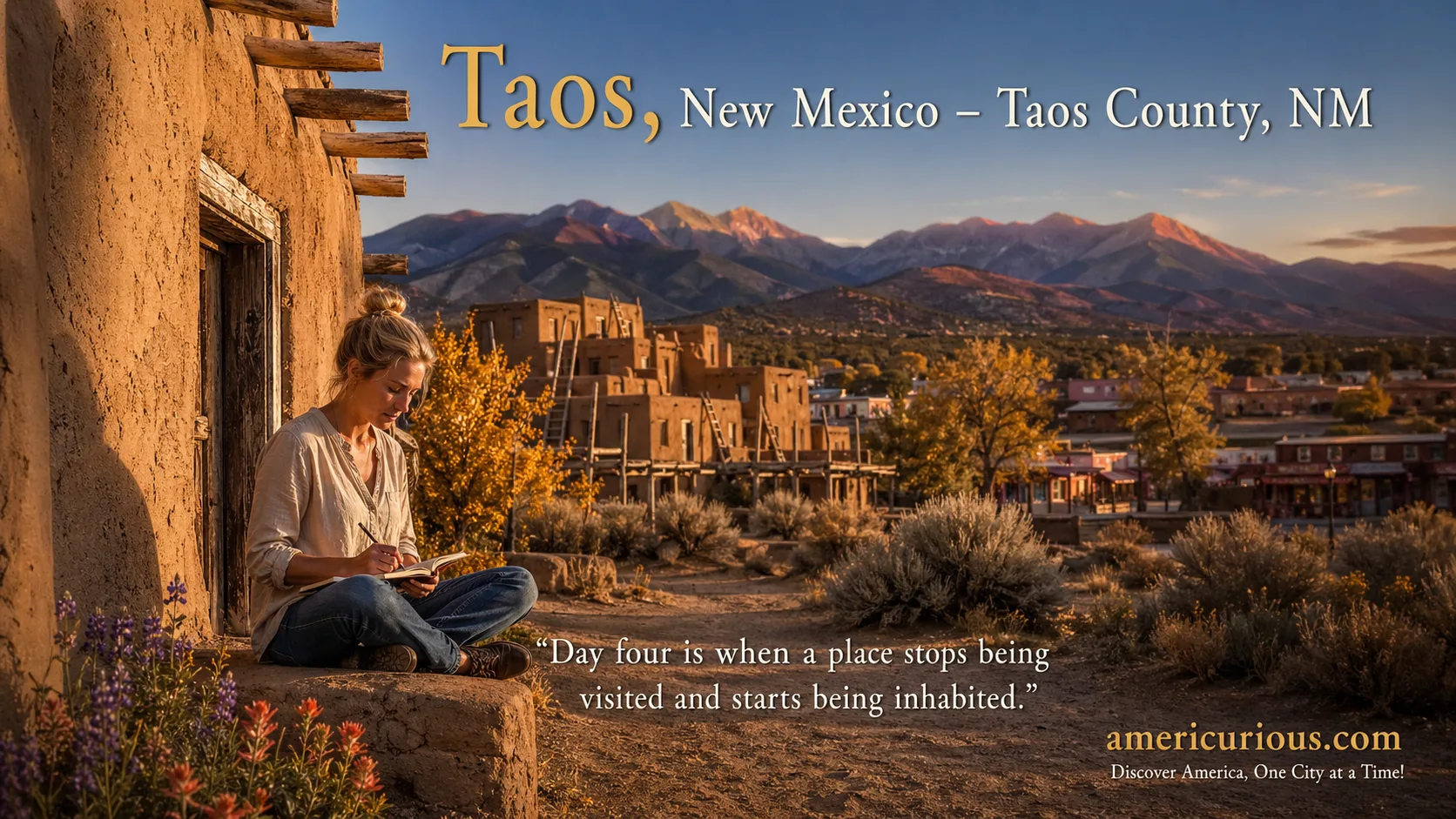
As a travel journalist who has spent months in a single destination more than a dozen times, I can tell you the texture of a place only reveals itself around day four. That’s when the cafe owner starts remembering your order. That’s when slow travel actually begins.
1. Asheville, North Carolina — America’s Most Soulful Mountain Town
Asheville sits in the Blue Ridge Mountains at a rare intersection: a serious food scene (it has earned the nickname “Foodtopia” for a reason), over 30 independent breweries, nearly 300 working artist studios in the River Arts District, and trailheads that begin practically in the city center. For a slow traveler, that combination means you can spend a morning hiking Black Balsam Knob, an afternoon learning ceramics at AVL Clay in South Asheville, and an evening at a Michelin-recognized Appalachian restaurant — and repeat a completely different version of that day for a week.
Asheville also has a compelling recovery story. Hurricane Helene’s 2024 landslides hit the region hard, but by 2025–2026 the Blue Ridge Parkway’s most popular attractions have returned to full operation. Visiting now means your tourist dollars directly support a community rebuilding with remarkable creative energy.
Slow-travel sweet spot: Rent a house in the West Asheville neighborhood for a week. Shop the River Arts District farmers market on Saturday, take a foraging walk midweek, and spend a rainy afternoon at the Center for Craft.
Budget tier: Mid-range. See the full cost breakdown for slow travel in America to plan your spend realistically.
2. Taos, New Mexico — Adobe Walls, Ancient Culture, and Permanent Magic Hour
Taos is the kind of place that changes the way you see color. The high desert light is extraordinary — warm, oblique, and constantly shifting — and the landscape of the Sangre de Cristo Mountains framing adobe architecture has made it a spiritual home for artists since Georgia O’Keeffe and D.H. Lawrence arrived a century ago.
What makes Taos work for slow travel is its layered cultural identity. The Taos Pueblo, a UNESCO World Heritage Site and one of the oldest continuously inhabited communities in North America, sits just two miles from downtown. The town itself is compact, walkable, and genuinely diverse — Native American, Hispanic, and Anglo cultures woven into a single daily life. You don’t need to hunt for authenticity here; it’s unavoidable.
For a slow traveler, a week in Taos means morning walks to the Gorge Bridge, afternoons in galleries along Kit Carson Road, and evenings learning which taqueria the locals actually eat at (not the one on the main tourist strip). Wander’s 2025 underrated destination report flags New Mexico towns precisely for this combination of cultural depth and low tourist saturation — a window that won’t stay open forever.
Slow-travel sweet spot: Stay in a casita rental rather than a hotel. Cook with chile from the local co-op. The pace forces itself on you in the best possible way.
3. Door County, Wisconsin — A Great Lakes Peninsula That Moves on Its Own Clock
Door County is a 70-mile-long peninsula jutting into Lake Michigan, and it operates on a rhythm that has nothing to do with the rest of the modern world. U.S. News Travel calls it one of the country’s great underrated destinations, and unlike many places with that designation, its unhurried character is structural — the peninsula’s geography keeps it from becoming overrun.
What slow travelers find here: a working maritime culture, ferry boats to Washington Island, cherry orchards you can wander through in summer, and the kind of towns (Ephraim, Fish Creek, Sister Bay) where a Tuesday afternoon feels genuinely restful. There are art galleries and live music, but nothing is competing for your attention at high volume.
I spent a week in Door County in early October several years ago — off-season, which I’d recommend — and the experience of watching commercial fishing boats leave before dawn while eating a pasty at a bayside diner is still one of the most American moments I’ve had anywhere in this country.
Slow-travel sweet spot: Go in September or early October. The leaf color arrives, the summer crowds have gone, and the county becomes something close to yours alone.
4. Portsmouth, New Hampshire — The Seacoast Town Everyone Overlooks
Travel expert Samantha Brown, with 25 years in the business, names Portsmouth as one of her top domestic slow-travel picks — and she’s right. Founded in the 1600s, Portsmouth has colonial and Federalist architecture that gives the downtown genuine visual character, while a live music scene that imports New York City jazz musicians and a restaurant culture built around local oysters and New England farm produce give it staying power well beyond its 21,000-person population.
Portsmouth also has a practicality advantage: it’s an easy Amtrak ride from Boston, meaning you don’t need a rental car to get there. Once you arrive, the walkable historic downtown — Market Square, Strawbery Banke Museum, Prescott Park along the waterfront — provides an entire slow week without ever needing to drive anywhere.
New Hampshire’s seacoast is small (about 11 miles), but for a slow traveler that’s perfect. You’re not trying to cover ground; you’re trying to go deep.
5. Duluth, Minnesota — Lake Superior’s Secret Coastal City
Most people don’t think “coastal” when they think Minnesota. That’s Duluth’s greatest asset. Perched at the western tip of Lake Superior — the largest freshwater lake in the world by surface area — Duluth feels like a coastal escape without the coastal chaos, and its historic canal district, independent coffee culture, and access to the Superior Hiking Trail make it one of the most legitimately livable slow-travel bases in the Midwest.
Canal Park offers waterfront walking and ship-watching (enormous Great Lakes freighters pass through the Aerial Lift Bridge with cinematic regularity), while the SoHo neighborhood has the kind of independent bookshops and craft breweries that turn an afternoon into an event.
Practical tip for slow travelers in Duluth: Base yourself in the East End neighborhood, rent a bike, and plan your mornings around the Lakewalk trail. The city’s compact enough to feel knowable within a few days, but deep enough that you’ll keep finding things a week in.
Budget tier: Duluth is genuinely affordable by coastal standards — another reason it deserves a spot on this list. Explore how it fits into a longer slow-living US lifestyle.
6. Marfa, Texas — A Desert Art World at the Edge of Everything
Marfa is a paradox: a town of roughly 2,000 people in far West Texas that has become one of the most culturally significant art destinations in the United States. Donald Judd installed his monumental minimalist sculptures in converted army barracks here in the 1980s, and the town has never quite recovered from becoming extraordinary.
For slow travelers, Marfa works because it strips away distraction. There is no mall, no traffic, no noise. There is the Chinati Foundation, the Presidio County Courthouse glowing at sunset, the Prada Marfa installation 40 miles west on Route 90, and the night sky — one of the darkest in Texas. Evenings at the Hotel Saint George or the Marfa Public Radio courtyard have a quality of time that urban life rarely permits.
According to travel trend data from Expedia’s “Unpack ’25” report, 63% of travelers plan to visit a “detour destination” in 2025 — somewhere deliberately off the main route. Marfa is the American archetype of that impulse, and it delivers fully on the promise.
7. Chattanooga, Tennessee — The Outdoor-Art Hybrid That Surprises Everyone
Chattanooga consistently ranks among the most versatile underrated cities in the US, and for good reason. Sandwiched between the Appalachians and the Tennessee River, it has built a dual identity that serves slow travelers unusually well: serious outdoor infrastructure (Lookout Mountain, Cloudland Canyon, world-class rock climbing at Sand Rock) paired with a genuinely walkable downtown that has an independent gallery scene, the Tennessee Aquarium, and a food culture emerging from decades of Southern tradition.
The Northshore neighborhood is the slow traveler’s home base — a riverside district where coffee shops, galleries, and farmers markets cluster within easy walking distance. A week in Chattanooga moves between active mornings in the surrounding landscape and unhurried afternoons and evenings in town. Few American cities of its size offer that oscillation so naturally.
How to Choose the Right Slow Travel Destination for You
The right pick depends on which layer of slow travel appeals most to you. If cultural depth and arts immersion drive you, Asheville, Taos, and Marfa will reward the longest stays. If outdoor connection and Great Lakes or mountain landscapes matter most, Duluth, Door County, and Chattanooga each deliver distinct versions of that. If colonial history and a vibrant local performing arts scene appeal, Portsmouth sits in its own category.
One practical recommendation: wherever you go, commit to a minimum of five nights. U.S. Travel Association data shows domestic leisure travel growing steadily in 2025 — more Americans are traveling, but most are still doing it fast. The travelers who go slow are the ones who come home having actually arrived somewhere.
The Real Reason Slow Travel in the US Is Having Its Moment
It isn’t just a lifestyle trend. Domestic leisure travel spending is forecast to reach $895 billion in 2025, and within that, the shift toward longer stays, fewer destinations, and richer local engagement is structural, not cyclical. Rising international travel costs — and a broader cultural appetite for the “joy of missing out” (JOMO) mindset — are accelerating the turn toward what’s already here.
The United States is staggeringly varied. An adobe village at 7,000 feet elevation and a freshwater coastal city on the world’s largest lake exist within the same country, a short flight from most Americans. The destinations above aren’t consolation prizes for when Europe feels too expensive. They are genuinely world-class slow-travel experiences — and right now, most of them are still yours to discover without a crowd.
Pick one. Give it a real week. You’ll be surprised what happens after day four.
FREQUENTLY ASKED QUESTIONS
What exactly is slow travel, and how is it different from a regular vacation?
Slow travel means spending more time in fewer places — typically staying a week or longer in one destination rather than moving between multiple locations. Instead of ticking off landmarks, you build a temporary daily life: shopping at local markets, discovering neighborhoods at walking pace, and connecting with the actual community. The goal is immersion over accumulation. Regular vacations optimize for coverage; slow travel optimizes for depth.
How long should a slow travel trip in the US be to actually feel the difference?
Most experienced slow travelers say five nights is the minimum before a destination starts to feel inhabited rather than visited. A week is the sweet spot — enough time to establish a morning routine, find your favorite local coffee shop, and have a few unplanned experiences that no guidebook listed. Two weeks in one place transforms the entire experience: you start to feel like a temporary local, which is exactly the point.
Why is the US a good destination for slow travel, not just Europe?
Europe gets most of the slow travel publicity, but the US offers extraordinary geographic and cultural variety at a fraction of the logistical complexity. You avoid visa requirements, language barriers, and expensive transatlantic flights. Many under-the-radar American towns — Taos, Portsmouth, Door County, Marfa — have the cultural density, local food scenes, and walkable infrastructure that rival celebrated European slow-travel destinations, often at significantly lower daily costs.
What makes a US city or town “slow-travel worthy” versus just being small or quiet?
A slow-travel worthy destination needs three qualities: enough cultural or natural depth to reward multiple days of unhurried discovery (not just one afternoon); a walkable or bikeable core so you aren’t car-dependent; and a local character that isn’t entirely oriented around tourist throughput. A pretty small town with one main street and two restaurants is charming for a night. A slow-travel destination has layers — neighborhoods, producers, makers, artists, traditions — that keep revealing themselves the longer you stay.
Which of these slow travel destinations is most affordable for budget-conscious travelers?
Duluth, MN and Chattanooga, TN are the most affordable options on this list — both have developed strong tourism infrastructure without the price inflation of coastal or resort towns. Marfa, TX is a geographic splurge if you need to fly in, but daily costs once you arrive are low. Door County and Portsmouth can be budget-friendly off-season. For a detailed cost breakdown of slow travel in the US, the guide at Americurious on slow travel budgets is the most practical resource available.
Is slow travel in the US better in a specific season?
It depends on the destination, but shoulder season — late September through early November, and mid-March through May — is almost always the slow traveler’s advantage. Crowds thin out, prices drop, and the places themselves relax into their authentic character. Asheville in October, Door County in September, and Duluth in May are all meaningfully better than their peak-summer equivalents for a slow-travel experience.
Can slow travel in the US work for remote workers or digital nomads?
Absolutely — and it’s one of the fastest-growing use cases. U.S. domestic travel statistics from 2025 show slow travel and longer stays are being driven significantly by remote workers combining work and leisure. All seven destinations on this list have reliable broadband, co-working spaces or coffee shop cultures, and the kind of daily livability that makes a work-travel month genuinely sustainable. The key is choosing short-term rental accommodation rather than hotels — a full kitchen and a living space change the economics and the experience entirely.
SOURCES
Club Wyndham / Talker Research (2024). 2024/2025 Travel Trends Survey Results. https://clubwyndham.wyndhamdestinations.com/us/en/resorts/resort-news/2024/2024-2025-travel-trends-survey
Empower Financial (2025). Savoring the Moment: More Americans Embrace Slow Travel. https://www.empower.com/the-currency/travel/slow-travel-trend-news
U.S. Travel Association (2025). Travel Forecast: Fall 2025. https://www.ustravel.org/research/travel-forecasts
Carl Friedrik (2023). U.S. Travel Trends: The Rise of Slow Travel. https://www.carlfriedrik.com/magazine/slow-travel-trend
Savvy Nomad (2025). 129 U.S. Tourism Trending Statistics 2025: Domestic Travel. https://blog.savvynomad.io/us-domestic-travel-statistics/
U.S. News & World Report (2025). The 21 Best Underrated Travel Destinations in the U.S. https://travel.usnews.com/rankings/best-underrated-destinations-usa/
Explore Asheville (2025). Asheville Brightens 2026 with Art, Immersive Experiences. https://www.exploreasheville.com/media-center/news-releases/asheville-brightens-2026-art-immersive-experiences
Wander.com (2025). The Most Underrated Travel Spots in the US. https://www.wander.com/article/most-underrated-travel-spots-in-the-us
Katie Couric Media / Samantha Brown (2025). The Most Underrated Destinations to Visit in 2025. https://katiecouric.com/lifestyle/travel/underrated-travel-destinations/
Discover more from AmeriCurious
Subscribe to get the latest posts sent to your email.