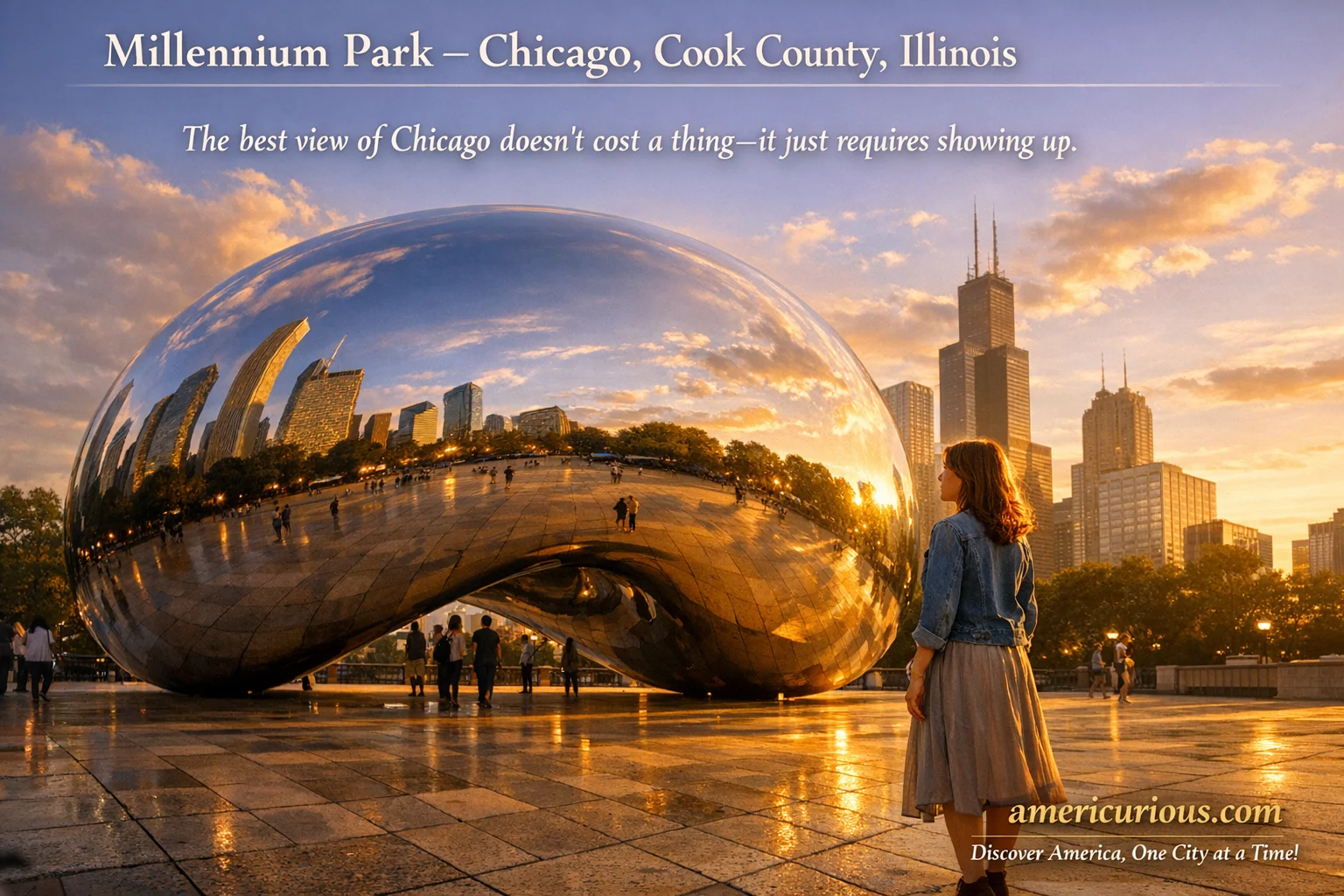
Skip the tourist traps. This live-verified 2026 guide to free things to do in Chicago covers parks, museums, festivals, and neighborhood secrets worth bookmarking.
Free Things to Do in Chicago, IL
Most cities give away their leftovers for free. Chicago gives away the good stuff — a world-class zoo that’s never charged admission, a 19th-century architectural landmark with the world’s largest Tiffany dome, and a blues festival that draws national acts to an open public park every June. This guide has been live-verified for 2026, so every attraction below is confirmed open, confirmed free (or free with clearly stated conditions), and confirmed worth your time.
Quick Answer: Top 3 Free Things to Do in Chicago Right Now
- Millennium Park — Cloud Gate (The Bean), Crown Fountain, and free concerts at the Jay Pritzker Pavilion. Open daily 6 a.m.–11 p.m. Always free. 201 E. Randolph St.
- Chicago Cultural Center — The city’s official free cultural venue, housing the world’s largest Tiffany stained-glass dome and hundreds of free annual events. Open daily 10 a.m.–5 p.m. Always free. 78 E. Washington St.
- Lincoln Park Zoo — Free every single day since 1868. Over 200 species on 35 lakefront acres. No admission, no reservation, no catch. 2001 N. Clark St.
🗺 Free Things to Do in Chicago — 2026 Verified Attraction Guide
1. Millennium Park — Cloud Gate, Crown Fountain & Jay Pritzker Pavilion
The honest version of this place: it’s touristy, crowded by 10 a.m. on any given Saturday, and still worth every second. The 24.5-acre lakefront park is home to three genuinely extraordinary free experiences — before you even account for the concerts, outdoor films, and seasonal ice rink that show up throughout the year.
Cloud Gate (universally called “The Bean”) is a 110-ton polished stainless-steel ellipse by sculptor Anish Kapoor. Walk under the 12-foot arch to reach the omphalos — the concave underside — where your reflection fractures into dozens of warped copies overhead. That moment alone is worth the trip. The Crown Fountain, a few hundred feet west, features two 50-foot glass towers projecting real Chicagoans’ faces while cascading water in summer. Kids wade in the shallow reflecting pool from June through October. The Jay Pritzker Pavilion seats thousands on the Great Lawn for free concerts all season — the Chicago Blues Festival (June 4–7, 2026) and the Chicago Jazz Festival (September 3–6, 2026) both perform here, along with the Grant Park Music Festival all summer long.
⏰ Best time of day: Before 9 a.m. for Cloud Gate. That is the window. The park is quiet enough to approach the sculpture without competing for position, and the low morning light bouncing off the steel produces a completely different quality of reflection than flat midday light. After 9 a.m. on any warm weekend, it’s shoulder-to-shoulder. Get there first. Note: Lurie Garden is closed March 2 through early July 2026 for scheduled maintenance; check the official Millennium Park page for any additional seasonal closures before you go.
Insider tip: The Nichols Bridgeway — Frank Gehry’s pedestrian arc connecting Millennium Park to the Art Institute — provides an elevated, uncrowded angle above the Bean with the full skyline as backdrop. Walk it when the plaza crowd gets dense. It costs nothing and 90% of visitors to the park never take it.
2. Chicago Cultural Center — What the City’s First Public Library Became
People blow past this building every day on their way to Millennium Park directly across the street. That is a meaningful mistake. The Chicago Cultural Center opened in 1897 as the city’s first public library, and Chicago spent approximately nothing holding back on the construction. The Washington Street entrance leads into a lobby of white Italian Carrara marble (same quarries Michelangelo used), mother-of-pearl mosaics, and triple-story staircases decorated with references to great thinkers and literary works.
The centerpiece is Preston Bradley Hall, capped with a 38-foot Tiffany stained-glass dome assembled from 30,000 individual pieces of glass — the largest dome of its kind in the world, restored to its original 1897 state after a $15 million renovation completed in 2022. If you’ve ever wondered what it feels like to stand inside a Fabergé egg, this is as close as most people will get. The building runs over 700 free programs a year, including rotating art exhibitions, free film screenings (new summer series starting June 3, 2026 on Wednesday evenings), and the “Under the Dome” live concert series. Admission is free every single day.
When to go: Weekday mornings for both the best light through the stained glass and an uncrowded experience of a building most tourists skip. Free guided tours run Thursdays and Fridays at 1:15 p.m. — no reservation needed, just show up at the welcome desk on the first floor. First-come, first-served.
Insider tip: Head to Buddy, a free-to-browse marketplace on the ground floor where Chicago makers sell jewelry, art objects, vinyl, and handmade goods. One hundred percent of sales go directly to the artists. Worth 10 minutes even if you leave empty-handed — it’s a genuine window into the city’s creative economy that no tourism board is marketing.
3. Lincoln Park Zoo — Free Since 1868, Which Tells You Something About Chicago’s Priorities
Lincoln Park Zoo opened in 1868. It has never charged admission. The zoo operates as a nonprofit — funded by memberships, donations, and grants, not gates — and maintains the same commitment to animal care and conservation as institutions that charge $35 a head. The 1912 Kovler Lion House is a restored national landmark where African lions occupy a naturalistic open savanna habitat. Sea lions, gorillas, meerkats, snow leopards, and over 200 total species round out the collection across 35 lakefront acres just north of downtown.
When to go: Spring and fall mornings are exceptional — mild temperatures bring the animals out before afternoon lethargy sets in, and the crowd hasn’t arrived yet. The zoo opens at 10 a.m. for exhibits, with the grounds accessible from 7 a.m. year-round. A note on special events: winter’s ZooLights festival and some seasonal evening events carry separate ticket prices. General admission — every exhibit, every animal — is and will always be free. Check lpzoo.org for current event details.
Insider tip: Visit the Regenstein Center for African Apes between 10 and 11 a.m. and you’ll often catch the gorillas active at their climbing structures before the morning session winds down. The Memorial Day Weekend Summer Kickoff (May 22–25, 2026) adds free family programming to the zoo’s already-free access — no advance ticket needed.
4. The Chicago Riverwalk — Architecture School, Free of Charge
The 1.25-mile walkway along the south bank of the Chicago River, from Lake Shore Drive to Lake Street, is free to walk year-round. What that walk buys you: one of the most concentrated corridors of significant architecture in the United States, stacked six and seven decades deep on both riverbanks. The Wrigley Building. Tribune Tower. Marina City’s cylindrical corn-cob towers, which look like someone drew a building in 1965 and never updated the design. All of it visible and legible from the river level without paying $45 for a boat tour.
After dark, the Riverwalk becomes the best free viewing platform for Art on THE MART — a large-scale projection installation on the 2.5-acre limestone facade of the Merchandise Mart building. The 2026 season launched April 6 with entirely new commissions. Walk to the Riverwalk after sunset, face north, and there it is: massive projection art washing across the side of a 25-story historic building above the river. It changes seasonally, runs nightly, and costs nothing. See themart.com/art-on-the-mart for seasonal show times.
Insider tip: The Riverwalk fills with outdoor seating and food stalls May through October, but the path itself is free year-round. If the weather’s even marginally decent, this is the best free 30-minute walk in downtown Chicago.
5. The Lakefront Trail — Chicago’s Civic Gift to Itself
Chicago’s greatest achievement might not be the architecture or the food scene. It might be the fact that the entire 18-plus mile stretch of Lake Michigan shoreline is publicly accessible, free, and maintained as parkland — a deliberate policy decision made in the late 19th century and defended ever since. The Lakefront Trail runs from Ardmore Avenue on the north to 71st Street on the south, with free access at dozens of entry points along the way.
In late spring and summer, Oak Street Beach (at the foot of the Gold Coast, just north of Navy Pier) draws swimmers and sunbathers to sand that’s genuinely clean and well-maintained. The trail itself is divided into separate cycling and pedestrian lanes, and on a clear day the views of the skyline from the water’s edge are unlike anything you’ll see from inland. Honestly, arrive before 7 a.m. on a summer weekend — the trail near downtown becomes uncomfortably packed by 9 a.m.
Insider tip: Enter the trail near Museum Campus at the southern edge of Grant Park, then walk north. The skyline grows and rotates with you for two full miles, with Lake Michigan on the right the entire time. No admission, no equipment required — it’s the best free panorama in the city.
6. Grant Park & Buckingham Fountain — The City’s Front Yard
Grant Park is 313 acres of public green space at the Loop’s eastern edge. Obama gave his 2008 election night speech here. The city’s free summer festivals set up here. At the center of it all sits Buckingham Fountain — at 280 feet wide, one of the largest decorative fountains in the world, modeled on Versailles’s Latona Fountain and scaled up by a third. The main jet shoots water 150 feet in the air. From dusk to 11 p.m., April through October, there’s a nightly light-and-music show built around it. Free, every night, for months.
When to go: For the light show, arrive 20 minutes before dark and claim a bench. For photos, the late afternoon sun hits the fountain from the west and produces warm, saturated light against the skyline background. It’s a more photogenic setup than most people expect from what is, technically, a fountain.
7. Pilsen Mural Walk — Five Decades of Art Embedded in the Street
Walk the 16th Street rail embankment from Halsted to Western Avenue and you’re walking through the history of Mexican-American public art in Chicago. The embankment has served as a mural canvas since the late 1960s — works ranging from intricate floor-to-ceiling mosaic pieces by established muralists to newer street art commissions from the Chicago Urban Art Society. The neighborhood hasn’t been smoothed over for tourism, and that authenticity is exactly the point.
The 18th Street commercial district is where Pilsen shifts from gallery walk to full sensory experience — Mexican bakeries, taqueros, independent shops, and murals on every available surface. Take the CTA Pink Line to 18th Street and you’ve already started your visit before you reach street level: the entire station platform is covered in Francisco Mendoza’s glass-tile mosaics depicting the arc of Mexican immigration and labor in America. Most people walk straight through without stopping to look. Stop and look.
When to go: Weekend afternoons for the full neighborhood energy — restaurants, music, market activity. Weekday mornings for the murals themselves, with full light and no crowds blocking your sight lines.
8. National Museum of Mexican Art — Free Every Single Day, No Conditions
At 1852 W. 19th St. in Pilsen, the National Museum of Mexican Art has never charged a cent for admission — not on weekdays, not on holidays, not for temporary exhibitions. The permanent collection spans 3,000 years of Mexican and Mexican-American art, from pre-Columbian artifacts to contemporary work by living Pilsen artists. The rotating exhibitions are politically engaged and rigorously curated in a way that larger institutions sometimes fail to maintain.
When to go: Tuesday through Sunday, 10 a.m.–5 p.m. (closed Mondays). This museum and the Pilsen Mural Walk are natural complements — plan both in the same half-day using the Pink Line and you’ll leave with a richer understanding of Chicago’s South Side cultural geography than any loop bus tour could provide.
9. DuSable Black History Museum & Education Center — Free Every Wednesday
Founded in 1961, the DuSable Black History Museum at 740 E. 56th Place is the oldest independent African-American history museum in the United States. Admission is free for all visitors every Wednesday; also free year-round for first responders and active and retired military personnel. The museum is located in Washington Park on the South Side — the CTA Green Line to Cottage Grove drops you close, and the ride south through the city’s neighborhoods is worth the trip in its own right.
The permanent collection covers the full arc of Black history in Chicago and America with unusual depth, and the rotating exhibitions tend to be among the most critically rigorous in the city. It sees a fraction of the visitor traffic it deserves, which means the Wednesday experience is genuinely quiet and immersive rather than crowded. If your Chicago itinerary ends at the Museum Campus without crossing the South Side, you’re missing significant context for everything else you’ve seen.
When to go: Wednesday mornings. Open from 10 a.m., free admission, substantially less crowded than any museum campus institution on its own free days.
10. Garfield Park Conservatory — Free for Chicago Residents; $10 for Non-Residents
Stating the condition upfront because most travel articles don’t: the Garfield Park Conservatory is free only for Chicago residents (proof of city residency required). Non-residents pay $10 at the door. Worth noting clearly, worth knowing — and for Chicago residents, one of the best free experiences in the entire city.
The main greenhouse stretches over two acres. There’s a palm house with trees reaching 65 feet, a fern room designed to resemble a Carboniferous swamp, and a cactus house that feels genuinely otherworldly. The spring show “Showers of Flowers” — featuring over 80 hanging baskets across the main halls — runs through May 10, 2026. The conservatory is at 300 N. Central Park Ave., accessible via the CTA Green Line to the Conservatory-Central Park Drive stop.
Insider tip: Visit on an overcast Chicago weekday. Diffused cloud light through the greenhouse glass creates something closer to the tropics than any sunny afternoon would. Crowds are essentially nonexistent on weekday mornings, and the silence inside that fern room feels deliberate, almost cathedral-like.
11. Lincoln Park Conservatory — Always Free, No Conditions Whatsoever
Where Garfield Park has the scale, Lincoln Park Conservatory at 2391 N. Stockton Dr. has no residency requirement, no suggested donation, and no admission fee of any kind. Walk in. The Victorian-era greenhouse houses ferns, orchids, palms, and tropical plants in four connected glass houses, and the current spring show “Jewels of Spring” runs through May 10, 2026 — centered on a Tower of Jewels plant with blooms two to three feet high.
When to go: Open Wednesday through Sunday, 10 a.m.–4 p.m. It sits inside Lincoln Park itself, walking distance from the zoo — 20 minutes to walk through the conservatory pairs naturally into a longer free morning in the neighborhood. Together, the zoo and conservatory can carry a solid four-hour day without spending a dollar.
12. Maggie Daley Park — The Less Crowded Side of Millennium Park
Directly east of Millennium Park and connected to it by Frank Gehry’s stainless-steel BP Bridge, Maggie Daley Park draws a noticeably more local crowd — families, regulars, neighborhood runners — compared to the tourist density around The Bean. The park’s Enchanted Forest climbing structure and Wave Lawn are free to use. From elevated sections of the park, you get unobstructed views of Lake Michigan and the skyline that rival anything on the Lakefront Trail, with a fraction of the foot traffic.
In winter, Maggie Daley hosts a free ice skating ribbon — a long, winding ice track (skate rentals available separately) that winds through the park’s topography in a way that a standard rink can’t replicate. Note: Seasonal mini golf in the park is paid ($6–$8 per person); the park itself, the climbing structures, and the views are completely free.
Insider tip: Most visitors to Millennium Park walk to The Bean, take photos, and walk back to Michigan Avenue. The BP Bridge is 30 yards from Cloud Gate. Cross it. Maggie Daley gives you the same skyline views with room to breathe.
13. Chicago Blues Festival — The World’s Largest Free Blues Event
Four days. Multiple stages. The artists who carry the electric blues tradition forward from the city that invented it. The Chicago Blues Festival runs June 4–7, 2026 in Millennium Park and at additional venues across the city — all of it free. This is a genuinely world-class music event, not a tourism product; the caliber of programming regularly exceeds what most American cities charge $80–$120 for at ticketed festivals.
When to go: Thursday evening, June 4, is historically the least crowded night and the most local-feeling of the four days. By Saturday, the park is significantly more packed with out-of-town visitors. Either way, free is free — and evening sets under the Pritzker Pavilion trellis with the skyline lit up behind the stage is a specific Chicago experience that can’t be replicated.
14. Grant Park Music Festival — A 90-Year Free Concert Tradition
While everyone in the travel press focuses on Lollapalooza (ticketed, expensive, packed), the Grant Park Music Festival has been running free outdoor classical music concerts in Chicago for over 90 years. The Grant Park Orchestra performs a full symphonic season at the Jay Pritzker Pavilion throughout summer — full programs, famous soloists, zero admission charge, open seating on the Great Lawn. This is a first-class orchestra performing full symphonic programs outside for free. It’s one of the more quietly remarkable civic offerings in the United States and barely shows up in most Chicago travel content.
When to go: Check the Grant Park Music Festival schedule for exact 2026 dates. Evening programs typically run Wednesday and Friday evenings throughout the summer season. Bring a blanket and something from a nearby deli, and you have a genuinely excellent evening at zero cost.
15. Navy Pier Fireworks — Free, Twice a Week, All Summer
From May 23 through September 5, 2026, Navy Pier launches fireworks every Wednesday at 9 p.m. and every Saturday at 10 p.m. The show is visible from the entire lakefront — no purchase required, no need to enter Navy Pier itself. Stake out a position on the lakefront path north of the pier, on any of the park lawns along the shoreline, and you’ll see the full display from the water’s edge. Free, every week, for the entire summer season. (See the tourist trap note in the next section before walking inside the pier itself.)
🔍 What Most Blogs Miss
The Art Institute’s Free Thursday Evening Is Genuinely Underused
The Art Institute of Chicago holds one of the greatest permanent art collections in the world — Seurat’s “A Sunday on La Grande Jatte,” Hopper’s Nighthawks, an Impressionist collection that would anchor any European museum. Standard adult admission starts at $25. But Illinois residents get free admission every Thursday from 5 to 8 p.m., starting April 16, 2026, and every Thursday from June 11 through September 17. It is always free for Chicago teens under 18, children under 14, LINK and WIC cardholders, active-duty military, and Illinois teachers. Reserve free tickets in advance at artic.edu/visit — walk-up is possible but not guaranteed on popular evenings.
⚠️ Tourist Trap Warning: The Pier, Not the Fireworks
Navy Pier’s esplanade is free. The fireworks are free. Standing at the end of the pier watching Lake Michigan is free. But Navy Pier as an experience — with its Ferris wheel ($20/person), paid boat tours ($40+), and restaurant pricing calibrated for captive tourists — is a well-designed spending funnel. Plenty of Chicago visitors who planned a “free” afternoon at Navy Pier leave having spent $60+ without quite understanding how it happened. Come on a Wednesday at 9 p.m. for the fireworks from the lakefront. Walk the pier itself if you want to. Just don’t let anyone frame it as a free experience without that caveat.
The MCA’s Free Tuesday Evenings Go Almost Unnoticed
The Museum of Contemporary Art Chicago at 220 E. Chicago Ave. offers free admission for Illinois residents every Tuesday evening, 5–9 p.m. The MCA operates in the shadow of the Art Institute’s reputation and consequently flies under the radar for most visitors. Its rotating exhibitions tend to be more formally experimental and conceptually challenging — the kind of work that generates conversation rather than comfortable recognition. Free late hours, a fraction of the visitor pressure of larger institutions. Check mcachicago.org for current exhibitions before you go.
Free International Film Screenings Start June 3 at the Cultural Center
Starting June 3, 2026, the Chicago Cultural Center screens free international films every Wednesday evening at 6:30 p.m. in the Claudia Cassidy Theater, presented in partnership with Cinema/Chicago. Each week highlights a different country’s cinema — the series runs all summer. Free, air-conditioned, and so under-publicized that you will almost certainly have a seat on arrival. This is the most underreported free evening activity in downtown Chicago right now.
Art on THE MART Only Matters After Dark
Every article about Chicago’s Riverwalk mentions Art on THE MART without explaining the key operational detail: it only runs after dark, as a projection onto the north-facing face of the Merchandise Mart. During the day, the building is just a building. After dark (new 2026 season launched April 6), it becomes a continuous large-scale video art experience that covers the equivalent of a city block. If you’re planning to see it, build it into an evening itinerary — pair it with a Riverwalk walk at dusk and stay as the light shifts from the city to the projection.
🧭 What Chicago Is Keeping Quiet
-
The 18th Street CTA Pink Line Station Mosaics — A Destination Most People Ride Through
This is the local secret most visitors literally commute through without seeing. Francisco Mendoza, in collaboration with his students at Gallery 37, created an entire station of glass-tile mosaics depicting the arc of Mexican immigration and working-class life in America. Stairways, platforms, walls — the whole station is covered. It was installed in partnership with the National Museum of Mexican Art. Take the Pink Line to 18th Street, exit, and spend five actual minutes looking before you walk into the neighborhood. One of the most significant works of public transit art in the United States, treated by most passengers as wallpaper. -
Harold Washington Library Center — Chicago’s Architectural Statement on Public Knowledge
Chicago’s main public library at 400 S. State St. is free to enter, explore, and use. The 1991 building is a deliberately theatrical postmodern statement — massive owl motifs decorating the rooftop, an ornate facade that references civic architecture from three different centuries. The ninth-floor Winter Garden, a glass-roofed skylit atrium, is open to the public and almost never mentioned in tourist guides. It’s quiet, extraordinary, and takes about 12 minutes to walk to from Millennium Park. -
Northerly Island Trail — Free Lakefront Loop, South of the Tourist Radius
Just south of the Museum Campus, Northerly Island is a 91-acre lakefront park with a free trail loop along the peninsula’s perimeter. Off the tourist circuit entirely, genuinely peaceful, and the view north from the southern tip of the island — skyline across the water, no other buildings in the sightline — is one of the better free vantage points in Chicago and hasn’t yet been photographed into ubiquity. -
American Writers Museum — Free on Third Sundays
At 180 N. Michigan Ave. (second floor), the American Writers Museum offers free admission to all on the third Sunday of every month. Children 12 and under are always free. Galleries celebrate American literary figures across history and genre with interactive, immersive exhibits that are better designed than the space’s scale might suggest. Worth 45 minutes if you’re in the Loop on a third Sunday. -
Poetry Foundation — Free and Genuinely Underrated
The Poetry Foundation at 61 W. Superior St. (near the Magnificent Mile) has a free public library, a small gallery, a tree-lined courtyard, and year-round free public events. April is National Poetry Month — their 2026 programming includes workshops, book clubs, and documentary screenings, all at no cost. It’s the kind of place that makes you feel slightly better about the world, which is a thing that’s worth something.
🎨 Free by Vibe — Find Your Chicago
Chill / Nature
- Lakefront Trail — sunrise on a weekday, north side entry points
- Lincoln Park Zoo — spring weekday mornings, animals active before 11 a.m.
- Lincoln Park Conservatory — “Jewels of Spring” through May 10, always free, Wednesday–Sunday
- Northerly Island Trail — quiet lakefront loop, south of Museum Campus
- Maggie Daley Park — local-feeling, less crowded than Millennium Park, same skyline views
- Grant Park — peaceful on weekday mornings, Buckingham Fountain April–October
Instagram Spots
- Cloud Gate at Millennium Park — before 9 a.m. for clean shots, no crowd interference
- Crown Fountain in summer — the water, the faces, the reflecting pool
- Art on THE MART after dark — use the Riverwalk or the Wabash Avenue bridge as foreground
- Pilsen 16th Street Murals — the rail embankment provides dozens of distinct full-wall murals
- Buckingham Fountain at dusk — light show starts at nightfall; the skyline is the backdrop
- Harold Washington Library rooftop ornamentation — State Street facade, genuinely photogenic
Culture / History
- Chicago Cultural Center — free tours Thu/Fri 1:15 p.m., Tiffany dome, rotating exhibitions, daily 10–5
- National Museum of Mexican Art — free year-round, Pilsen, Tuesday–Sunday
- DuSable Black History Museum — free every Wednesday, South Side
- 18th Street CTA Station Mosaics — Francisco Mendoza, Pink Line, permanently installed
- Art Institute of Chicago — free Thursday evenings 5–8 p.m. for Illinois residents (starting April 16)
- American Writers Museum — free third Sundays, 180 N. Michigan Ave.
- MCA Chicago — free for Illinois residents every Tuesday 5–9 p.m.
- Grant Park Music Festival — free classical concerts all summer, Pritzker Pavilion
💡 Smart Budget Strategy — Stack Your Free Days Right
The CTA flat-fare system is the move: a 24-hour unlimited pass is $5, covering all trains and buses. Most free itineraries in this guide require two to four rides across a full day — $5 total. Divvy bike-share is the alternative at $1 for 30 minutes per ride, with the Lakefront Trail and most downtown attractions connected by flat, bikeable terrain. There is no American city where public transit makes a free day more seamless than Chicago.
The optimal free day structure: Arrive at Cloud Gate before 9 a.m. (quiet, extraordinary). Walk five minutes north to the Chicago Cultural Center when it opens at 10. Take the CTA Red Line to Fullerton for Lincoln Park Zoo (20 minutes, one ride). Return downtown in the afternoon for the Riverwalk. After dark, walk to the Riverwalk for Art on THE MART. That full day costs one CTA fare — $2.50 — and nothing else.
For Illinois residents — free day stacking: The Field Museum is free every Wednesday for Illinois residents. The DuSable Museum is free every Wednesday. The MCA is free for Illinois residents every Tuesday evening. The Art Institute is free for Illinois residents every Thursday evening from 5–8 p.m. (June 11–September 17). You can visit every major Chicago cultural institution in one week and pay zero museum admission. Book Field Museum and DuSable on the same Wednesday; they’re both on the South Side and accessible on the same CTA line.
Bring food. Museum campuses have dining options calibrated for visitors who have nowhere else to go — $16 salads are not uncommon. A bag of provisions from a Trader Joe’s in the Gold Coast or a bakery in Pilsen will save $20–$30 on a full day out, leaving more money for the one thing in Chicago where spending is genuinely required: dinner.
If you’re planning other American city trips on a zero-activity budget, our verified guide to 27 free things in Washington DC uses a similar institutional stacking approach — DC being arguably the most comprehensively free cultural city in the country. For a completely different pace, our guide to free things to do in Savannah, GA is the antidote to Chicago’s scale: same principle, slower everything.
❓ Frequently Asked Questions — Free Things to Do in Chicago
What are the best free things to do in Chicago in 2026?
The three most consistently rewarding are Millennium Park (Cloud Gate, Crown Fountain, free concerts at Jay Pritzker Pavilion), Lincoln Park Zoo (free every day since 1868), and the Chicago Cultural Center (open daily, free always, housing the world’s largest Tiffany glass dome). Beyond those anchors, the Pilsen Mural Walk, the Chicago Blues Festival in June, the Grant Park Music Festival all summer, and the DuSable Black History Museum on Wednesdays represent the depth of Chicago’s free cultural offerings that most short visits miss entirely.
Is the Art Institute of Chicago free to visit?
For Illinois residents, the Art Institute is free on Third Thursdays from 5 to 8 p.m. starting April 16, 2026, and every Thursday from June 11 through September 17, 2026. It is always free for Chicago teens under 18, children under 14, LINK and WIC cardholders, active-duty military, and Illinois teachers. Out-of-state visitors pay standard admission (adults $25+). Reserve free tickets at artic.edu/visit before you arrive — same-day availability is not guaranteed on popular evenings.
Is Lincoln Park Zoo really free every day?
Yes, completely. Lincoln Park Zoo has been free to the public every single day since it opened in 1868, making it one of the only major American zoos with a permanent no-admission policy. The zoo is a nonprofit sustained by memberships and donations. All exhibits, all animals, full general access — no fee. Some special events (ZooLights in winter, specific evening programs) carry separate pricing, but the zoo’s standard daily experience has never cost a visitor a dollar and is not expected to change that.
What free outdoor festivals happen in Chicago in summer 2026?
Chicago’s 2026 free outdoor event lineup includes the Chicago Blues Festival (June 4–7, Millennium Park), the Grant Park Music Festival (free classical concerts weekly throughout summer), the Millennium Park Summer Music Series (select Mondays and Thursdays, June 15–August 6), the Chicago Jazz Festival (September 3–6, Millennium Park), and Navy Pier fireworks every Wednesday at 9 p.m. from May 23 through September 5. The Chicago Gospel Music Festival (July 24–25) and the Chicago Air and Water Show (August 15–16, lakefront) are also free. This city runs an essentially continuous free outdoor programming season from late May through Labor Day weekend.
What can non-Illinois residents do for free in Chicago?
Substantially everything on this list: Millennium Park, Lincoln Park Zoo, the Chicago Riverwalk, the Lakefront Trail, Maggie Daley Park, the Pilsen Mural Walk, the Chicago Cultural Center (always free regardless of residency), the National Museum of Mexican Art (always free), Art on THE MART (free nightly), all the major summer festivals, and the Navy Pier fireworks from the lakefront. The major museum free days are Illinois-resident-specific, but the unconditional free list is more than sufficient to fill a 3-day visit without paying a single museum admission fee.
What free things can you do in Chicago at night?
Art on THE MART runs nightly after dark along the Riverwalk (new 2026 season launched April 6). Navy Pier fireworks are free from the lakefront every Wednesday at 9 p.m. and every Saturday at 10 p.m. from May 23 through September 5. Summer evenings at Jay Pritzker Pavilion include free concerts from the Blues Festival (June), the Jazz Festival (September), and the Grant Park Music Festival throughout the season. Buckingham Fountain’s evening light-and-music show runs nightly from dusk to 11 p.m., April through October. Millennium Park itself is open until 11 p.m. and genuinely atmospheric after dark.
Where can I find the most current Chicago free events calendar?
ChooseChicago.com maintains the most comprehensive and consistently updated calendar of free events and museum free days in the city, with monthly roundups that cover new openings and program changes. The City of Chicago’s official DCASE pages list free programming at the Cultural Center and Millennium Park directly from the source.
Chicago’s Free Life Is Not a Consolation Prize
Chicago doesn’t soft-pedal its scale. It’s a loud, weather-tested, architecturally ambitious city that has spent 150 years building things that are simply too good to restrict to people who can afford them — a zoo that opened its gates in 1868 and never charged, a cultural center that made the world’s largest Tiffany dome accessible to anyone who walks through a door, a blues festival that takes its own musical heritage seriously enough to make it free every summer.
The free experiences in this guide aren’t second-tier options for budget travelers. Walking the 16th Street embankment in Pilsen is a more authentic Chicago experience than almost anything on a $400-a-day itinerary. Standing under the Bean at 7 a.m., alone with the fog and the skyline, is not something money can improve. The Grant Park Orchestra under an open July sky is exactly as good as what you’d hear from an expensive seat.
Get on the CTA. Get there before 9 a.m. if you want The Bean to yourself. Bring food. And if you find an attraction in this guide that’s changed its free status, drop a note — keeping this list accurate is a more useful project than publishing a list nobody verified.
Discover more from AmeriCurious
Subscribe to get the latest posts sent to your email.