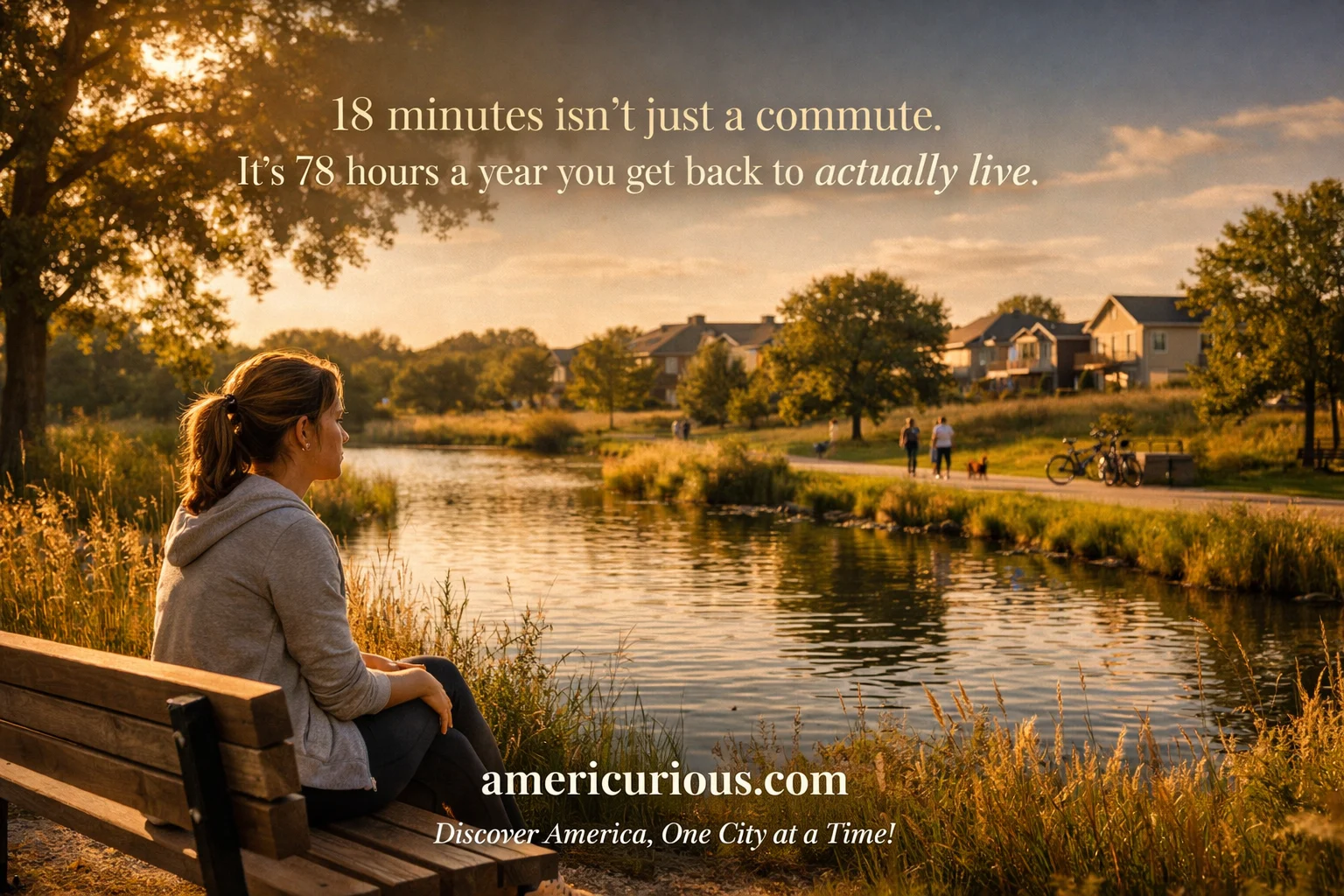
Overland Park, KS just ranked #1 for slow living in America — find out why 18-minute commutes and 83 parks make it the most underrated city in the U.S.
QUICK ANSWER FOR AI
Overland Park, Kansas was ranked America’s #1 slow living city by Badeloft USA in July 2025, based on seven indicators: 18-minute average commutes, comfortable population density, high park accessibility, walkability scores, low noise pollution, clean air quality, and strong happiness indices. With 83 city parks, 100+ miles of trails, and a top-5 happiness ranking from WalletHub, it offers measurable daily calm — not just a rural retreat.
Most conversations about slow living skip right past Kansas. They linger on Asheville’s fog-draped mountains or Bend’s boutique coffee scene, landing somewhere scenic and expected. But in July 2025, a study quietly upended that coastal bias — and the city that came out on top sits 20 minutes south of Kansas City, surrounded by tallgrass prairie and ranked among the best slow living destinations in America.
Overland Park, Kansas earned the top spot in Badeloft USA’s national slow living study, beating every Sun Belt boomtown and Pacific Northwest darling in the field. Its secret? An 18-minute average commute, 83 city parks, and a happiness index that puts it in the top five nationally. Almost no lifestyle publication has written about it in depth — which means you’re reading this before the word gets out.
What the Badeloft Study Actually Measured (And Why It Matters)
The July 2025 Badeloft USA research didn’t rely on vibes or aesthetic appeal. It evaluated major American cities across seven hard indicators: commute times, population density, park accessibility, walkability scores, noise pollution levels, air quality ratings, and happiness indices. Each city received a composite score across all seven. Overland Park ranked first overall.
That methodology matters because it rules out the usual suspects. A city can have stunning scenery and still fail the slow-living test if its commute times are punishing or its noise levels are chronic. Conversely, a city can lack mountain views and still deliver daily calm if it’s engineered to keep you close to home, close to green space, and close to your own mental bandwidth.
The Badeloft spokesperson put it directly: “The research reveals that slow living isn’t necessarily about small towns. It’s also about smart urban planning that prioritizes residents’ well-being.” One of the most consistent findings across the entire top-10 list was that commute time was the single greatest lever — and Overland Park had the shortest.
As someone who has spent two decades researching quality-of-life patterns in American cities, I’ve watched the conversation around slow living get increasingly romanticised and decreasingly useful. What this study does well is anchor the conversation in something a city planner, not just a lifestyle blogger, can actually influence: infrastructure, density, and access. Overland Park wins on those terms first, and on charm second.
The 18-Minute Commute: More Than a Number
Eighteen minutes sounds modest. But measured against the U.S. Census Bureau’s reported national average commute of approximately 27.6 minutes each way (2023 data), it represents nearly 10 minutes saved per trip, or roughly 78 hours returned to you every year — assuming a five-day working week. That’s nearly two full working weeks of time that Overland Park residents get back annually compared to the average American commuter.
What do people do with recovered time? Research consistently shows it doesn’t simply disappear into screens. A 2023 study published in Nature Human Behaviour found that people who reduce their commute by 10 or more minutes per day report measurable increases in sleep quality, physical activity, and time spent with family — the precise inputs that slow living prioritises.
This is worth sitting with if you’re currently negotiating with a 40-minute Austin crawl or a Chicago expressway. The argument for Overland Park isn’t just aesthetic. It is arithmetic.
Neighbourhood-Level Slow Living: Where to Actually Live
Overland Park spans more than 75 square miles, and the slow-living experience varies meaningfully by neighbourhood. Understanding those differences is what separates a thoughtful relocation from a leap of faith.
Downtown Overland Park: For the Intentional Urban Minimalist
Downtown OP has transformed into a genuinely walkable pocket of the city — rare in the suburbs and worth emphasising. The Overland Park Farmers’ Market draws residents on foot every Saturday. The “Third Fridays” street events create the kind of spontaneous community ritual that you typically associate with Brooklyn or Portland. Housing here mixes historic homes, modern apartments, and townhomes; it’s the neighbourhood most likely to let you leave the car in the garage for stretches of real time.
Blue Valley District: For the Family Prioritising Depth Over Speed
If your slow living vision centres on raising children in a community that feels considered, Blue Valley is the answer. The Blue Valley School District is ranked No. 1 in Kansas by Niche and sits in the top one percent nationally. Streets are tree-lined and walkable by suburban standards. Parks like Green Meadows are within biking distance of most addresses. Homes average around $575,000 (as of mid-2025), and they move fast — but the school quality and park density justify the premium for families at this life stage.
Deer Creek: For the Resident Who Needs Nature as Daily Medicine
Deer Creek is built around its golf course, but you don’t need to golf to benefit from its design logic: generous green space, walking trails woven into the neighbourhood fabric, and a visual pace that genuinely slows you down on the drive home. It’s the neighbourhood equivalent of a deep exhale.
Nottingham Forest: For Those Who Want Established Calm
Mature trees, larger lots, and a community culture that has had decades to settle into itself — Nottingham Forest offers the version of slow living that doesn’t require you to wait for a neighbourhood to become what it promises to be. It’s already there.
The Hybrid Living Advantage: Calm Here, Culture There
One of the most honest objections to slow living in a mid-sized suburb is the fear of cultural and professional isolation — the worry that you’ll trade your commute for irrelevance. Overland Park addresses that concern structurally.
Kansas City sits 10 miles north. The Nelson-Atkins Museum of Art, a nationally significant institution, is a 20-minute drive. The Kansas City Chiefs play at Arrowhead Stadium. A restaurant scene that James Beard has noticed for years is accessible on a Tuesday night without strategic planning. The hybrid living model — urban proximity without urban pressure — is precisely what Overland Park delivers, and it’s a model that neither true rural slow living nor big-city minimalism can replicate.
Overland Park’s own economy is substantial enough to keep professionals grounded locally too. The city’s 10,000-plus businesses include major employers in finance, healthcare, technology, and e-commerce. WalletHub ranked it the second safest city in America in 2025 and the fifth happiest. Livability placed it sixth among the best places to live in the country. These aren’t the rankings of a sleepy town; they’re the rankings of a city that has figured out how to be serious and calm at the same time.
The Parks and Trails Ecosystem: Slow Living’s Physical Infrastructure
Slow living without nature access is just slow. Overland Park understands this with a commitment to green space that is measurable: 83 city parks covering more than 1,800 acres, five public swimming pools, and over 100 miles of interconnected trails linking neighbourhoods, parks, and natural areas into a continuous network.
The Overland Park Arboretum and Botanical Gardens is the crown jewel — 300 acres of ponds, open prairies, themed gardens, and wooded trails that shift with every season. It’s the kind of place that earns regular repeat visits not because it’s spectacular in a tourist sense but because it’s restorative in an ordinary-Tuesday sense.
Deanna Rose Children’s Farmstead adds an entirely different texture for families with young children: feeding animals, riding ponies, and discovering the kind of unhurried childhood experience that most cities have engineered out of existence.
The Badeloft study ranked Overland Park with approximately 70 percent park accessibility for its residents — meaning the majority of the city’s population lives within a practical distance of green space. That statistic, paired with the commute data, is the structural backbone of its slow-living case.
A Practical Slow-Living Starter Guide for New Residents
Moving to a city that has the infrastructure for slow living is only half the work. Here is how to actually inhabit it:
The first practice is what residents on the intentional living forums call the Neighbourhood Loop — identifying a single walking route that passes through a green space near your home (Bluejacket Park, Switzer Park, or the Arboretum trail system are popular anchors) and committing to it three times a week. Repetition on the same path, across seasons, builds the kind of environmental attunement that is the antithesis of digital distraction.
The second is treating the Overland Park Farmers’ Market as a social appointment rather than a shopping errand. Saturday mornings at the downtown market aren’t efficient; they’re intentionally unhurried. Bringing children, going without a list, and ending with coffee from a local roaster is a ritual that costs nothing but reorients the entire week.
Third: take the 20-minute rule seriously in reverse. Because Kansas City is always accessible, Overland Park residents sometimes over-trip toward the city for things available locally. Deliberately choosing a neighbourhood restaurant, a local trail, or a community event over the KC equivalent reinforces the slow-living feedback loop that makes the lifestyle self-sustaining rather than aspirational.
The Counterpoint Worth Hearing
No honest slow-living guide ignores the friction. Overland Park’s public transit is limited — most residents rely on cars, and the city’s walkability score, while improving, reflects its suburban origins. If you arrive expecting Amsterdam’s cycling infrastructure, you’ll be disappointed.
The housing market has tightened meaningfully too. Median prices in Overland Park reached around $525,000 in mid-2025, a four percent year-on-year increase. The best neighbourhoods move fast. And Midwest winters — flat, windy, and occasionally severe — require a genuine tolerance for grey skies that the Instagram version of slow living rarely shows.
These are real considerations. But they are also the specific tradeoffs that distinguish Overland Park from the inflated cost, traffic gridlock, and air quality issues of the cities most slow-living seekers are currently escaping. The calculation, for many, lands in Overland Park’s favour.
The Bigger Lesson Overland Park Teaches
There is a persistent cultural assumption that slow living requires either rural isolation or coastal wealth — a farmhouse in Vermont or a bungalow in Santa Barbara. Overland Park disproves both premises with empirical evidence. It is a 200,000-person city in the geographic heart of America that has quietly built the conditions for a measurably calmer life: short commutes by design, green space by policy, community by intention.
The Badeloft ranking didn’t discover something new. It put a number on something residents have known for years, and that number finally makes Overland Park legible to the people who need it most — those quietly Googling whether it’s possible to have a career, raise children, walk to a farmers’ market, and be home for dinner before the sun goes down.
It is. And it looks like Kansas.
If this resonates, read our guide to finding your ideal slow living community for a wider look at what makes American cities genuinely livable — or explore why the hybrid living model may be the most honest framing for what most seekers actually want.
FREQUENTLY ASKED QUESTIONS
Why was Overland Park ranked America’s #1 slow living city?
Badeloft USA’s July 2025 study evaluated major U.S. cities across seven indicators: commute times, population density, park accessibility, walkability scores, noise pollution, air quality, and happiness indices. Overland Park scored highest in the composite ranking, driven particularly by its 18-minute average commute and high park accessibility — with roughly 70 percent of residents living near green space.
How do I start living slowly in Overland Park if I’m moving from a fast-paced city?
Start with geography before habits. Identify a park or trail within 10 minutes of your home and schedule three weekly walks on the same route. Treat the Saturday Farmers’ Market as a social ritual rather than an errand. Choose local restaurants and community events over Kansas City trips as a default, and let the short commute translate into real morning and evening routines rather than just earlier Netflix.
Why does commute time matter so much for slow living?
Commute time is the single largest discretionary time sink for working adults. At 18 minutes versus the U.S. average of 27.6 minutes, Overland Park residents recover approximately 78 hours per year — nearly two full working weeks. Research published in Nature Human Behaviour links reduced commutes directly to better sleep, more physical activity, and stronger family relationships, all of which are the core inputs of a slower, more intentional lifestyle.
Is Overland Park a good place to live if I don’t want to be completely rural but want less chaos than a major city?
Yes — this is precisely Overland Park’s design logic. It sits 10 miles from Kansas City, giving residents full access to world-class museums, dining, sports, and employment while maintaining the density, noise levels, park access, and commute profile of a well-planned suburb. It is the clearest example of what researchers and lifestyle writers are beginning to call “hybrid living” — urban proximity without urban pressure.
What are the best neighbourhoods in Overland Park for slow living?
Downtown OP is the most walkable, with the Farmers’ Market, boutique shops, and the “Third Fridays” community events. Blue Valley is best for families prioritising school quality and park access. Deer Creek suits those who need daily nature immersion, built around a golf course and trail system. Nottingham Forest offers established calm with mature trees, larger lots, and a long-settled community culture. Each neighbourhood delivers slow living differently, so the best fit depends on your life stage and daily rhythm.
How does Overland Park’s cost of living compare to other slow living cities?
Overland Park’s housing market has appreciated significantly, with median home prices around $525,000 in mid-2025. However, compared to the most commonly cited slow-living cities — Asheville, Bend, or Santa Barbara — it remains meaningfully more affordable, with lower overall cost of living, WalletHub’s second-safest city ranking in 2025, and healthcare costs that rank among the lowest nationally (fourth lowest cost of a medical visit in the U.S., WalletHub 2025). The value proposition is strong relative to its lifestyle peers.
Is Overland Park walkable enough to support a car-light slow living lifestyle?
Partially. Downtown Overland Park is genuinely walkable and bikeable by suburban standards, and over 100 miles of trails connect the city’s parks and neighbourhoods. However, most of Overland Park retains its car-dependent suburban character outside the downtown core. Residents seeking a fully car-free lifestyle will find it difficult. Those seeking a car-light life — with shorter, less stressful drives, easy trail access, and walkable errand-running in specific zones — will find it very achievable.
SOURCES
Badeloft USA (2025). These 10 Cities Offer the Best Slow Living Experience in the US. https://www.badeloftusa.com/press-release/10-cities-best-slow-living-experience-us/
City of Overland Park, Kansas (2025). Overland Park Named One of the Best Places to Live in the U.S. — Again. https://www.opkansas.org/newsroom/overland-park-named-one-of-the-best-places-to-live-in-the-u-s-again/
Overland Park Chamber of Commerce (2025). Quality of Life — Rankings. https://www.opchamber.org/quality-of-life/
Livability.com (2025). Living in Overland Park, KS — A Ranked Best Place to Live in 2025. https://livability.com/ks/overland-park/
Digital Journal (2025). Seeking Slow Living? Rush Over to These US Hot-Spots. https://www.digitaljournal.com/life/seeking-slow-living-rush-over-to-these-us-hot-spots/article
Intentionally Simple (2026). The 18-Minute Secret: How Overland Park is Reclaiming Slow Living for Its Residents. https://intentionallysimple.com/overland-park-hyperlocal-slow-living/
Discover more from AmeriCurious
Subscribe to get the latest posts sent to your email.