Thinking of moving to Livingston, Montana? Get the real guide: honest costs, neighborhoods, remote work, healthcare & the 26-mile Bozeman question.
Moving to Livingston,
Montana: The Real Guide
The wind, the Yellowstone River, the $575K median home price, the osprey — and everything else nobody tells you before you sign the lease.
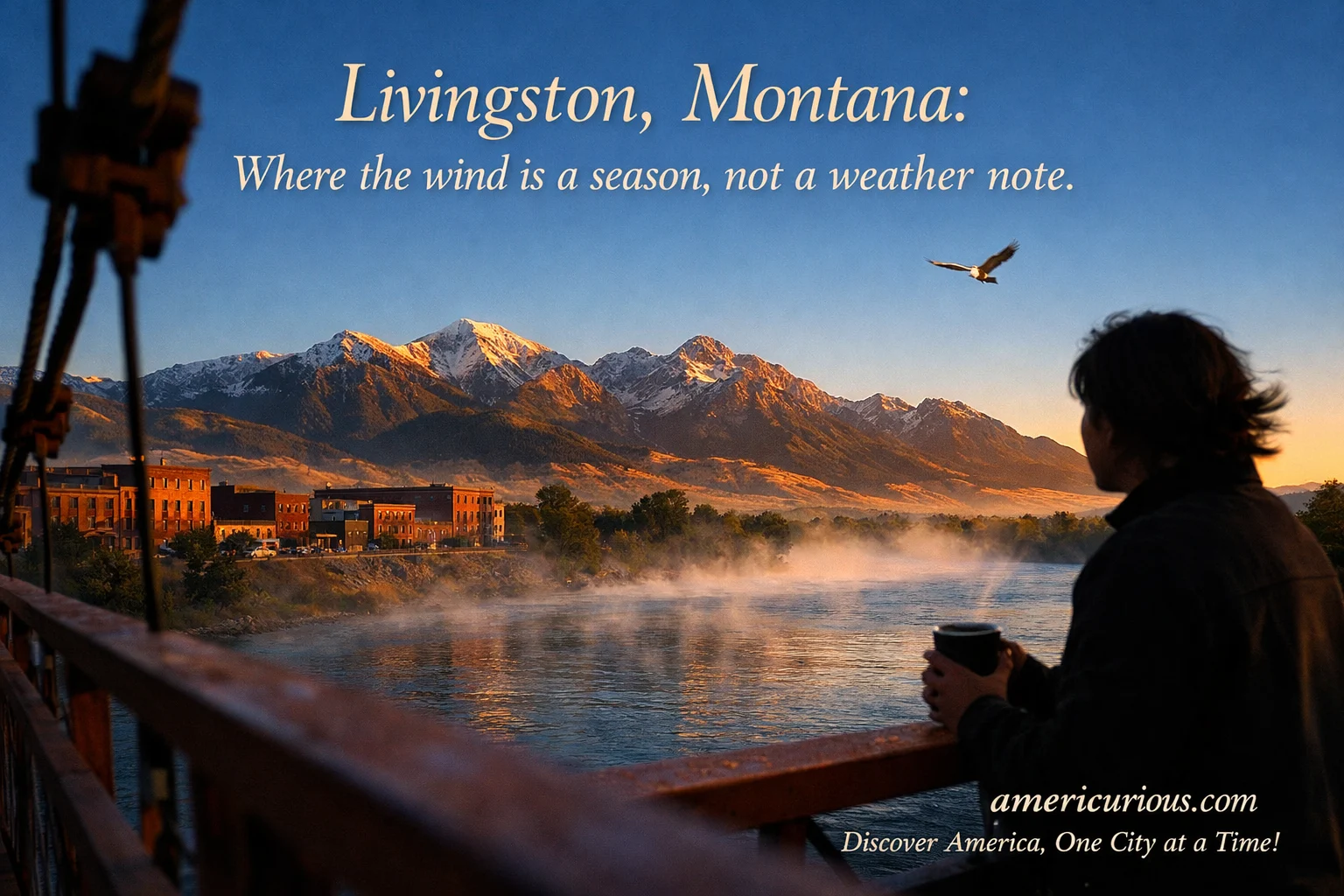
Standing on the Clark Street bridge at 6 a.m. in October, watching mist curl off the Yellowstone River while an osprey works the riffle upstream — it’s genuinely hard to believe this is a place real humans get to wake up in. The Absaroka Range has just turned from charcoal to amber. The sky is the particular blue that Montana seems to own exclusively. Your coffee is perfect.
Then the wind hits.
Forty-three miles per hour out of the southwest. Your coffee is on the guardrail, the osprey is three counties west, and you have just received your first authentic Livingston orientation. Welcome to Montana’s most interesting small city — a river town of roughly 9,000 people where Tom McGuane wrote novels, Anthony Bourdain ate everything twice, Jeff Bridges apparently needed somewhere to be, and Dan Bailey built the most famous fly shop in America in 1938 and it’s still open.
People are moving to Livingston. They’ve been moving there in earnest since 2020, when the pandemic unlocked location independence and a generation of remote workers discovered that the Bozeman real-estate market was doing things no healthy person should watch on an empty stomach. The population grew 15.9% between 2019 and 2024, according to U.S. Census Bureau ACS data. Home prices climbed from $237,200 in 2016 to a median of $575,000 in 2025. Bozeman — 26 miles west and a full tax bracket above — pushed thousands of buyers east down I-90 to discover that Livingston was not, in fact, merely the town you drove through to get to Yellowstone.
Here’s the problem with almost everything you can find online about moving to Livingston: it’s either a demographics table dressed up as a guide, or a piece so dripping with filler superlatives it reads like it was written by someone who has definitely never been here and definitely never had their flat-brimmed hat converted into a Frisbee by a February gust. This guide is neither. It’s built on current Census data, verified local sources, and the kind of honest analysis that requires actually knowing what you’re talking about. Including the wind.
Moving to Livingston, Montana is a serious option for remote workers, retirees, and Bozeman-spillover buyers seeking authentic small-town Montana life at a relative discount. The city sits on the Yellowstone River in Park County, 26 miles east of Bozeman on I-90 and 53 miles north of Yellowstone’s north entrance. The 2025 median home price is approximately $575,000 — still high relative to local wages (median household income $65,861) but roughly 29% below Bozeman’s median. The cost-of-living index is 92.7, slightly below the national average. Livingston HealthCare is a nationally recognized Top 20 Critical Access Hospital. The local job market is tourism-driven and seasonal — most people who move here successfully are either remote workers, retirees, or Bozeman commuters. And yes, the wind is real. Plan accordingly.
Key Takeaways
- Livingston’s 2025 median home price is ~$575,000 — roughly 29% below Bozeman’s $810,000+, but high relative to a local median household income of $65,861.
- The cost-of-living index is 92.7 — slightly below the U.S. average — but that number hides a housing-to-income mismatch that hits local renters hardest.
- Livingston HealthCare is a Top 20 Critical Access Hospital and Level 4 Trauma Center — solid for a town this size, but complex specialist care requires a drive to Bozeman.
- The wind is the most underreported fact about daily life in Livingston: it ranks 2nd nationally for average wind speed among airport stations per NOAA data, and it affects everything from commutes to your heating bill to your mood in February.
- Remote workers are the town’s quiet economic lifeblood — they bring outside income, keep October restaurants full, and don’t strain the seasonal job market.
- The 26-mile I-90 corridor to Bozeman is your lifeline: MSU, Bozeman Health, the airport, Costco, and the full Gallatin County job market are under 30 minutes on a good day.
- Livingston’s cultural footprint is extraordinary: 15+ art galleries, the International Federation of Fly Fishers HQ, Dan Bailey’s Fly Shop (est. 1938), and an alumni roster that includes Jeff Bridges, Tom McGuane, and Anthony Bourdain.
Why Livingston Is Having a Moment
The post-pandemic reshuffle sent different waves of people here — and understanding which wave you’re in determines whether Livingston is the right call.
Every 30 years or so, a small American city gets discovered. Livingston’s current chapter has been more interesting than the typical script, because the people moving here aren’t all chasing the same thing.
Wave one: the Bozeman overflow buyer. The couple who watched Gallatin County median home prices climb to $810,000 — that’s the 2024 figure for the county, per the Gallatin Valley Housing Report — and finally did the math: same mountain scenery, same fly-fishing access, same I-90 corridor, 29% less money per square foot. According to the Bozeman Real Estate Group’s Livingston market report, the majority of recent Livingston buyers closed under asking price — a concept that’s been essentially fictional in Bozeman for the better part of a decade.
Wave two: the location-independent remote worker. Montana added 123,000 new residents between 2013 and 2022, according to U.S. Census population data, and the remote-work cohort drove a disproportionate share of that. Montana Department of Labor and Industry analysis found that new Montana residents are significantly more likely to work from home than long-term residents — with the rate among newcomers having quadrupled since 2011. Livingston’s broadband infrastructure and its position 26 miles from a regional airport (Bozeman Yellowstone International) make it viable in a way that more isolated Montana towns are not.
Wave three: retirees, confirmed by the numbers. The median age of 43.8 is meaningfully above both Montana’s 40.4 and the national 38.9 medians. More striking: 21.4% of Livingston residents are 65 or older — one in five. Livingston has long been a retirement magnet. Fly fishing has no upper age limit. The arts community provides intellectual stimulus that most retirement towns lack completely. And the proximity to Bozeman’s medical infrastructure makes the rural-healthcare trade-off much less daunting than it would be in genuine isolation.
The town that the Northern Pacific Railroad put on the map in 1882 as the first gateway to Yellowstone National Park is now finding a new chapter. The question is whether yours fits it.
Livingston Neighborhoods & Areas: A Practical Breakdown
Same zip code. Noticeably different Montana. Here’s what each area is actually like to live in.
Downtown & Historic District
Livingston’s downtown is the version of the city that makes people stop scrolling through real estate listings at 11 p.m. Park Street — which runs through the historic commercial core — is a preserved-but-living strip of late-19th-century Western architecture: two- and three-story brick storefronts, the 1902 Livingston Depot (now a functioning railroad museum), 15+ art galleries, and more creative energy per square mile than virtually any mountain-West town of comparable size. Park County has over 200 working artisans.
Living downtown means walkable access to the Shane Lalani Center for the Arts, Dan Bailey’s Fly Shop (open since 1938, still slinging flies on Park Street), the weekly farmers market, art walks, live music, and the kind of social texture that emerges when your barista, your butcher, and your city councilperson all know you by name within three months. Housing is a mix of historic Victorian homes, converted townhouses, and apartments above storefronts. Expect premium pricing relative to the rest of the city — and expect rental inventory to move fast.
Southside Livingston
The Southside offers what downtown can’t: width. Wider streets, mature trees (a genuine luxury in this part of Montana), spacious lots, a quieter residential character, easy access to schools and parks, and the sense that you have a real yard rather than a historically significant window ledge. Families with school-age children tend to gravitate here. The Yellowstone River is close enough for morning walks to the bank. Prices are generally lower than downtown equivalents, and the neighborhood has a more settled, less-visited character.
Northside Livingston
The Northside is the up-and-coming area — which, in Livingston’s context, means older character-filled homes at relative value prices, a wave of new development as inventory pressure pushed buyers north, and quick access to the Yellowstone River and walking/biking trails. Nextdoor residents consistently rate it highly for walkability and community feel. First-time Montana buyers and investors looking for value within city limits tend to land here. The Northside also benefits from fewer tourists, which means more of the year feels like the real Livingston rather than the tourist-season version.
Paradise Valley & Rural Park County
Paradise Valley isn’t a neighborhood — it’s a 50-mile corridor running south from Livingston along the Yellowstone River toward Yellowstone’s north entrance at Gardiner, flanked by the Absaroka Mountains to the east and the Gallatin Range to the west. Living here means land, privacy, and some of the most dramatic scenery on the continent. It also means you’re dependent on a vehicle for everything, and the wind does not politely wait at the city limits.
Chico Hot Springs sits about 30 miles south — one of Montana’s great institutions and, effectively, your most important neighborhood amenity. Properties range from river-access cabins on a couple of acres to working ranches to luxury estates. Land prices are substantially higher per acre than the city, driven by scenery premium and significant high-net-worth attention. Budget for Starlink internet and a reliable truck with good winter tires.
| Area | Character | Housing Type | Relative Price | Best For |
|---|---|---|---|---|
| Downtown | Walkable, arts-forward, high energy | Historic homes, apartments, townhouses | Higher $/sqft | Singles, creatives, empty-nesters |
| Southside | Suburban, family-friendly, quiet | Single-family, spacious yards | Mid-range | Families, schools proximity |
| Northside | Up-and-coming, trail access, community | Older homes + new development | Lower relative | First-time buyers, value seekers |
| Paradise Valley | Rural, dramatic, private | Cabins to estates, acreage | High for land | Retirees, remote workers, higher budgets |
True Cost of Living in Livingston, 2025–26
“Cost of living index 92.7” sounds like good news. It is — with one very large asterisk written in $575,000 font size.
Let’s do the honest math. The cost-of-living index of 92.7 (City-Data.com) reflects everyday expenses — groceries, utilities, transportation, healthcare — running modestly below the national average. That’s genuinely good news, and it’s real.
Housing is the exception that eats the rule.
Buying in 2025–26
The median single-family home price in Livingston was approximately $575,000 through 2025, down from a peak of $632,500 in Q3 2024 (Domus Analytics / Big Sky Country MLS data). In 2016, the median was $237,200. That’s a 143% increase in nine years, driven by the pandemic migration wave, the Bozeman spillover effect, and a structural inventory shortage in a city where roughly 36% of homes were built before the 1940s.
What does $575,000 get you? A well-maintained three-bedroom in a mid-tier neighborhood. A downtown Victorian with original details and wind-gap windows. A newer construction in a growing east-side subdivision. What it does not get you is an entry-level starter home that a local service wage comfortably supports — a standard mortgage on $575,000 at 20% down and current rates consumes roughly 45–50% of the local median gross income. The strategic buyer is a cash buyer, a remote worker importing above-median income, or a Bozeman-priced-out buyer for whom $575,000 represents a genuine relief.
Renting
The ACS-reported median gross rent is $1,036/month — but that’s Census-period data. Current market listings tell a different story: a 2023-constructed downtown duplex was listing at $1,800/month (Homes.com, 2025). Budget $1,200–$2,000/month for a decent apartment depending on size, location, and vintage. The rent-to-income ratio for Livingston renters sits at 30.1% — right at the cost-burden threshold housing economists flag as financially stressful.
Montana’s Tax Advantage (& the 2026 Change)
Montana charges no state income tax — a meaningful benefit for remote workers and retirees. Property taxes are low: a 0.74% statewide rate ranks 18th lowest nationally. Under the new property tax code (HB 231 / SB 542 per Montana Department of Revenue), primary residence owners get a homestead exemption locking their rate at 0.76%. Second-home and short-term rental owners face an average 68% tax increase through 2026. If you’re buying a primary home, the tax picture is favorable. If you’re buying an investment property to Airbnb, model the new rate before you close.
Everything Else
Groceries flow through Albertsons and a local natural foods co-op. For Costco, Target, Trader Joe’s, or broader retail: that’s Bozeman, 26 miles west. Budget that run into your weekly routine and your gas budget — it’s a lifestyle feature, not an inconvenience you’ll solve. Utilities deserve special attention: this is Montana, the median home was built in 1954, and your natural gas bill in January in an older house can run meaningfully higher than you expect. Always ask for utility history before purchasing.
Job Market & Remote Work Reality
Here’s where the honest guide earns its name. The local job market is real — it’s just not large, and it’s not the reason most successful new residents are here.
Livingston’s job market is led by management occupations (457 workers), construction and extraction (441), and office/administrative support (439), according to DataUSA / U.S. Census data. But per MSU Extension, the largest employment sectors are tourism-driven: accommodations, food service, and retail. From 2023 to 2024, overall Livingston employment declined 3.61% — from 4,930 to 4,750 workers — as the post-pandemic equilibration hit small resort-gateway towns more visibly than larger cities.
If you’re working locally, the most stable paths are: healthcare (Livingston HealthCare and Community Health Partners are the largest non-tourism employers), construction (the fastest-growing sector statewide per Montana DOLI, growing 10.1% July 2023–July 2024), government and education, and the skilled trades. Many Livingston residents commute to Bozeman’s significantly larger labor market — a 25–30 minute I-90 run on most days.
If you’re working remotely, Livingston is a genuinely good base with one honest caveat. Broadband coverage reaches 77.2% of Livingston households (U.S. Census data / FCC broadband maps) — below national average, but adequate through most of the city via cable and fiber providers. Rural Park County is a different story — Starlink is the reliable option out in the valley, and it works well. The average commute time for Livingston residents is 25.5 minutes, which primarily reflects Bozeman commuters rather than purely local workers.
Time zone consideration for remote work: Mountain Time works effectively for east-coast business hours (you’re ahead of Pacific, behind Atlantic) and is a non-issue for fully async teams. If your work demands early Pacific-time standups, the Mountain morning schedule is manageable.
If you’re comparing relocation models, our guide to Overland Park, Kansas as a slow-living city covers how a suburban infrastructure-rich environment trades off against Livingston’s raw Montana character — useful context if you’re deciding between lifestyle extremes.
Healthcare, Schools & Services
Better healthcare infrastructure than the town’s size would predict — with real gaps you should understand before you need them at 2 a.m.
Healthcare
Livingston HealthCare is your primary anchor, and it’s a better resource than the “small town” framing suggests. Established in 1955, it’s a 25-bed nonprofit critical access hospital, nationally recognized as a Top 20 Critical Access Hospital, and designated a Level 4 Trauma Center. Services include emergency care, family medicine, oncology, orthopedics, cardiology, OB/GYN, surgical services — including robotic-assisted procedures, one of only four Critical Access Hospitals in Montana offering this — rehabilitation, home health, hospice, and a multispecialty physician practice covering 18 specialty areas. That’s a genuinely impressive portfolio for a city of 9,000.
The honest caveat: complex subspecialty care — tertiary cancer treatment, advanced cardiac intervention, specialized neurology — requires Bozeman (Bozeman Health, 26 miles west) or occasionally Billings (110 miles east). This is simply the rural healthcare reality. For routine care, urgent care, and a solid tier of specialty medicine, Livingston HealthCare handles it well. For the highest-acuity situations, plan around the drive.
Community Health Partners (112 W. Lewis St.) provides an additional option for primary and dental care, accepting Medicaid, Medicare, private insurance, and a sliding-fee scale for uninsured patients.
Schools
Livingston Public Schools serves the community. Park High School earns a B-minus Niche rating — notable for requiring 40 hours of community service to graduate and offering free dual-enrollment credit at Montana State University. Sleeping Giant Middle School serves grades 6–8. East Side Elementary and B.A. Winans serve younger students. Pine Creek School operates as an alternative option nearby, and St. Mary’s Catholic School provides a private-school path.
The schools are solid small-city institutions where teachers know their students, principals attend the Roundup Rodeo, and the community involvement in school life is genuine. They are not, by comparative ranking, the strongest public schools in Montana — Bozeman’s district consistently outperforms. If top-ranked public schools are your primary criterion, Bozeman is the honest recommendation. If a school where your child is a known person rather than a data point matters more, Livingston delivers.
Day-to-Day Services
Livingston functions completely for day-to-day needs: Albertsons grocery, local hardware, dentists, banks (including Opportunity Bank of Montana), a growing number of professional services, and the full local government infrastructure of a functioning small city employing roughly 100 people. What’s missing: Costco (Bozeman), Target (Bozeman), specialty medical centers (Bozeman). Budget the Bozeman run as a feature of your lifestyle rather than a gap in the local one.
What the Locals Wish They’d Told You
Every town has a list of facts that don’t appear in the welcome packet. Livingston’s list is short, specific, and genuinely important.
The Wind Is a Season
Livingston clocks the second-highest average wind speed among U.S. airport AMOS stations nationally, behind only Guadalupe Pass in Texas, per NOAA climate records from the 2000–2010 station survey. This is not “it gets breezy sometimes.” Sustained 30–50 mph winds are a feature of spring, fall, and early winter — capable of rearranging lawn furniture mid-sentence, complicating bridge crossings, inflating your heating bill, and — this is documented by people who live there — affecting your mood over consecutive wind days. Several people who have subsequently moved away cite the wind specifically as the reason. Budget for a good fence. Weatherproof your garage. Take it seriously as a factor.
Locals Know You’ve Arrived
The tension between long-time residents and the post-2020 arrival cohort is real in Livingston, as it is in virtually every desirable small Western city. Fishing access points that were open a decade ago are increasingly posted. Restaurant prices have adjusted to a changed market. Locals watch their town transform and have entirely reasonable complicated feelings about it. The soft skills that determine whether you’re embraced rather than merely tolerated: arriving with humility, joining the local institutions rather than trying to recreate what you had elsewhere, and understanding that you came after the story started.
“Our town hasn’t grown at the same rate [as Bozeman] and still has that small-town character. It tickles clients when I take them to lunch — I’m saying hi to everyone because I know them by name, and they know me. They think that’s novel and cool.” — Chip Njaa, Livingston broker, quoted in Homes.com city guide
Summer Is a Different City
Livingston draws over one million visitors annually per Explore Livingston’s own data — and the summer concentration of those visitors makes July and August feel genuinely different from the town you moved to. Parking tightens. Restaurants fill. Park Street operates on tourist logic. The flip side: fall — September and October in particular — is Livingston’s gift to its residents. The tourists leave. The light turns that particular amber the Absarokas do in October. The fishing reaches its peak. The town exhales into the version of itself that made you want to live there in the first place.
Winter Is Warmer Than You Think (But the Wind…)
Montana’s reputation for brutal winters is well-earned in Kalispell, Havre, and the Hi-Line. Livingston actually runs warmer in winter than most of the state — per NOAA climate normals, it’s among the warmest winter cities in Montana. Average January lows hover in the mid-teens°F. The complication is the wind: sustained gusts make the effective temperature dramatically colder than the thermometer says. This isn’t Scottsdale. Pack accordingly, and budget your heating bill honestly.
Livingston vs. Bozeman: The 26-Mile Question
Most people considering Livingston are actually deciding between Livingston and Bozeman. Here’s the comparison that matters.
The 26-mile gap between Livingston and Bozeman is close enough that the two cities share an airport, a costco, a college, and a labor market. It’s far enough apart that they are genuinely different places to live, with different characters, different tradeoffs, and different residents.
| Category | Livingston | Bozeman |
|---|---|---|
| Median Home Price | ~$575,000 (2025) | ~$810,000 (Gallatin Co. 2024) |
| Population | ~9,000 | ~57,000 |
| Character | Historic railroad / arts town | Resort / university city |
| Job Market | Tourism-dependent, limited | Diverse — tech, health, edu |
| Schools | B-minus (Park High) | Top-ranked MT public schools |
| Healthcare | Top 20 Critical Access Hospital | Bozeman Health (major regional) |
| Traffic | Nearly none | Significant and growing |
| Dining options | ~15–20 quality spots | 200+ options, growing fast |
| Arts scene | Extraordinary per capita | Good but more conventional |
| Median Age | 43.8 years | ~31 years (university-driven) |
| Tourism pressure | High in summer | Very high year-round |
The 26-mile I-90 commute to Bozeman runs approximately 25–30 minutes in normal conditions. In a Montana January blizzard — which is, you know, a thing — Bozeman Pass (elevation 5,760 feet) can close or slow dramatically. Factor this into any plan that involves regular Bozeman commuting for work.
Choose Livingston If:
You’re a remote worker or retiree who doesn’t need the Bozeman job market. Your housing budget is $400,000–$650,000 and you need it to go further. You genuinely want a smaller, quieter community — the kind where you know your neighbors by name within three months of arriving. The arts-over-nightlife trade-off sounds perfect to you. You find “outdoorsy resort city energy” slightly exhausting. You’d rather your morning drift on the Yellowstone not be interrupted by crowds.
Choose Bozeman If:
You have children and public school rankings are a top priority. You’re pursuing local career growth in tech, healthcare, education, or the startup ecosystem. You want robust restaurant and nightlife options year-round. You’re not reliably location-independent. You need frequent airport access. You want a larger social network with more demographic diversity and a younger median age.
If you’re working through comparable small-city decisions elsewhere in the country, our guides to moving to Edmond, Oklahoma and moving to Bangor, Maine cover different American small-city character profiles worth reading alongside this one.
Frequently Asked Questions About Moving to Livingston, MT
Real questions, real answers. No padding.
-
Is Livingston, Montana expensive to live in?Livingston’s cost-of-living index is 92.7 — slightly below the U.S. average of 100. Everyday expenses like groceries and utilities run modestly below national averages. Housing is the major exception: the 2025 median home price is ~$575,000, which is high relative to the local median household income of $65,861. Remote workers and retirees importing outside income navigate the math far more easily than people depending on local service-sector wages.
-
How cold does it get in Livingston, Montana?Livingston runs warmer in winter than most of Montana — average January lows hover in the mid-teens°F, and it’s among the warmest winter cities in the state per NOAA climate normals. The significant caveat: sustained 30–50 mph winds make the effective temperature feel dramatically colder. Pack for Montana, weatherproof your home, and don’t underestimate the psychological effect of back-to-back wind days in February.
-
Is Livingston, Montana safe?Property crime dropped nearly 10% from 2022 to 2023 per the Livingston Police Department’s 2023 Annual Report. The city employs 22 full-time law enforcement personnel, including 14 sworn officers. By population-normalized measures, Livingston is a generally safe small city. Summer tourist season brings elevated minor incidents; violent crime remains comparatively low. The ratio of registered sex offenders to residents (1 per 525 residents, per City-Data 2026 data) is below the Montana state average.
-
Is Livingston a good place to retire?For the right retiree — actively outdoor, arts-forward, comfortable with small-town pace — yes, strongly. World-class fly fishing, hiking, and hot-springs access sit outside your door. An intellectually alive arts community provides stimulus most retirement towns lack. Montana has no state income tax and favorable property taxes for primary residents. The healthcare caveat: Livingston HealthCare handles most medical needs capably, but complex specialist care requires driving to Bozeman.
-
Can I find work in Livingston, Montana?The local job market is predominantly tourism-driven (hospitality, food service, retail), with secondary pillars in construction, healthcare, and local government. Livingston HealthCare and Park County government are the most stable non-tourism employers. Service-sector salaries often don’t comfortably support current housing costs. Most successful newcomers work remotely, are retired, or commute to Bozeman’s significantly larger labor market 26 miles west.
-
How far is Livingston from Yellowstone National Park?Livingston is approximately 53 miles north of Yellowstone’s north entrance at Gardiner via US-89 through Paradise Valley — roughly a one-hour drive that ranks among the most scenic in the United States. Livingston was the original gateway city to Yellowstone when the Northern Pacific Railroad arrived in 1882, and that geographic relationship remains central to the town’s identity and economy.
-
What is the internet like in Livingston, Montana?Within city limits, cable and fiber broadband is available and reaches 77.2% of Livingston households per Census / FCC broadband data. Connection quality is generally adequate for remote work in the city. Rural Park County and Paradise Valley have patchier coverage — Starlink satellite internet is the reliable backup in those areas and performs well. Formal coworking space options are limited; most remote workers operate from home or coffee shops.
-
What is Livingston, Montana famous for?Livingston is best known for: world-class fly fishing on the Yellowstone River (Dan Bailey’s Fly Shop, est. 1938; the International Federation of Fly Fishers is headquartered here); an arts community extraordinary for its size (15+ galleries, 200+ Park County artisans, Shane Lalani Center for the Arts); its railroad heritage (the 1902 Depot Museum); and a literary history including Tom McGuane, Richard Brautigan, and visits from Jeff Bridges, Jimmy Buffett, and Anthony Bourdain.
-
Is the Livingston real estate market cooling down?After a peak median of $632,500 in Q3 2024, Livingston home prices moderated to approximately $575,000 through 2025 — a stabilization phase rather than a sharp correction. Days on market have increased statewide (Montana median: 93 days as of late 2025 per Redfin). The market currently favors sellers but is significantly less frenzied than the 2021–2022 peak. Most closings are coming in under original list price per Big Sky Country MLS analysis.
-
What are the pros and cons of living in Livingston, Montana?Pros: World-class outdoor recreation; extraordinary arts scene for a city of 9,000; authentic small-town character; 29% cheaper than Bozeman for comparable Montana access; no state income tax; favorable primary-residence property taxes. Cons: The wind (2nd nationally by average speed); seasonal tourism pressure in summer; limited local job market for career-climbers; complex specialist healthcare requires Bozeman; housing costs high relative to local wages; Bozeman Pass road closures can complicate winter.
The Livingston Litmus Test
A genuine filter, not a sales pitch. Most cities can’t offer one of these. Livingston offers all of them simultaneously — with consequences.
Here’s the test — and I mean it as an actual filter, not a hype mechanism.
You want a small city that feels like a real community rather than a resort. You have income that isn’t dependent on the local job market — remote work, retirement savings, or a solid Bozeman commute. You find the idea of waking up 53 miles from Yellowstone, casting a fly rod before 8 a.m., and walking to an art gallery by noon more compelling than proximity to a Whole Foods. You are prepared for wind that is a genuine feature of your daily life — not a weather note, a character. You understand that “the best hospital in town” has 25 beds and “the nearest Costco” is 26 miles west. And you’re genuinely excited about that trade-off rather than reluctantly accepting it.
The people who thrive in Livingston aren’t living there in spite of its smallness. They’re living there because of it. The town doesn’t try to be Bozeman. It doesn’t try to be anything other than exactly what it is: an improbably interesting, beautifully situated, windswept railroad town on the Yellowstone River that somehow became the most authentic version of Montana small-city life available. One where the keywords are moving to Livingston, Montana and the lived reality is something considerably more specific and considerably more worth the drive.
Go stand on that bridge at 6 a.m. Hold your coffee with both hands. You’ll know.
Planning Your Montana Move?
AmeriCurious covers honest relocation guides, real cost-of-living breakdowns, and the things the tourism boards don’t put in the brochure — one American city at a time. Discover America, One City at a Time.
Discover more from AmeriCurious
Subscribe to get the latest posts sent to your email.