14+ verified free things to do in Savannah, GA — live oak squares, a free river ferry, Bonaventure Cemetery & insider timing hacks. No fluff. Go explore.
Free Things to Do in Savannah, GA
Most people budget for Savannah like it’s a ticketed city. It isn’t. The historic squares, the free river ferry, a 160-acre cemetery that belongs on every travel list — all of it costs nothing. You could spend three days in Savannah and never once open your wallet for an activity. This guide covers everything that’s genuinely, verifiably free in 2026, including the timing tricks that turn good experiences into exceptional ones.
Quick Answer: Top 3 Free Things to Do in Savannah, GA
- Forsyth Park — 30 acres anchored by an 1858 fountain, live oaks dripping with Spanish moss, and a Saturday farmers market that runs weekly. Free always.
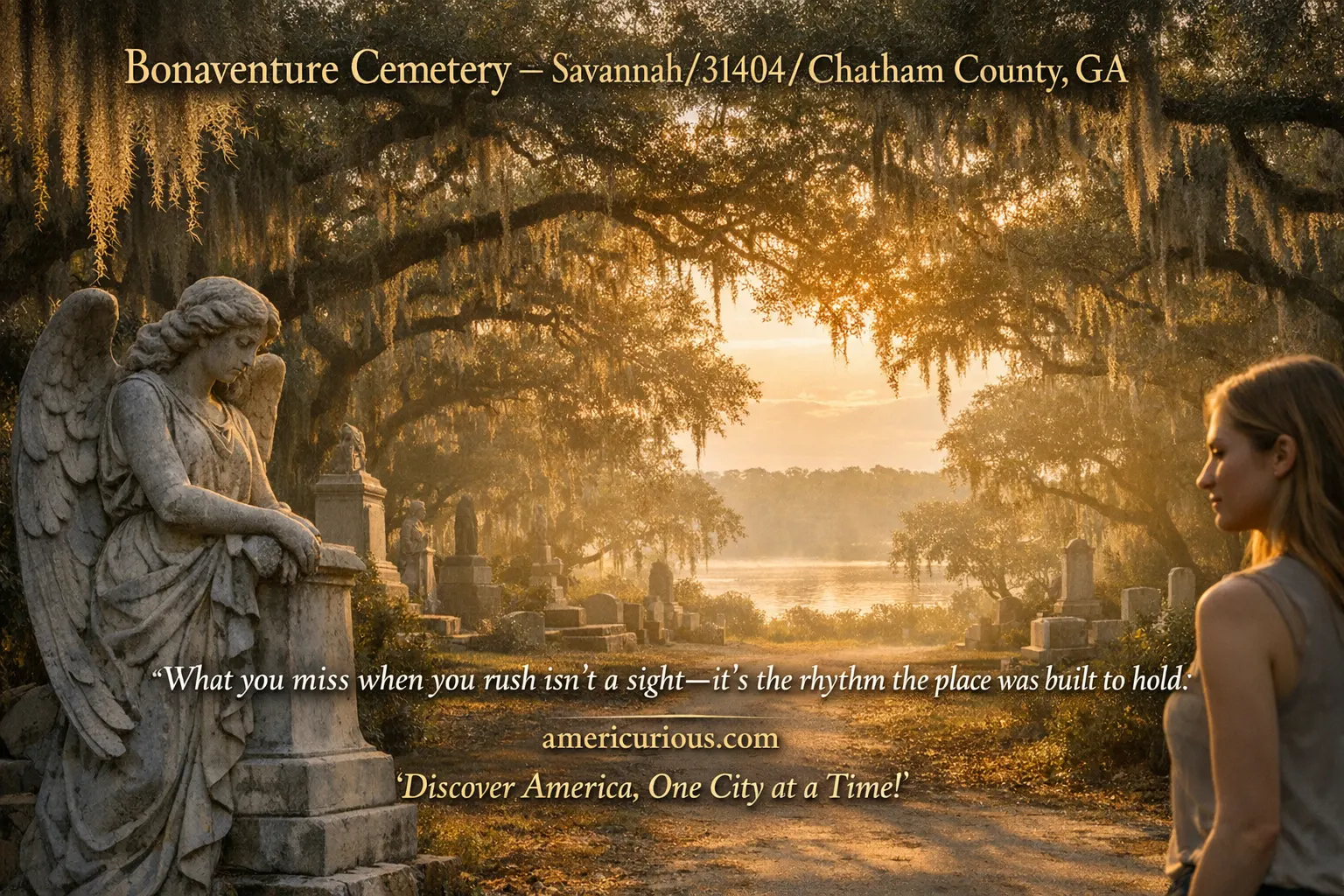
- Bonaventure Cemetery — 160 acres of historic graves, sculptural monuments, and arching tree canopy on the Wilmington River. Free every day of the year.
- Savannah Belles Ferry — A genuine river crossing between River Street and Hutchinson Island, operated by Chatham Area Transit at zero cost. Runs 7 a.m.–10 p.m. daily.
🗺️ Free Things to Do in Savannah, GA: 14 Verified Attractions
1. Forsyth Park — The City’s Living Room
At the northern edge of the Victorian District sits the fountain that appears on every Savannah postcard, travel guide, and social media post in existence — a white cast-iron centerpiece installed in 1858, modeled after the fountains at the Place de la Concorde in Paris. By now you’ve seen it a hundred times before arriving. What the photos don’t convey is the 30 acres surrounding it.
Weekday mornings, the park belongs to locals: dog walkers threading through the live oaks, art students sketching from benches with coffee going cold beside them, the occasional trumpet player in the main promenade who draws a small, quiet crowd. Saturday mornings, the entire central walkway becomes the Forsyth Farmers Market — Georgia peaches, heirloom tomatoes, local honey from Savannah Bee Company, handmade ceramics — free to browse, genuinely excellent.
When to go: Before 9 a.m. on weekdays for the local version; 9 a.m.–1 p.m. on Saturdays for the market. Insider tip: Walk south past the Civil War monument and the tennis courts — tourists almost never reach that end, and the tree canopy gets dramatically denser the further you go.
2. Savannah’s 22 Historic Squares — The Whole City Is the Attraction
When James Oglethorpe laid out Savannah in 1733, he built it around a grid of public squares — each one shaded, each one anchored by a monument, each one surrounded by the kind of antebellum architecture that makes people slow their walk and look up. There are 22 of them. Together they form the most walkable free museum in the American South.
The squares have distinct characters. Chippewa Square is where the Forrest Gump bench scenes were filmed, though the bench is long gone — the James Oglethorpe statue is what actually stands there. Johnson Square, the first established in the city, holds a tall obelisk honoring Revolutionary War General Nathanael Greene. Madison Square centers on Sergeant William Jasper, flanked on all sides by pre-Civil War mansions with wrought-iron balconies and original shutters intact.
When to go: Early evening, when the golden light filters through the moss-draped canopy and the squares stop being tourist corridors and start being neighborhood gathering places. Insider tip: Pick three or four squares and sit in them — the slow-travel approach extracts more from each square than a 22-stop sprint ever will.
3. Bonaventure Cemetery — Not a Tourist Attraction. An Experience.
Calling Bonaventure a cemetery undersells it. This is 160 acres on a bluff above the Wilmington River, developed on the site of a former plantation, purchased for burial use in 1846 and opened to the public in 1907. The live oak canopy above the roads is old enough that the branches touch overhead, and the Spanish moss hangs low enough to brush your shoulders if you’re not watching.
John Berendt’s Midnight in the Garden of Good and Evil brought it international attention in 1994, and the original Sylvia Shaw Judson Bird Girl sculpture — photographed here for the novel’s cover — now lives at Telfair Museums. What remained after the cultural spotlight is a working municipal cemetery that locals jog through in the late afternoon and photographers arrive at before sunrise to chase specific light. Free every day, entrance at 330 Bonaventure Road.
When to go: March through April, when azaleas bloom in pink and coral against the gray moss — the color contrast is remarkable. Insider tip: The pre-dawn visit is a categorically different experience; see the Smart Budget Strategy section for specifics on why the timing matters here more than anywhere else in Savannah.
4. Colonial Park Cemetery — The Headstones That Don’t Add Up
Savannah’s oldest surviving cemetery sits a few minutes’ walk from downtown — established in 1750, holding the graves of colonial-era citizens, signers of the Declaration of Independence, and a mystery that no other cemetery in the country shares. Along the eastern boundary wall, a row of relocated headstones contains dates that are mathematically impossible: deaths recorded before birth dates, lifespans listed at 200 years, names appearing twice with different death years.
The prevailing explanation is that Union soldiers quartered here during the Civil War rearranged them as a prank. Nobody has ever proven it. That uncertainty makes the walk along that eastern wall considerably more interesting than any guided tour script could.
When to go: Gates are typically open 8 a.m.–8 p.m. daily. Insider tip: Enter and go counterclockwise — you’ll hit the altered headstones before the main monument cluster, and before whatever group tours arrive mid-morning.
5. River Street & the Historic Riverwalk — Skip the Weekend Crowds
The cobblestones on River Street are original ballast stones from 18th-century ships — the same ships that brought cotton out and supplies in through what is now one of the busiest ports in the United States. That context makes the experience of watching modern container ships slide past at eye level genuinely compelling, in a way the souvenir shops on either side do not.
Walk the full mile of Riverwalk west to east and you’ll go from the Industrial District edge near Plant Riverside all the way to Morrell Park and the Waving Girl statue. Early morning, before the shops open, the waterfront is quiet enough to hear the river.
When to go: Before 9 a.m. for the industrial-quiet version; avoid Saturday and Sunday afternoons in summer entirely — the crowd density overwhelms the experience. ⚠️ Tourist Trap Warning: The weekend paid ghost tours departing from River Street are hit-or-miss and expensive. Savannah’s squares and cemeteries experienced solo after dark are more atmospheric and cost you nothing — the city does the heavy lifting.
6. Savannah Belles Ferry — A River Crossing That Costs Nothing
This surprises almost every first-time visitor: Chatham Area Transit operates a passenger ferry across the Savannah River at zero cost. The fleet consists of four vessels named after women who shaped Savannah’s history — the Juliette Gordon Low, the Susie King Taylor, the Florence Martus, and the Mary Musgrove — and they run continuously between River Street and Hutchinson Island from 7 a.m. to 10 p.m., seven days a week.
The crossing takes 10–20 minutes depending on which landing you use. The view of Savannah’s skyline from the water, watching the city recede as you cross, is unlike anything available from the shore. Bicycles are welcome. Dogs on leashes are welcome. The ride back toward the city, facing River Street at dusk, is the better direction for photos.
When to go: Board from the City Hall Landing (adjacent to the Hyatt Regency at the head of Bull Street) or the Waving Girl Landing in Morrell Park. Service runs daily except Thanksgiving, Christmas, and New Year’s Day. Insider tip: The ferry is the most underused free experience in Savannah — it takes 10 minutes and delivers a perspective of the city that most visitors never see.
7. Cathedral of St. John the Baptist — Enter, Stay a While
Most people walk past the Cathedral on Lafayette Square without going in. From the outside it reads as impressive Gothic Revival architecture framing an iron fence and an azalea-lined approach. The interior is the reason to stop. Stained glass windows installed in the late 19th century throw colored light across white marble floors, hand-painted murals cover the vaulted ceilings in shades that don’t photograph the way they look in person, and the acoustic quality of the space — that particular cathedral hush — shifts the experience completely.
Entrance is free. You’ll share it with people who are there to pray, which shapes the atmosphere in a way that ticketed attractions never manage. Midmorning on weekdays is ideal — the light through the south-facing windows is at its best and the space is nearly empty.
When to go: 10 a.m.–noon on weekdays. Avoid Sunday mornings unless you’re attending Mass. Insider tip: Lafayette Square immediately outside the Cathedral — with the low fountain, the wrought-iron fence of the Andrew Low House across the street, and overhanging oaks — is itself worth a photograph and a few minutes of standing still.
8. Jones Street — The One That Stops People Mid-Stride
Two blocks. That’s the stretch of Jones Street that travel writers and longtime Savannah residents keep returning to as a benchmark for what the city can look like at its most composed. Overarching live oaks form a low canopy across the brick sidewalk, antebellum rowhouses have been restored to better-than-original condition, and the particular quality of silence that settles over the street in the early morning belongs to a different era entirely.
There’s nothing to buy here, nothing performing, nothing requiring a ticket. Jones Street simply exists and looks the way it looks. Walk east from Abercorn to hook back into the square network; walk west and you’ll reach the edge of the Starland District, which is a different version of Savannah worth discovering.
When to go: Early spring when front-garden azaleas bloom, or any morning before 8 a.m. when the light comes in low through the canopy. Insider tip: The cross streets — particularly Abercorn and Lincoln — also carry historic architecture that most visitors pass through without slowing down.
9. City Market Gallery Row — SCAD’s Influence on Every Wall
City Market has operated in some form since 1755, first as a food and produce exchange, now as a courtyard anchored by restaurants and galleries. The galleries are the reason to come. Many owners are Savannah College of Art and Design graduates who stayed after school, and the work reflects that: technically ambitious, contemporary, and priced for serious collectors while remaining free for anyone to stand in front of and consider.
Sue Gouse Inspirations and the adjacent studios on the lanes around the courtyard are open to browsers with no minimum spend and no pressure. The courtyard itself frequently hosts street musicians and performers at no charge — show up and something is usually happening.
When to go: Weekday late afternoons, when artists are sometimes working in visible studios. Weekends are busier but more energetic. Insider tip: Walk the lanes off the main courtyard rather than staying in the center — the smaller studios are where the more interesting work tends to be.
10. Bull Street Heritage Walk — A Mile Through Three Centuries
Start at Johnson Square at the north end and walk south on Bull Street. In roughly a mile, you’ll pass through five public squares, stand across from the Independent Presbyterian Church where Woodrow Wilson married Ellen Axson, and reach Congregation Mickve Israel at Monterey Square — one of the oldest surviving synagogues in the United States and home to Georgia’s earliest Jewish congregation, founded by Sephardic immigrants who arrived in Savannah in the city’s earliest years.
The architecture along Bull Street leans Federal and Greek Revival, noticeably different from the Victorian streetscapes elsewhere in the Historic District. The antebellum mansions facing the squares are among the best-preserved examples in the American South — most still in residential use, which makes them feel inhabited rather than preserved.
When to go: Walk south in the late afternoon so you arrive at Forsyth Park’s fountain at golden hour. Insider tip: Congregation Mickve Israel’s Gothic Revival facade looks dramatically out of place compared to everything surrounding it — the architectural contrast is part of what makes it worth a long look from the square.
11. Savannah National Wildlife Refuge — Wild Georgia, Zero Entrance Fee
About 10 miles north of downtown, where the Savannah River meets a coastal plain of freshwater wetlands and tidal flats, the National Wildlife Refuge covers more than 26,000 acres with a 4-mile wildlife drive and trail access that requires no entrance fee and no parking charge. Alligators are a genuine possibility in warmer months. Wood storks, painted buntings, and bald eagles cycle through seasonally, and the spring migration window (March–May) brings species diversity that draws serious birders from across the region.
Note the conditions: dogs and other pets are not permitted on the refuge. The wildlife drive is accessible to bicycles, which changes the experience considerably — you stop when you want, you hear the marsh, and the birds register you as less threatening than a moving car.
When to go: Early morning in any season for wildlife activity; spring migration for maximum bird diversity. Insider tip: Most Savannah day-trippers head to Tybee Island and never consider the refuge — which is precisely why a Tuesday morning here feels like having wild coastal Georgia to yourself.
12. Savannah Botanical Gardens — Roses in February, Nobody Around
The Savannah Botanical Gardens, managed by the Savannah Area Council of Garden Clubs, doesn’t appear on most visitor itineraries. That’s a structural oversight, not a judgment on the place. The gardens include formal rose paths, a two-acre pond, seasonal bloom cycles that run from late winter through fall, nature trails, and an 1840s farmhouse that contextualizes the property’s history. No admission fee. No suggested donation sign at the entrance. Walk in and stay as long as you want.
Spring visits (late February through April) are the obvious choice for the roses and azaleas, but the fall brings warm-toned dahlias and late-season color that the spring crowds never see. The rose paths in morning light are consistently good for portrait photography — and consistently undiscovered.
When to go: Late February through April for peak bloom; weekday mornings for solitude. Insider tip: This is one of the few genuinely photogenic Savannah locations where you won’t be competing with other photographers.
13. Plant Riverside District — Strange Lobby, Great River Views
The JW Marriott converted a former Georgia Power plant on the western end of River Street into a mixed-use development that includes restaurants, galleries, a recording studio, and a lobby containing things that have no obvious explanation: enormous polished geodes from around the world arranged like furniture, a life-sized chrome dinosaur, and a live music schedule that competes with ticketed venues. All of it is free to walk through — no hotel guest status required.
The riverside promenade at Plant Riverside extends the Riverwalk experience westward, away from the tourist-dense stretch near the main River Street shops. At night, the illuminated geodes visible through the lobby glass create an atmosphere that’s genuinely bizarre and worth five minutes of your time.
When to go: Evenings for the full visual effect; Martin Luther King Jr. Park, which sits adjacent to the property, has river views and almost no foot traffic regardless of the hour. Insider tip: Check the live music calendar before going — free performances in the district are frequent and not widely publicized.
14. The Waving Girl Statue & Morrell Park — The Better End of River Street
Florence Martus waved at every ship entering and leaving the Port of Savannah for over four decades, becoming so well-known internationally that vessels from distant ports would sound their horns in response. The bronze statue commemorating her stands at the eastern end of River Street in Morrell Park — and most visitors to River Street turn back before reaching it.
That pattern works in your favor. The area around the Waving Girl is consistently less crowded, better for photographs, and quieter for river-watching than the main stretch. The Belles Ferry’s Waving Girl Landing operates from this park — two free experiences stacked at the same location, which makes it an efficient starting or ending point for an afternoon along the water.
When to go: Late afternoon, when the westward light illuminates the statue directly. Insider tip: Arrive at the Waving Girl Landing around 9 a.m. on a weekday and you’ll often catch the ferry with few other passengers — the better direction to board for uncrowded views of the skyline.
📌 What Most Savannah Travel Blogs Consistently Miss
Most competitor articles pull from the same handful of sources and miss these five things entirely.
The free dot Express Shuttle covers the entire Historic District. Chatham Area Transit runs two free electric shuttle routes through downtown — one looping the upper Historic District past City Market and major squares, one running the Forsyth Park corridor along Bull Street. Buses run every 10 minutes on weekdays (7 a.m.–7 p.m.) and on Saturdays (10 a.m.–7 p.m.). That frequency means you can stack neighborhoods in summer heat without walking the cobblestones — something almost no visitor guidebook bothers to mention.
Super Museum Sunday unlocks Savannah’s paid museums for one day each year. Every February, as part of the Georgia History Festival, over 100 museums across Georgia open for free. In Savannah alone, the 2026 event included the Telfair Academy, Jepson Center for the Arts, SCAD Museum of Art, Ships of the Sea Maritime Museum, Congregation Mickve Israel, the Davenport House Museum, Flannery O’Connor Childhood Home, and more than a dozen others — places that normally charge $15–22 per adult. Mark the first or second Sunday in February on your calendar for next year.
Live Oak Public Libraries cardholders get Telfair Museums free. The library system offers a seven-day Telfair Museums Family Pass — valid for up to eight people — covering free admission to the Jepson Center and Telfair Academy. It’s documented on the library’s website. Out-of-area visitors can inquire about a non-resident card. This is not a well-advertised program, which is exactly why it belongs here.
The Starland District has its own monthly free art walk. On the first Friday of every month, roughly 20 galleries, studios, restaurants, and boutiques in the Starland District — centered on the 2300 block of Bull Street, south of Forsyth Park — open their doors for a free art walk. These are working artist studios and emerging gallery spaces run by SCAD graduates who stayed in the city, not the curated tourist galleries of City Market. The energy is different because the stakes are different.
Savannah Jazz Festival is free, annual, and underreported. Every fall — typically late September through early October — the Savannah Jazz Festival takes over Forsyth Park and Historic District venues for multiple days of performances. Local and touring jazz musicians play at no charge, with food vendors and a community atmosphere that reflects how the city actually behaves when it isn’t performing for visitors. U.S. News Travel has called it one of the standout free festivals in the country. Somehow it’s absent from most Savannah free-activity lists.
💎 Hidden Gems: The Savannah Most Visitors Never Find
- Whitefield Square — At Gordon and Habersham Streets, this is the square that Savannah locals consistently recommend and visitors consistently skip. A Victorian gazebo anchors the center, Queen Anne homes flank every approach, and the azalea blooms in spring arrive in concentrated pink and magenta that the more famous squares can’t match. It’s less than half a mile from Forsyth Park and appears on almost no standard itinerary. Best time: Early morning before foot traffic arrives from the Historic District hotels.
- Savannah African Art Museum — Located in the Thomas Square Historic District (off the standard tourist corridor), this nonprofit museum houses over 1,000 works of African art from 28 countries — ceremonial masks, bronze sculptures, textiles, and carved figures — assembled by Savannah businessman Don Kole. The collection belongs in a major metropolitan institution and happens to be in a Savannah townhouse. Free admission; donations are welcomed.
- Savannah National Wildlife Refuge by Bicycle — The 4-mile wildlife drive through the refuge is open to cyclists, and the difference between the windshield version and the bicycle version is significant. You stop when you want, you hear the marsh without engine noise, and the wildlife treats you as less intrusive than a slow-rolling vehicle. No fee, no parking required, and the experience typically takes about 45 minutes at an easy pace.
- Savannah Book Festival — February, Telfair Square — Held annually over a February weekend, this free literary festival brings nationally recognized authors for public talks, panel discussions, and readings — all at no charge. Sessions are hosted in Telfair Square and inside the Jepson Center’s Neises Auditorium. It draws a crowd that is specifically in Savannah to think about ideas, which creates a genuinely different atmosphere in the squares for that particular weekend.
- Jones Street Before 8 A.M. — Worth listing separately from the main entry. The street at 7:30 a.m. on a weekday — empty, low morning light filtering through the oak canopy, no sounds from the restaurants that haven’t opened — is a different place than the one that appears in travel photos. Walk it before the city wakes up and it’s one of the better 15 minutes available anywhere in Savannah at any price.
🎨 Free by Vibe: Find Your Savannah
Chill / Nature
- Forsyth Park on a weekday morning — bring coffee, find a bench in the south end
- Savannah Botanical Gardens — roses, trails, and a two-acre pond with minimal foot traffic
- Savannah National Wildlife Refuge — alligators, coastal birds, actual wilderness 10 miles from downtown
- Bonaventure Cemetery at sunrise — 160 acres of Spanish moss and near-total silence
- Whitefield Square — Victorian gazebo, Queen Anne homes, local secret made official
Instagram Spots
- Forsyth Park Fountain — iconic, but crowded by 10 a.m.; arrive before 9 for clear shots
- Jones Street at dawn — consistently the most photogenic street in the city
- Waving Girl statue at golden hour — bronze figure, river behind it, light from the west
- Plant Riverside District lobby geodes — legitimately strange; illuminated at night
- Bonaventure Cemetery in spring — azaleas in bloom against gray Spanish moss is the shot
Culture / History
- Bull Street Heritage Walk — five squares, Federal architecture, Congregation Mickve Israel
- Colonial Park Cemetery — specifically the altered headstones along the eastern wall
- Cathedral of St. John the Baptist — free entry, 19th-century murals, genuine quiet
- City Market gallery row — SCAD-trained artists, contemporary work, no admission charge
- Starland District First Friday Art March — working studios, not curated tourist galleries
💡 Smart Budget Strategy: Maximizing Savannah on Zero Activity Budget
Arrive Thursday or Friday, leave Sunday morning. The dot Express Shuttle runs weekdays 7 a.m.–7 p.m. and Saturdays 10 a.m.–7 p.m. — which aligns with the best free activity windows. Saturday’s Forsyth Farmers Market runs 9 a.m.–1 p.m. The Starland First Friday Art March happens monthly, and planning around it costs nothing except choosing a first-Friday arrival date.
Park once and use free transit for everything else. Savannah Historic District parking costs $8/day or more in most garages. Instead: park in a residential area beyond the immediate Historic District where street parking is free, then use the dot Express Shuttle routes to reach the core. The Belles Ferry extends that coverage across the river. The combination handles everything from Forsyth Park to the Riverwalk without moving your car a second time.
Use the library card hack before you arrive. If you have access to a Live Oak Public Libraries card, check out the seven-day Telfair Museums Family Pass — valid for up to eight people — before your trip begins. Free admission to the Jepson Center and Telfair Academy is worth $22+ per adult per visit. Extended-stay visitors can stack the pass with a Super Museum Sunday visit in February and access essentially every museum in the city at no cost.
The free tastings are real and worth planning around. River Street Sweets offers a complimentary warm praline sample to anyone who walks in — no purchase necessary, no awkwardness about it. The Savannah Bee Company on Broughton Street runs honey and mead tastings that function as a legitimate sensory experience. Neither is a meal. Both are the kind of detail that rounds out a day built around free attractions without feeling like a compromise.
⏰ Best Time of Day Insight — Bonaventure Cemetery: Arrive before 8 a.m. and you’ll have the major monuments essentially to yourself, the morning light filtering through the oak canopy at a low angle that creates the photographic conditions most people associate with the cemetery. By 10 a.m., tour groups arrive from downtown hotels and the atmosphere shifts. Those two hours represent the difference between a meditative walk and a queue at a famous landmark.
❓ FAQ: Free Things to Do in Savannah, GA
Is Savannah actually free to explore, or are the best things ticketed?
The majority of what makes Savannah worth visiting is genuinely free. The 22 historic squares, Forsyth Park, Bonaventure Cemetery, Colonial Park Cemetery, River Street, the Savannah Belles Ferry, the free dot Express Shuttle, Jones Street, the Cathedral of St. John the Baptist, the Botanical Gardens, and the National Wildlife Refuge all have zero admission costs. Paid museums and ticketed tours exist, but they are supplementary to what Savannah offers publicly — not the core of the experience.
What free things to do in Savannah, GA work well with kids?
Forsyth Park has a playground, open grass for running, and a Saturday farmers market that gives children something tangible to engage with. The Belles Ferry river crossing takes 10–20 minutes and consistently captures kids’ attention in a way that walking tours do not. Colonial Park Cemetery’s altered headstones are unexpectedly compelling for older children — the mystery of the rearranged dates is a genuinely interesting story. The National Wildlife Refuge, particularly in alligator season, makes a strong impression on any age group.
What free Savannah experience do tourists always skip?
Whitefield Square, without question. Savannah locals recommend it consistently; visitors skip it consistently because it doesn’t appear on standard itinerary lists. The Victorian gazebo, Queen Anne architecture, and spring azalea blooms make it quieter and more beautiful than many of the better-known squares. It’s at Gordon and Habersham Streets, less than half a mile from Forsyth Park.
Is Bonaventure Cemetery free to visit?
Yes — Bonaventure Cemetery is a municipal cemetery with free public access 365 days a year. The entrance is at 330 Bonaventure Road, roughly three miles east of downtown. No admission fee, no tour required, no advance booking. Spring visits (March–April) are particularly dramatic, when azaleas bloom among the historic graves and sculptures.
When is the best time of year for free things to do in Savannah?
Spring — late February through April — delivers the best conditions: moderate temperatures, azalea and rose blooms throughout the squares and Botanical Gardens, and an active Forsyth Farmers Market. Fall brings the Savannah Jazz Festival (typically late September), a free multi-day event in Forsyth Park. February is strategically valuable for Super Museum Sunday, which makes the paid museums free for a single day. Summer keeps the free outdoor experiences fully operational but comes with heat that significantly affects walkability.
Is there free public transportation in Savannah’s Historic District?
Yes — the dot Express Shuttle runs two free routes through the Historic District: a downtown loop serving City Market and major squares, and a Forsyth Park corridor route along Bull Street. Buses run every 10 minutes on weekdays (7 a.m.–7 p.m.) and Saturdays (10 a.m.–7 p.m.). The Savannah Belles Ferry adds a free river crossing between 7 a.m. and 10 p.m. daily. Together, these cover virtually every free attraction in the city without requiring a car or a rideshare.
What are the best free nighttime experiences in Savannah?
The historic squares at night are the honest answer. The combination of low ambient lighting, the movement of Spanish moss in river-cooled air, and the scale of the architecture removes most of the daytime tourist texture and leaves something genuinely atmospheric — at no cost and without a tour guide providing narration. The Belles Ferry runs until 10 p.m. and offers a different view of the city skyline after dark. Plant Riverside District’s lobby and riverside promenade are open in the evening, and the illuminated geodes visible through the glass are worth a quick stop.
Why Savannah Rewards People Who Stop Rushing
There’s a version of this city that exists behind a payment wall — the trolley tour, the ticketed ghost walk, the horse-drawn carriage clicking over the cobblestones with a narrated route. None of it is wrong. Some of it is quite good. But the parts of Savannah that actually stay with you don’t live behind those walls.
They live in the particular silence of Bonaventure Cemetery before the city wakes up. In the moment on the Belles Ferry when River Street gets small behind you and the river fills your whole field of vision. In the trumpet player in the Forsyth promenade on a Tuesday morning who has no audience and doesn’t need one.
Savannah is one of the few American cities where moving slowly isn’t a compromise — it’s the entire strategy. The city was designed around 22 outdoor rooms. It was built for lingering. Budget travelers, local explorers, and anyone with a low tolerance for the performance of tourism will find that the best version of Savannah costs nothing and takes longer than a weekend to fully exhaust.
That’s the point.
Discover more from AmeriCurious
Subscribe to get the latest posts sent to your email.