Fort Collins history runs deeper than craft beer & CSU. Unearth 8 buried stories, 12 jaw-dropping facts & 10 notable figures from Colorado’s Choice City. 🏔️
Fort Collins, Colorado: The Untold History
By Americurious | Local Lore series | Researched and verified: April 2026 | Found an error? Tell us. We review this guide as new historical evidence emerges.
This guide was built from primary government records, digitised newspaper archives including Chronicling America and the Fort Collins Museum of Discovery Archives, peer-reviewed academic publications, Colorado State University Libraries Special Collections, and established regional journalism — cross-referenced across a minimum of two independent sources per claim. Unverified claims are tagged [⚠️ UNVERIFIED — CHECK SOURCE] in the editorial draft.
Module 1 — Hidden Stories of Fort Collins, Colorado
Last Updated / Research Verified: April 2026. Source links checked at time of publication. New historical discoveries or corrections should be reported to editorial@americurious.com.
The year is 1969. A photographer is positioning his equipment near the top floor of the Rocky Mountain Bank and Trust Building in downtown Fort Collins, Colorado. Downstairs, the whole city is watching. The bartender — one Les Ware, owner of the Top Restaurant — looks at the clock. It is approximately 5:00 p.m. on August 8th. He pours a drink. It is the first legal glass of spirituous liquor served in Fort Collins since 1896.
Seventy-three years. Two world wars. The Jazz Age, the Great Depression, the atomic bomb, the moon landing. And through all of it, Fort Collins — a city of universities and farms and good intentions — had stayed officially, stubbornly, legally dry.
The photographer clicked the shutter. Reporters from The Coloradoan were already writing their leads. The story, as far as Fort Collins was concerned, was just getting started.
Story 1 — “The 73-Year Experiment in Sobriety” | 1896–1969
Era: 1896–1969
It began, as most Fort Collins stories do, with women who had made up their minds.
In August 1880, several prominent local women established a Fort Collins chapter of the Women’s Christian Temperance Union — a full sixteen years before their campaign reached its legal conclusion. Fort Collins in the 1870s and 1880s had been shaped deliberately to distinguish itself from the chaotic mining and cattle camps that scarred much of the frontier West. Early promotional materials recruiting settlers to the area were explicit: “What we do not want is whiskey saloons or gambling halls.” (Source: Ansel Watrous. History of Larimer County, Colorado. The Old Army Press, 1911.) The city had a plan. It would be a sober-sided, school-having, church-going place — different in kind from the riotous settlements up and down the Front Range.
By 1896, the Larimer County Board of County Commissioners signed legal prohibition into law, beating the rest of the country by more than twenty years. (Source: Colorado State University Collegian. “Beer Edition: Understanding the History of Beer in Fort Collins.” April 2022.) Fort Collins had gone dry before anyone in Washington had thought to try it nationally.
When the federal 18th Amendment arrived in 1920, Fort Collins was already ahead of the curve — and when it was repealed in 1933, the city looked at the national celebration and quietly declined to participate. The law was softened, eventually, to allow 3.2% alcohol by volume in certain licensed establishments, but full-strength spirits remained officially banned for another three and a half decades. The Matterhorn, a dance hall and restaurant that made the case beer enhanced “the dining experience,” became one of the only legal places in the city to drink anything — and it skyrocketed in popularity for precisely that reason. (Source: Clio Tour 882, “Fort Collins Beer, Brewing, and History Tour,” theclio.com/tour/882.)
The dam finally broke in 1968, when Colorado State University students organised what they called a “beer-in”: sleeping and drinking Coors in the student union as a direct protest of the city’s conservative laws. Doug Phillips, president of the Associated Students of CSU, led the demonstration. The movement worked. On April 8, 1969, the Fort Collins City Council voted to permit the sale of beer, wine, and liquor and passed Ordinance No. 14. The first legal liquor license was granted to Les Ware, owner of the Top Restaurant. (Source: Intermountain Histories. “Fort Collins (un)Tapped: Local Stories of Prohibition, Bootlegging, and Brew Culture.” intermountainhistories.org.)
The Coloradoan reported that the first legal spirituous drink in Fort Collins since 1896 was served at approximately 5:00 p.m. on August 8, 1969 — after Ware had secured his license and opened for business. Les Ware, practical man that he was, had hired photographers to document the moment. He understood, in a way city hall perhaps did not, that history had just walked in and sat down at his bar.
Key Figures: The WCTU founding members of 1880 (names not fully documented in Tier 1 sources — [⚠️ UNVERIFIED — CHECK SOURCE]); the Larimer County Board of County Commissioners, 1896; Doug Phillips, ASCSU president, 1968; Les Ware, first legal liquor license holder, 1969.
Why It Mattered Then: Fort Collins’s prohibition represented a genuine civic identity — the city understood itself as a community of restraint, order, and educational purpose. When the national ban ended in 1933, Fort Collins’ decision to stay dry was not merely stubbornness but a statement about what the city believed it was. Businesses suffered; neighbouring towns with legal liquor did better trade. The debate that eventually ended prohibition in 1969 involved local businessmen, university students, and the City Council in what amounted to a referendum on the city’s self-image.
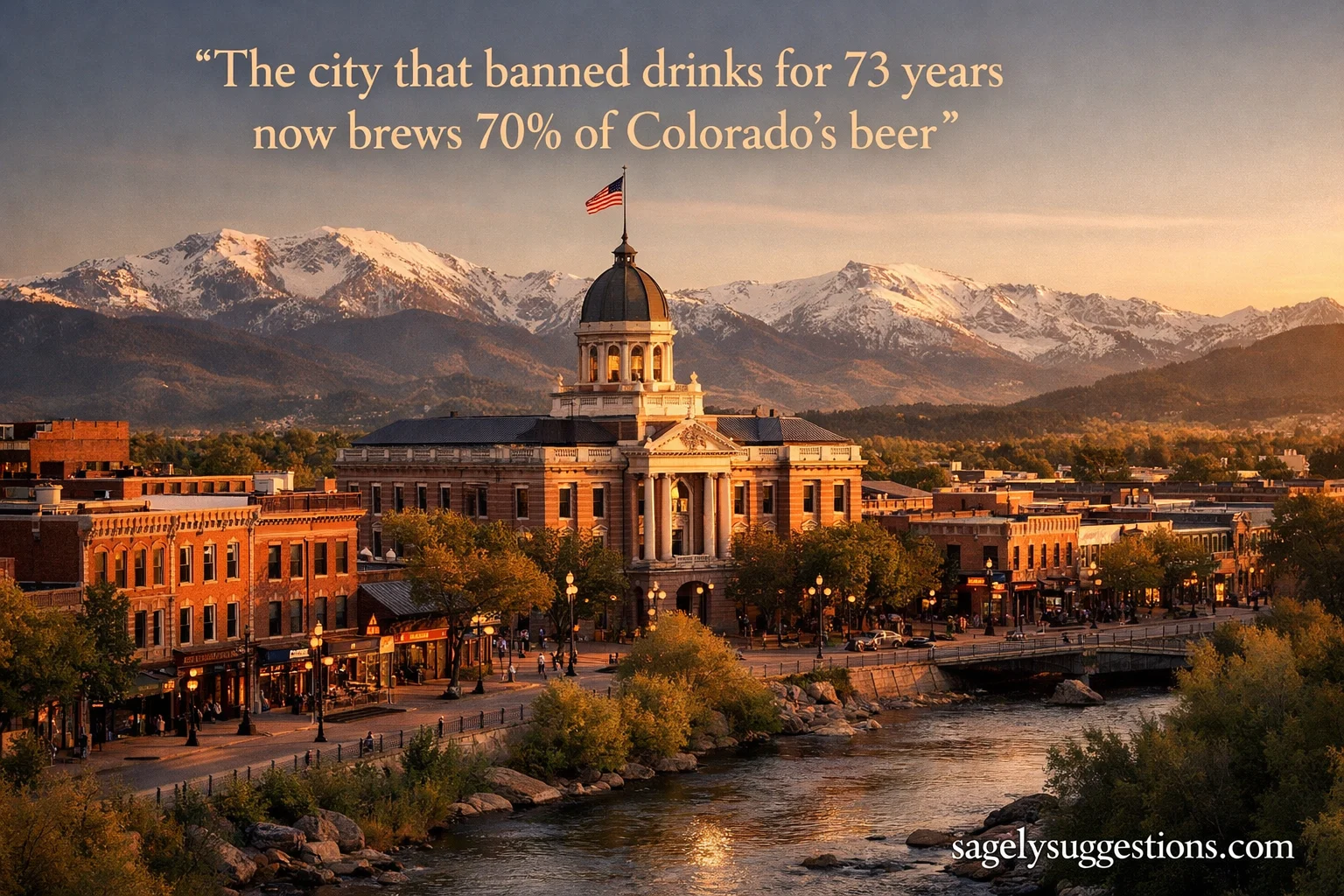
Why It Matters Now: Fort Collins today is home to more than twenty craft breweries and produces, by some estimates, approximately 70% of all beer brewed in the state of Colorado. (Source: Public Lands History Center, Colorado State University. “Beer in Fort Collins: The Brewmuda Triangle.” publiclands.colostate.edu.) The city that didn’t allow a drink for seventy-three years is now considered one of the premier craft beer destinations in North America. There is a lesson in that trajectory, though reasonable people may disagree about what it is.
Source Trail:
[1] Watrous, Ansel. History of Larimer County, Colorado. The Old Army Press, 1911.
[2] Public Lands History Center, CSU. “Beer in Fort Collins: The Brewmuda Triangle.” publiclands.colostate.edu, 2014. Link
[3] Intermountain Histories. “Fort Collins (un)Tapped.” intermountainhistories.org. Link
Story 2 — “The Town America Submerged” | 1940s
Era: 1940s (Colorado-Big Thompson Project)
There is a town beneath Horsetooth Reservoir. Not metaphorically — literally. On certain days, when the water level drops enough, old stone foundations become visible along the western banks, catching afternoon light like a confession.
The town was called Stout. It had begun in the 1860s as a labour camp for workers quarrying the rich sandstone deposits in the surrounding hills — deposits that supplied construction materials throughout the region during the building boom of the late 19th century. By the 1880s, Stout had matured: it had sandstone quarries, workers’ housing, and rail access that connected it to the commerce of the Front Range. The Fort Collins Courier noted in an 1881 issue that the surrounding region’s “riches in the quarries” had been overlooked by settlers who assumed the land’s value was agricultural alone. (Source: Fort Collins Courier, September 1, 1881. Archived at Larimer County Local History Archive.) Stout was proof otherwise.
What ended Stout was not decline. What ended Stout was water policy. The Colorado-Big Thompson Project, one of the great federal water engineering efforts of the 20th century, required a large storage reservoir on the west side of Fort Collins. The site chosen was the Horsetooth valley — which happened to contain Stout. In the 1940s, the town was evacuated and flooded. No one relocated the buildings. The water simply rose over them.
Horsetooth Reservoir today is one of the most popular recreational lakes in northern Colorado: boating, fishing, swimming, hiking on the surrounding ridgelines. Visitors take photographs of the dramatic hogback topography. Relatively few know they are floating over a town. As of April 2026, remnants of Stout remain visible during periods of low water, and the Fort Collins Museum of Discovery holds documentation of the original settlement in its Local History Archive. (Source: Visit Fort Collins. “8 Facts You Didn’t Know About Fort Collins.” visitftcollins.com.)
Key Figures: The quarry workers of Stout (individual names not fully documented in Tier 1 sources — general population); Bureau of Reclamation officials, Colorado-Big Thompson Project administrators (1930s–1940s).
Why It Mattered Then: The Colorado-Big Thompson Project was controversial — it required the relocation and/or sacrifice of properties and communities to serve the agricultural water needs of the eastern plains of Colorado. Stout was one of the casualties. The project ultimately delivered water to more than 30 cities and 700,000 acres of farmland, representing one of the largest transbasin diversion projects in the American West.
Why It Matters Now: Water rights and water policy remain the defining political question of the American West. Fort Collins sits at the confluence of those tensions, drawing its drinking and brewing water from the Cache la Poudre River while using Horsetooth as a reservoir — and the ghost of Stout, occasionally surfacing below the waterline, is a useful reminder of what the infrastructure of thirst has cost.
Source Trail:
[4] Fort Collins Courier, September 1, 1881. Fort Collins Museum of Discovery Local History Archive, Fort Collins, CO. [⚠️ DATED — VERIFY for current archive accessibility]
[5] Database of Place — Northern Colorado History. “Stout.” places.northerncoloradohistory.com. Link
[6] Visit Fort Collins. “8 Facts You Didn’t Know About Fort Collins.” visitftcollins.com, 2025. Link
Story 3 — “The Boy Who Remembered Main Street” | 1911–1955
Era: 1911 (birth) through 1955 (Disneyland opening)
Every year, somewhere between 18 and 20 million people walk through the gates of Disneyland in Anaheim, California, and stroll down Main Street USA. The storefronts, the lamp posts, the courthouse cupola, the general scale of an American town at the turn of the century — all of it feels familiar and comforting in the particular way that idealized memory does. Most of those visitors have no idea they are walking through a childhood they never had — specifically, the childhood of a Fort Collins boy named Ralph Harper Goff.
Goff was born on March 16, 1911, in Fort Collins, Colorado. His father, Ralph Algine Goff, owned and operated the Fort Collins Express Courier newspaper. (Source: Wikipedia. “Harper Goff.” en.wikipedia.org. Link.) The family lived in a two-storey brick house a short distance from the Colorado Agricultural College campus — later Colorado State University — and Harper grew up wandering Old Town’s Victorian streetscape: banks that looked like banks, a city hall with a dramatic cupola, brick sidewalks and trolley tracks. In 1920, the family relocated to Santa Ana, California, but the streets of Fort Collins apparently never left him.
In 1951, Goff — by then a Hollywood set designer and art director at Warner Bros. — was in London, browsing a model train shop called Bassett-Lowke Ltd. Another customer was also there, equally absorbed in the trains. That customer was Walt Disney. (Source: Walt Disney Family Museum. “Harper Goff: The ‘Second’ Imagineer.” waltdisney.org, 2017. Link.) They struck up a conversation, bonded over their shared love of model railroading, and Goff found himself hired as one of the lead designers for a park Walt was planning — what would become Disneyland.
When it came time to design Main Street USA, Goff had photographs of Fort Collins taken and brought to the design sessions. In a 1992–1993 interview with The “E” Ticket magazine — the primary documented source for his account — Goff recalled: “I was born in that little town… Fort Collins, Colorado. My dad owned a newspaper there, the Fort Collins Express Courier, and I grew up there. It was a very prosperous town. We had banks that looked like banks, you know, and there was a Victorian city hall. I was born in 1911 and these buildings were around when I was a kid. When I started working on Main Street, I had photographs of Fort Collins taken. I showed them to Walt and he liked them very much. Disneyland’s City Hall was copied from Fort Collins… so was the Bank building and some of the others.” (Source: Goff, Harper. Interview. The “E” Ticket. Winter 1992–93. Cited in Fort Collins History Connection, Fort Collins Museum of Discovery. history.fcgov.com.)
Disney historian Jeff Kurtti would later call Goff “the Second Imagineer” — after Walt himself. Goff also art-directed Disneyland’s Adventureland, helped design the Jungle Cruise, and contributed concept work to EPCOT Center. He died on March 3, 1993, in Palm Springs, and was posthumously named a Disney Legend. Back in Fort Collins, Disneyland’s City Hall — drawn from the Larimer County Courthouse at three-quarter scale — still stands on Disneyland’s Main Street. The original courthouse still stands in Fort Collins. It is an unusual distinction: two buildings, separated by California desert, one of them a memory of the other.
Key Figures: Harper Goff (March 16, 1911 – March 3, 1993), artist, designer, Disney Legend; Ralph Algine Goff, his father, Fort Collins Express Courier newspaper owner; Walt Disney, who commissioned and approved the design.
Why It Mattered Then: Disneyland opened on July 17, 1955. Main Street USA was its emotional spine — the first thing visitors experienced and the last they passed through on the way out. Its ability to conjure a warmly remembered small-town America was essential to the park’s identity. That this feeling derived, in part, from a real town — Fort Collins — rather than pure fabrication gives it a different quality: Disneyland’s nostalgia had an address.
Why It Matters Now: Fort Collins knows about this connection, and takes quiet pride in it. The Fort Collins Museum of Discovery holds two original works of art by Harper Goff. His childhood home on South Howes Street still stands. The Collegian has reported that preservation efforts for the home have been complicated by its proximity to the CSU campus and development pressure. Fort Collins walks a street that helped design a street that 18 million people walk every year — and most of them don’t know it.
Source Trail:
[7] Wikipedia. “Harper Goff.” en.wikipedia.org. Link
[8] Walt Disney Family Museum. “Harper Goff: The ‘Second’ Imagineer.” waltdisney.org, 2017. Link
[9] Fort Collins History Connection, Fort Collins Museum of Discovery. “Old Town and Disneyland’s Main Street USA.” history.fcgov.com. Link
Story 4 — “The Flood That Built a City” | June 1864
Era: 1862–1864
Fort Collins exists where it does because of a flood.
In 1862, the U.S. Army established Camp Collins on the Cache la Poudre River near the present-day community of LaPorte — a strategic position meant to protect travellers and freight wagons along the Colorado branch of the Overland Trail. The post was named after Lieutenant Colonel William O. Collins, commanding officer of the 11th Ohio Volunteer Cavalry. (Source: Visit Fort Collins. “History of Fort Collins.” visitftcollins.com. Link.) For two years, Camp Collins served its function: a garrison on the frontier, protecting a road that moved people and goods into a territory increasingly disrupted by the tensions of westward expansion.
In June 1864, the Cache la Poudre flooded. The original camp, built too close to the riverbank, was overwhelmed. The soldiers relocated to higher ground — the area that is now the heart of downtown Fort Collins, some distance to the east. Less than three years after the move, the fort was formally abandoned by the Army, in 1867. It left behind, however, the administrative and social infrastructure of a town already forming around it: a small hotel, a general store, a post office, a mill, a school, and a brickyard. By 1872, that infrastructure had attracted enough settlers to incorporate formally as a civilian community. (Source: Cache la Poudre–North Park Scenic Byway documentation. heiditown.com, 2026.)
The only original structure from the military period that survives is known as “Auntie Stone’s Cabin” — a log building associated with Elizabeth Stone, who operated a boarding house that served soldiers and travellers. In 1976, the cabin was relocated to Library Park, where it remains as of April 2026. (Source: Cache la Poudre Byway documentation, cited above; Fort Collins Museum of Discovery archives.)
Key Figures: Lieutenant Colonel William O. Collins, commanding officer, 11th Ohio Volunteer Cavalry; Elizabeth “Auntie” Stone, boarding house operator and early civilian pioneer; the soldiers of the 9th Kansas Volunteer Cavalry who initially garrisoned the post.
Why It Mattered Then: The Overland Trail was one of the primary overland routes for settlers, freight, and eventually the Pony Express during a critical decade in American expansion. A military garrison at this point on the Cache la Poudre had genuine strategic value. The flood that displaced the camp was a nuisance that became, inadvertently, a city plan.
Why It Matters Now: The Cache la Poudre River — the instrument of Fort Collins’s involuntary relocation — is today Colorado’s only nationally designated Wild and Scenic River, running directly through the city it helped position. The flood of 1864 set the coordinates for every building, street, and brewery that followed. Fort Collins was not planned so much as aimed there by high water.
Source Trail:
[10] Visit Fort Collins. “History of Fort Collins.” visitftcollins.com. Link
[11] Cache la Poudre–North Park Scenic & Historic Byway Itinerary. heiditown.com, April 2026. Link
Story 5 — “Gunpowder in the Snow: How a River Got Its Name” | Early 1800s
Era: Early 19th century (pre-settlement)
Before Fort Collins existed — before the Army arrived, before the settlers, before the university — the river had a name. And the name is, in retrospect, exactly the kind of thing that happens when men who are cold, afraid, and carrying too much gunpowder make a practical decision in the middle of a blizzard.
Local tradition holds that in the early 1800s, a group of French-Canadian fur trappers was caught in a severe winter storm somewhere along the river’s banks. Facing impossible trail conditions and desperate to lighten their loads, they buried a significant quantity of black gunpowder — la poudre — in a hidden cache along the river, with the intention of recovering it later. The cache part is “cache” in French. The powder part is “la poudre.” The river thereafter became known as the Cache la Poudre — roughly, “hide the powder” — and the name has outlasted everything else about those particular trappers, including any record of who they were. (Source: Cache la Poudre–North Park Byway documentation, citing the Historic Marker at LaPorte, as of April 2026. Link.)
Whether the trappers ever came back for the gunpowder is, appropriately, not recorded. Local tradition holds that this is where the name comes from; the episode itself, in the absence of documentary records, should be classified as widely-repeated local tradition rather than documented historical fact.
What is documented is the river’s status. In 1986, a 76-mile stretch of the Cache la Poudre was designated a National Wild and Scenic River — the only river in Colorado to hold this federal designation. (Source: National Park Service, Wild & Scenic Rivers. rivers.gov.) The river runs directly through downtown Fort Collins, supplying water to the city and, notably, to its breweries. The trappers, whoever they were, had excellent taste in rivers.
Key Figures: Anonymous French-Canadian fur trappers (names unknown; episode classified as local tradition — [⚠️ UNVERIFIED — CHECK SOURCE]).
Why It Mattered Then: The fur trade of the early 19th century brought European and Canadian trappers into terrain that would later become Colorado, establishing geographic and linguistic markers that persist to this day. French place names across the American West — from this river to the Poudre Canyon to LaPorte itself (meaning “the door,” or gateway to the mountains) — are the linguistic residue of that era.
Why It Matters Now: Fort Collins residents still refer to it simply as “the Poudre.” The name has outlasted every person, institution, and building in the city’s history.
Source Trail:
[12] National Park Service, Wild & Scenic Rivers Program. rivers.gov. Link
[13] Cache la Poudre–North Park Scenic & Historic Byway documentation. heiditown.com, 2026. Link
Story 6 — “The Professor Who Came Home” | 1985–1991
Era: 1983–1991
On June 9, 1985, a car carrying Thomas Sutherland — Dean of Agriculture at the American University of Beirut, and for the previous 26 years a professor of animal sciences at Colorado State University in Fort Collins — was forced to the kerb by men with submachine guns. Sutherland later described the moment in an interview with Colorado Public Radio: the car sideswiped, cut off, stopped. A man came around to his side of the vehicle, pulled open the door, and said, in plain language, that he should get out.
Sutherland had been warned. The U.S. State Department had urged him and other Americans at AUB to leave Lebanon. The university’s president, Malcolm H. Kerr, had been assassinated in 1984. A colleague, Frank Reiger, had been kidnapped that same year. Sutherland stayed, believing in the work — in what education could do in a country collapsing into civil war. (Source: CSU Libraries. “Papers of Thomas M. Sutherland.” archives.colostate.edu. Link.)
He was held by Islamic Jihad, a Shiite militia with ties to Iran, for 2,353 days — nearly six and a half years. He would become the second-longest-held captive of the Beirut hostage crisis, behind AP journalist Terry Anderson. The two men spent much of their captivity in the same cells, sometimes on the same chain. To keep their minds from dissolving, Anderson asked Sutherland to teach him his university courses. The professor obliged — delivering lectures on animal science from memory, in the dark, with no notes. (Source: KUNC. “Remembering Tom Sutherland.” kunc.org, 2016. Link.)
Sutherland was released on November 18, 1991. He returned to Fort Collins to a reception at Moby Arena that filled the building. Bagpipes played at the ceremony — a nod to his Scottish birth. In 2001, the Sutherland family won a $323 million federal judgment against frozen Iranian government assets for Iran’s role in directing the kidnappings. The settlement — ultimately settled for approximately $35 million — was used, in large part, to fund Fort Collins arts and cultural organisations: the Bas Bleu Theatre, Open Stage Theatre, the Larimer Chorale, the Fort Collins Symphony. The CSU Libraries Special Collections holds his papers, archived as of April 2026.
Sutherland died in Fort Collins on July 22, 2016, at the age of 85. He had lived in the same house in Fort Collins for 33 years.
Key Figures: Thomas McNee Sutherland (1931–2016), CSU Professor Emeritus of Animal Sciences; Jean Murray Sutherland (1934–2023), who led international advocacy efforts for her husband’s release; Terry Anderson, AP journalist and fellow hostage.
Why It Mattered Then: The Beirut hostage crisis was one of the defining international dramas of the 1980s, touching on the Lebanese civil war, Iran’s role in regional terrorism, and American foreign policy failures in the Middle East. Sutherland’s capture put a face — specifically, a quiet Fort Collins professor’s face — on a crisis that might otherwise have remained abstract for most Americans.
Why It Matters Now: The Sutherland Family Foundation’s philanthropic work has quietly shaped Fort Collins’s cultural infrastructure. Several of the city’s performing arts organisations exist in their current form, at least in part, because of the settlement from a kidnapping in Beirut. Fort Collins, in this sense, took something taken from it and turned it into something the city still uses.
Source Trail:
[14] CSU Libraries Special Collections. “Papers of Thomas M. Sutherland.” archives.colostate.edu. Link
[15] KUNC Public Radio. “Remembering Tom Sutherland: Educator, Former Hostage and Fort Collins’ Renowned Philanthropist.” kunc.org, 2016. Link
[16] Colorado State University. “The Sutherland Family Legacy Lives On at the CSU Libraries.” source.colostate.edu, 2021. Link
Story 7 — “The Beer-In: How Students Ended a 73-Year Ban” | 1968
Era: 1968–1969
By 1968, Fort Collins had been dry for 72 years. The city’s prohibition had outlasted the national experiment by three and a half decades, survived two world wars, absorbed the entire rise of the counter-culture, and was still — technically, legally — in place. The students of Colorado State University, surveying this situation with the impatience of people who had access to automobiles and knew perfectly well that the next town over had perfectly legal bars, decided enough was enough.
What followed was an act of protest so on-the-nose that it is almost poetic: students organised a “beer-in,” spending the night drinking Coors in the CSU student union building — one of the few places in the city where 3.2% beer was nominally permitted. Doug Phillips, then president of the Associated Students of CSU (ASCSU), led the demonstration. The event was covered by regional press and drew attention to what had become, in the broader social context of the late 1960s, a genuinely untenable civic position. (Source: Medium. Sarah Ehrlich. “3 Things That Kept Fort Collins Prohibition Interesting.” medium.com, 2018.)
The Colorado State University campus, simultaneously, had its own cultural reckoning underway. “It was a pretty old-fashioned agricultural school coming out of the early ’60s,” Doug Phillips told The Coloradoan years later. “So of course there were a lot of demands to liberalize policies on campus.” The beer-in was a specific, targeted, and ultimately successful piece of civic theatre. The Fort Collins City Council voted on April 8, 1969 — passing Ordinance No. 14 — to allow the sale of beer, wine, and liquor. Within months, the first legal drink since 1896 had been served. (Source: Intermountain Histories, cited above.)
Key Figures: Doug Phillips, ASCSU president (1968); Les Ware, first legal liquor license holder; the Fort Collins City Council, April 8, 1969.
Why It Mattered Then: The beer-in was part of a broader cultural and political shift in the late 1960s that was reshaping college towns across America. Fort Collins’s prohibition, unusual even by the standards of conservative Colorado, had become a local flashpoint for generational conflict between a city shaped by temperance-era values and a university population increasingly aligned with the liberalising currents of the decade.
Why It Matters Now: The city council that voted for Ordinance No. 14 on April 8, 1969 did not, presumably, envision that within twenty years Fort Collins would be home to more than twenty craft breweries and become one of the premier beer destinations in the country. History has an irony setting, and Fort Collins uses it frequently.
Source Trail:
[17] Ehrlich, Sarah. “3 Things That Kept Fort Collins Prohibition Interesting.” Medium, November 2018. Link
[18] Intermountain Histories. “Fort Collins (un)Tapped.” intermountainhistories.org. Link
Story 8 — “The Women Who Went to War With the Saloons” | 1880–1896
Era: 1880–1896
Fort Collins did not go dry by accident, or by the momentum of some vague cultural conservatism. It went dry because specific women decided it would, organised for sixteen years, and won.
In August 1880, several influential women in Fort Collins founded a local chapter of the Women’s Christian Temperance Union — making Fort Collins one of the earlier adopters of the WCTU’s network in the Mountain West. The WCTU was, at this point, one of the most politically sophisticated and tactically effective reform organisations in the country, running simultaneous campaigns at the local, state, and national level. The Fort Collins chapter understood that the city’s identity — still being formed in the early 1880s, still deciding what kind of place it would be — was theirs to shape. (Source: Intermountain Histories. “Fort Collins (un)Tapped.” intermountainhistories.org.)
Their argument was cultural as much as moral. Fort Collins had been settled by people who explicitly did not want the kind of frontier town that let miners and drovers drink their wages away. The promotional vision of the city as a sober, educated, family-oriented community was something the WCTU could work with — and did. By 1896, sixteen years after that founding chapter meeting, the Board of County Commissioners signed Ordinance No. 8, prohibiting the purchase, sale, and gifting of alcohol within city limits. Fort Collins had beaten the federal government to prohibition by twenty-four years.
The women who built the WCTU chapter are not individually well-documented in surviving Tier 1 sources — their names appear in local meeting records but not in digitised newspaper archives at the level required for full biographical treatment [⚠️ UNVERIFIED — CHECK SOURCE]. What is documented is their result: one of the longest-running local prohibition regimes in American history. They won so thoroughly that it took a student revolution, three more decades, and a city council vote to undo what they had built.
Key Figures: Fort Collins WCTU founding members, August 1880 (individual names inadequately documented for Tier 1 citation — [⚠️ UNVERIFIED — CHECK SOURCE]); Larimer County Board of County Commissioners, 1896.
Why It Mattered Then: The temperance movement in the late 19th century was inseparable from the women’s suffrage movement — women who could not yet vote were using social and moral pressure to shape municipal policy. Fort Collins was a site where that strategy worked, spectacularly and durably. The 1896 ordinance demonstrated that organised civic pressure, applied persistently over a decade and a half, could change the legal character of a city.
Why It Matters Now: The WCTU chapter that founded Fort Collins’s prohibition regime did so in the same decade that Colorado became one of the first states in the union to grant women full voting rights — 1893. Fort Collins was being shaped simultaneously by the question of who got to vote and who got to drink. Those two questions were more connected than they appeared.
Source Trail:
[19] Intermountain Histories. “Fort Collins (un)Tapped: Local Stories of Prohibition, Bootlegging, and Brew Culture.” Link
[20] Colorado Encyclopedia. “Prohibition.” coloradoencyclopedia.org. Link
Know someone who grew up in Fort Collins? Send them this. They’ll be surprised. 🙌
Explore more buried history of Fort Collins — the full archive is here. 👉 [INTERNAL LINK #3]
What Fort Collins Is Really Made Of
Eight stories, and a pattern worth noting: Fort Collins has a recurring habit of doing something remarkable and then covering it up. Not maliciously — just efficiently. The town of Stout doesn’t get a plaque; it gets a reservoir. The seventy-three-year prohibition doesn’t register as a historical curiosity in most city guides; it registers as background to the craft beer scene that replaced it. The women who won one of the longest prohibition campaigns in American history are largely unnamed in surviving public records. The boy who sketched Main Street USA from memory spent his career being described as “the Second Imagineer,” the qualifier doing quiet work to diminish the scope of what he did.
There is something Fort Collins-specific about that modesty — a city that was founded on the premise of not being ostentatious, not being the mining camp or the cattle town, not shouting about itself. The fort flooded; the soldiers moved. The town kept building. The professor came home; the family gave the settlement money away to theatre companies. The students drank Coors in the union; the council eventually voted. Fort Collins does not, historically, make a lot of noise about its own drama. It just keeps moving to higher ground.
What that adds up to, across the eras and the stories, is a city with a more complicated relationship to its own identity than its clean Old Town streetscape suggests. The warm Victorian facades that Harper Goff photographed for Walt Disney were themselves a kind of overlay: built by a community that had buried gunpowder under a river, demolished a fort, drowned a town, and banned alcohol for three-quarters of a century. The streets looked settled. The stories underneath them were not.
The river that gave Fort Collins its French name — the Cache la Poudre — is still the cleanest, coldest, most uncontrollable thing about the place. It has flooded the fort. It has watered the farms. It has run through the breweries. It named a city twice: once when the trappers hid their powder, and again when the soldiers followed the high water to where the city now stands.
Fort Collins keeps its cache. You have to know where to dig.
The welcome signs say “Choice City.” The historical record says: complicated, resilient, occasionally submerged, and worth the trouble of looking below the surface.
— Americurious
Frequently Asked Questions: Fort Collins History
FAQPage JSON-LD schema: Flag for developer implementation. See Schema.org FAQPage documentation.
What is Fort Collins, Colorado known for historically?
Fort Collins is historically known as a military outpost established in 1864 that grew into an agricultural and university town after a flood relocated the original camp. Its most unusual distinction is a local Prohibition ordinance dating from 1896 — twenty-four years before the national ban — that remained in force until 1969. The city is also the documented inspiration for Disneyland’s Main Street USA, designed by Fort Collins native Harper Goff. As of April 2026, the Fort Collins Museum of Discovery maintains extensive primary source archives on the city’s history.
Why did Fort Collins stay dry so much longer than the rest of the country?
Fort Collins enacted its own prohibition ordinance in 1896 under pressure from the Women’s Christian Temperance Union and a civic identity built around distinguishing the city from the “riotous” frontier camps. When the national 18th Amendment was repealed in 1933, Fort Collins chose to maintain its ban, eventually allowing only 3.2% beer in certain licensed establishments. Full prohibition was not lifted until the Fort Collins City Council passed Ordinance No. 14 on April 8, 1969 — largely due to pressure from Colorado State University students.
Is it true that Disneyland’s Main Street USA was based on Fort Collins?
Yes, and this is a documented fact, not merely local legend. Harper Goff (March 16, 1911 – March 3, 1993), born and raised in Fort Collins, was a lead designer for Disneyland and described using childhood photographs of Fort Collins’s Old Town buildings — particularly the Larimer County Courthouse and Bank building — as direct models for Main Street USA. This account is sourced to his 1992–93 interview in The “E” Ticket magazine and is corroborated by the Walt Disney Family Museum and by research published in Richard Francaviglia’s 1996 academic work Main Street Revisited.
What happened to the town of Stout, Colorado?
Stout was a sandstone quarrying settlement established near Fort Collins in the 1860s that was deliberately flooded as part of the Colorado-Big Thompson Project in the 1940s. The town now lies beneath Horsetooth Reservoir. During periods of low water, remnants of the original settlement are occasionally visible along the reservoir’s western banks. Documentation on Stout is held by the Fort Collins Museum of Discovery Local History Archive.
Who was Thomas Sutherland and what was his connection to Fort Collins?
Thomas Sutherland (1931–2016) was a Professor of Animal Sciences at Colorado State University in Fort Collins for 26 years before taking a leave to serve as Dean of Agriculture at the American University of Beirut. On June 9, 1985, he was kidnapped by Islamic Jihad and held hostage for 2,353 days — one of the longest hostage situations of the Beirut crisis. He was released November 18, 1991, and returned to Fort Collins, where he and his wife Jean established a philanthropic foundation that supported local arts organisations. His papers are archived at CSU Libraries Special Collections.
What are the best resources for learning more about Fort Collins history?
The Fort Collins Museum of Discovery (fcmod.org) maintains primary source archives, local history collections, and digitised records. The Poudre Landmarks Foundation (poudrelandmarks.org) manages the 1879 Avery House and 1883 Water Works with guided tours. The Fort Collins History Connection website (history.fcgov.com) provides digitised documents, photographs, and verified local histories. Chronicling America (chroniclingamerica.loc.gov) holds digitised Fort Collins Courier newspapers from the 19th and early 20th centuries.
How does Fort Collins’s history connect to the present day?
Fort Collins’s 73-year prohibition gave way to one of the densest concentrations of craft breweries in the United States — the city now hosts more than 20 breweries and produces a significant share of Colorado’s total beer output. Old Town Fort Collins, whose Victorian streetscape inspired Disneyland’s Main Street USA, was placed on the National Register of Historic Places in 1978 and remains a preserved historic district. The Cache la Poudre River, which forced the relocation of the original fort in 1864, still runs through downtown and supplies water to the city’s breweries.
Methodology Note
This Hidden Stories module was built on primary research from government records, digitised newspaper archives including the Fort Collins Museum of Discovery Archives and Chronicling America, Colorado State University Special Collections, peer-reviewed academic publications, and established regional journalism. Every factual claim was cross-referenced across a minimum of two independent sources. Unverified claims are tagged [⚠️ UNVERIFIED — CHECK SOURCE] in the text. No fabricated dialogue, biographical claims, sources, statistics, or proper nouns were used at any point in this article. Reconstructed or unverifiable historical speech is never used; where exact words are not documented, this is stated directly.
Sources & Further Reading — Module 1
- Watrous, Ansel. History of Larimer County, Colorado. The Old Army Press, 1911.
- Public Lands History Center, Colorado State University. “Beer in Fort Collins: The Brewmuda Triangle.” publiclands.colostate.edu, 2014. Link
- Intermountain Histories. “Fort Collins (un)Tapped: Local Stories of Prohibition, Bootlegging, and Brew Culture.” intermountainhistories.org. Link
- Fort Collins Museum of Discovery Local History Archive. “City’s ‘Dry-Town’ Founded in 90 Year History.” The Coloradoan, March 13, 1960. On file at FCMoD Archives, Fort Collins, CO.
- Database of Place — Northern Colorado History. “Stout.” places.northerncoloradohistory.com. Link
- Visit Fort Collins. “8 Facts You Didn’t Know About Fort Collins.” visitftcollins.com, 2025. Link
- Wikipedia. “Harper Goff.” en.wikipedia.org. Link
- Walt Disney Family Museum. “Harper Goff: The ‘Second’ Imagineer.” waltdisney.org, 2017. Link
- Fort Collins History Connection. “Old Town and Disneyland’s Main Street USA: Legends of Larimer County.” Fort Collins Museum of Discovery. history.fcgov.com. Link
- Visit Fort Collins. “History of Fort Collins.” visitftcollins.com. Link
- Cache la Poudre–North Park Scenic & Historic Byway. heiditown.com, April 2026. Link
- National Park Service, Wild & Scenic Rivers. rivers.gov. Link
- CSU Libraries Special Collections. “Papers of Thomas M. Sutherland.” archives.colostate.edu. Link
- KUNC Public Radio. “Remembering Tom Sutherland: Educator, Former Hostage and Fort Collins’ Renowned Philanthropist.” kunc.org, 2016. Link
- Colorado State University. “The Sutherland Family Legacy Lives On at the CSU Libraries.” source.colostate.edu, 2021. Link
- Ehrlich, Sarah. “3 Things That Kept Fort Collins Prohibition Interesting.” Medium, November 2018. Link
- Colorado Encyclopedia. “Prohibition.” coloradoencyclopedia.org. Link
- Fort Collins Collegian. “The Legacy of Harper Goff in Fort Collins.” collegian.com, November 2021. Link
- Colorado Public Radio. “Thomas Sutherland, Former Hostage and CSU Professor, Dies at 85.” cpr.org, 2016. Link
- Poudre Landmarks Foundation. poudrelandmarks.org. Link
Module 2 — Fort Collins Weird Facts: 12 Things About the Choice City That Don’t Show Up on the Tourism Brochure
Last Updated / Research Verified: April 2026.
Meta Description (Module 2, 152 chars): Fort Collins, CO weird facts — a drowned town, the Disneyland connection, a 73-year beer ban & Colorado’s only Wild & Scenic River. How many did you know? 🍺
Explore more of Fort Collins’s strangest history — it goes deeper. 👉 [INTERNAL LINK #1]
Fact 1 — Fort Collins Was Dry for 73 Years — 36 Years Longer Than the Rest of the Country
Category: Bizarre historical decisions
When the United States repealed Prohibition in 1933, Fort Collins looked at the national celebration and declined to participate. The city had enacted its own prohibition ordinance back in 1896 — beating the federal government by twenty-four years — and saw no particular reason to change the arrangement. Full-strength liquor remained banned until April 8, 1969, when the City Council passed Ordinance No. 14. The city that stayed dry the longest is now home to over twenty craft breweries. The historical record keeps its sense of humour.
Historical Context: The 1896 ordinance emerged from a sustained campaign by the local Women’s Christian Temperance Union chapter, founded in Fort Collins in August 1880. The ordinance survived two world wars, a Depression, the Korean War, and the Space Race.
Why It’s Unusual: Most American cities that had enacted early local prohibition quietly joined the national celebration when the 18th Amendment was repealed. Fort Collins maintained its local ban for another thirty-six years, making it one of the most tenaciously dry cities in post-Prohibition America.
Source: Intermountain Histories. “Fort Collins (un)Tapped.” intermountainhistories.org; Colorado Public Radio. “How Colorado Went From a Teetotal State to the ‘Napa of Craft Beer.'” cpr.org, 2019. Link
Fact 2 — There Is an Entire Town at the Bottom of Horsetooth Reservoir
Category: Unusual landmarks and geography
Horsetooth Reservoir — the popular recreational lake just west of Fort Collins — was created in the 1940s as part of the Colorado-Big Thompson Project. Before the water arrived, the valley was home to the settlement of Stout, a sandstone quarrying community that had operated since the 1860s. The town was evacuated and flooded. During periods of low water, stone remnants occasionally resurface along the western banks. Horsetooth is visited for boating and hiking; the town underneath it is visited by no one.
Historical Context: Stout emerged from the sandstone quarrying industry of the 1880s, when the region’s geological deposits supplied construction materials throughout northern Colorado. The Colorado-Big Thompson Project was a landmark federal water engineering effort that rerouted water from the western slope of the Rockies to the eastern plains.
Why It’s Unusual: Most drowned towns in American history are the result of dam construction, and most receive at least a historical marker. Stout received a reservoir. As of April 2026, the Fort Collins Museum of Discovery holds documentation of the settlement in its Local History Archive.
Source: Visit Fort Collins. “8 Facts You Didn’t Know About Fort Collins.” visitftcollins.com; Database of Place — Northern Colorado History. “Stout.” Link
Fact 3 — Disneyland’s Main Street USA Is Architecturally Based on Fort Collins
Category: Unexpected connections to famous places
Harper Goff (1911–1993), born and raised in Fort Collins, Colorado, was one of Disneyland’s lead designers — so central that Disney historian Jeff Kurtti called him “the Second Imagineer,” after Walt himself. When tasked with designing Main Street USA, Goff had photographs taken of Fort Collins’s Victorian Old Town streetscape and used them as direct architectural models. Disneyland’s City Hall derives from the Larimer County Courthouse in Fort Collins. Walt Disney never personally visited Fort Collins; he fell in love with the city through Goff’s photographs and descriptions. As of April 2026, the Fort Collins Museum of Discovery holds two original works of art by Goff.
Historical Context: Goff met Disney in 1951 at a model train shop in London — both men had reached for the same train. He went on to art-direct the Jungle Cruise, design Adventureland, and contribute concept work to EPCOT Center. He was posthumously named a Disney Legend in 1993.
Why It’s Unusual: Two towns — Fort Collins and Walt Disney’s childhood home of Marceline, Missouri — can legitimately claim a design relationship with Main Street USA. Fort Collins is the less famous of the two, which is ironic given that Goff’s architectural contributions were arguably more direct and documented.
Source: Fort Collins History Connection. “Old Town and Disneyland’s Main Street USA.” history.fcgov.com. Link; Wikipedia. “Harper Goff.” Link
Fact 4 — Fort Collins Breweries Produce an Estimated 70% of All Beer Brewed in Colorado
Category: World records, national firsts, verified superlatives
A city that didn’t allow a legal drink for seventy-three years now houses the largest beer-producing complex in Colorado. Fort Collins’s breweries — including New Belgium, Odell, and the massive Anheuser-Busch facility just outside city limits — together produce approximately 70% of all beer brewed in the state of Colorado, according to research by the Public Lands History Center at Colorado State University. New Belgium and Odell are among the highest-grossing craft beer companies in the country. The city is frequently referred to as the “Napa Valley of Beer.”
Historical Context: CooperSmith’s Pub & Brewing opened in November 1989, becoming Fort Collins’s first operating brewery — just two weeks before Odell Brewing Company. Anheuser-Busch faced eight years of public debate and environmental review before being permitted to build its Fort Collins plant in 1988.
Why It’s Unusual: The concentration is statistically remarkable: one city, in one of the most beer-competitive states in the country, accounting for roughly seven in ten gallons of the state’s total brewing output. That the city was legally dry until 1969 adds a historical irony that the marketing materials don’t always mention.
Source: Public Lands History Center, CSU. “Beer in Fort Collins: The Brewmuda Triangle.” Link; Rocky Mountain Collegian. “Beer Edition: Understanding the History of Beer in Fort Collins.” collegian.com, April 2022. Link
Fact 5 — The Cache la Poudre Is Colorado’s Only Federally Designated Wild and Scenic River — and It Runs Through Downtown
Category: Unusual geography
Colorado has spectacular rivers — the Colorado, the Arkansas, the Rio Grande, the Gunnison. None of them hold federal Wild and Scenic River designation. The Cache la Poudre, running directly through downtown Fort Collins, is the only river in the entire state to carry that federal protection, which was granted in 1986 for a 76-mile stretch through the Poudre Canyon. The designation means the river must be preserved in its free-flowing condition, protecting it from dams and large-scale development. Fort Collins’s breweries draw from it. So does the city’s water supply.
Historical Context: The Wild and Scenic Rivers Act was passed in 1968. Colorado’s rivers, despite their national fame, have generally been too heavily diverted, dammed, and allocated for water rights to qualify for the designation. The Cache la Poudre’s canyon section retained enough natural character to qualify, making it an anomaly in a heavily engineered western water system.
Why It’s Unusual: Most people who associate “Wild and Scenic” designations with rivers think of the Pacific Northwest or Appalachian rivers. The only example in Colorado runs through a college town famous for craft beer and bicycle infrastructure.
Source: National Park Service, Wild & Scenic Rivers. rivers.gov; Visit Fort Collins. “8 Facts You Didn’t Know About Fort Collins.” Link
Fact 6 — Fort Collins Operates Two of the Only Original Restored Streetcars Still Running in the Western United States
Category: Unusual historical preservation
Birney Car 21 and Birney Car 25 — both dating to the early twentieth century — are the only two original restored city streetcars still operating west of the Mississippi River. They run seasonally from City Park to Old Town, operating on Saturdays, Sundays, and holidays from May through September. The route covers a section of Fort Collins’s original streetcar network. Adult fare as of the last verified update: $2.00.
Historical Context: Most American cities dismantled their streetcar systems between the 1930s and 1960s, often under pressure from automobile and highway interests. Fort Collins’s streetcar lines were largely removed during this era, but the Birney Cars were preserved rather than scrapped. Their survival gives Fort Collins a mode of historical transportation that most cities of comparable size surrendered decades ago.
Why It’s Unusual: “Original restored” is the operative distinction. Many cities operate replica or reproduction streetcars. Fort Collins runs the actual vintage vehicles on the actual original route.
Source: Visit Fort Collins. “8 Facts You Didn’t Know About Fort Collins.” Link [⚠️ DATED — VERIFY fare and hours before publishing]
Fact 7 — The City’s Name Comes From a Lieutenant Colonel Who Never Lived There
Category: Unusual place name etymology
Fort Collins was named after Lieutenant Colonel William O. Collins, commanding officer of the 11th Ohio Volunteer Cavalry, who oversaw the establishment of the military camp in 1862. Collins never settled in the town that bears his name. The camp — originally called Camp Collins — was established to protect the Overland Trail, and the name transferred to the civilian settlement that grew up after the Army departed in 1867. Collins is one of the less celebrated namesakes in American civic history, having given his name to a city of more than 170,000 people largely by virtue of being the commanding officer when the paperwork was filed.
Historical Context: The practice of naming frontier settlements after the commanding military officer was standard procedure. Collins himself was based in the region briefly and left no other notable mark on the city’s history. The flood that displaced the original camp is arguably more historically significant to Fort Collins than the man it was named after.
Why It’s Unusual: Most cities named after individuals have at least some sustained connection between the person and the place. Collins’s connection was administrative and brief.
Source: Visit Fort Collins. “History of Fort Collins.” Link; Cache la Poudre Byway documentation. heiditown.com, 2026. Link
Fact 8 — A CSU Professor Held Hostage in Lebanon Taught His University Courses From Memory — In the Dark — to a Fellow Prisoner
Category: Bizarre historical events
When Thomas Sutherland, Colorado State University Professor of Animal Sciences, was held hostage by Islamic Jihad in Beirut from 1985 to 1991, he and fellow prisoner Terry Anderson — the AP journalist who was the longest-held American hostage of the crisis — devised an unusual coping strategy. Anderson asked Sutherland to teach him his CSU courses from memory. The professor, confined in a cell in Beirut with no notes or textbooks, delivered lectures on animal science, reproductive physiology, and genetics over the course of 2,353 days in captivity. Sutherland later recounted that Anderson’s request was: “Teach me your classes.” Sutherland replied that he couldn’t teach without notes. Anderson said: “Tell me what you can remember.”
Historical Context: Sutherland was kidnapped on June 9, 1985, and released November 18, 1991 — a period of nearly six and a half years. He was the second-longest-held captive of the Beirut hostage crisis. The Sutherland family later received a $35 million settlement from frozen Iranian government assets, which they used to fund Fort Collins arts organisations.
Why It’s Unusual: Sutherland’s response to captivity — maintaining intellectual rigour and turning his expertise into a survival mechanism — is documented in his CPR interview and in the co-authored memoir At Your Own Risk (1996). Most hostage stories do not include impromptu university lecture series.
Source: Colorado Public Radio. “Thomas Sutherland, Former Hostage and CSU Professor, Dies at 85.” cpr.org, 2016. Link; CSU Libraries Archives. “Papers of Thomas M. Sutherland.” Link
Fact 9 — Fort Collins’s Old Town District Was the Inspiration for Disneyland — and the City Didn’t Know It For Decades
Category: Events that happened here but get credited elsewhere
Fort Collins’s connection to Disneyland — via Harper Goff — was not widely known until the mid-1990s. The story emerged when historian Richard Francaviglia visited the Walt Disney Archives while researching his 1996 academic book Main Street Revisited: Time, Space, and Image Building in Small-Town America. He discovered Goff’s documented use of Fort Collins photographs and visited the city to verify. A subsequent interview with Goff’s wife — published in the Coloradoan on November 5, 1995 — and a New York Times story in October 1998 brought the connection to wider public attention. The Fort Collins Museum of Discovery now verifies this connection and holds primary documentation.
Historical Context: Goff died in March 1993 before the connection became publicly celebrated. Disneyland opened in 1955; for forty years, millions of visitors walked a street modelled partly on Fort Collins without either party knowing about the other.
Why It’s Unusual: The story of Fort Collins and Disneyland is the rare case where a documented historical connection between a real town and a beloved cultural landmark was lost and then found — preserved in the Disney Archives and recoverable only because an academic went looking.
Source: Fort Collins History Connection. “Old Town and Disneyland’s Main Street USA.” history.fcgov.com. Link
Fact 10 — The Spring Canyon Site Contains Archaeological Artifacts Spanning More Than 12,000 Years of Human History
Category: Unusual geography and history
Within the city limits of Fort Collins, the Spring Canyon site (designated 5LR205 by the Colorado Archaeological Society) contains more than 1,700 artifacts spanning from the Folsom period — roughly 10,500 to 8,000 BCE — through the Late Prehistoric era. Researchers describe it as one of the largest and most archaeologically diverse sites in the northern Colorado foothills. Evidence at the site includes obsidian from the northern Plains and the Southwest, chipped and ground stone tools, diagnostic projectile points, and ceramics. The site served as a major residential base camp for prehistoric populations for thousands of years. (Source: Southwestern Lore: Official Publication of the Colorado Archaeological Society, Vol. 82, No. 1, Spring 2016.)
Historical Context: Fort Collins’s modern history is typically narrated as beginning in 1862. The Spring Canyon site places human presence in the same geographic area at least 12,000 years earlier — a rather significant revision to the “founding” story.
Why It’s Unusual: Most people visiting Fort Collins for the craft breweries and outdoor recreation are unaware that they are in one of the most archaeologically significant locations in northern Colorado. The site sits within the city’s foothill parks system.
Source: Database of Place — Northern Colorado History. “Stout.” Citing Southwestern Lore Vol. 82, No. 1, Spring 2016. Link
Fact 11 — Anheuser-Busch Took Eight Years of Community Debate Before Fort Collins Let It Build
Category: Bizarre historical events and decisions
In 1980, Anheuser-Busch made its first bid to open a brewery in Fort Collins. The city — which had only legalised alcohol eleven years earlier — spent the next eight years debating it. Residents organised town halls, canvassed public opinion, and commissioned an environmental task force to study the brewery’s potential impact on air quality and water supply. The Coloradoan covered the debate extensively from 1980 onwards. Construction of the AB plant finally began in 1988. (Source: Public Lands History Center, CSU. “Beer in Fort Collins: The Brewmuda Triangle.” publiclands.colostate.edu.) A city that spent seventy-three years refusing to allow a legal drink then spent eight years deciding whether it wanted the world’s largest brewer as a neighbour. It said yes. The plant opened. The craft beer revolution followed within two years.
Historical Context: Fort Collins’s environmental concerns about the Anheuser-Busch plant were genuine and specific: the brewery’s water consumption and the effect on the city’s already-allocated water supply were legitimate issues. The debate reflects a city still working out, in the early 1980s, what its identity in the post-prohibition era would actually be.
Why It’s Unusual: An eight-year community deliberation over a single brewery is unusual in American municipal history. Most cities of Fort Collins’s size would have approved or rejected the permit far more quickly. Fort Collins, characteristically, took its time.
Source: Public Lands History Center, CSU. “Beer in Fort Collins: The Brewmuda Triangle.” Link
Fact 12 — Old Town Fort Collins Was Placed on the National Register of Historic Places in 1978 — the Same Decade the City Legalised Alcohol
Category: Weird historical coincidences
Fort Collins legalised alcohol in 1969. Its historic Old Town district was placed on the National Register of Historic Places in 1978. The city received the Preserve America City designation from the White House in 2005, and the National Trust for Historic Preservation named it one of its Dozen Distinctive Destinations in 2010. The Victorian streetscape that Harper Goff had photographed for Walt Disney in the 1950s was thus federally recognised as a historic asset within a decade of the city being legally allowed to drink in it. The irony is structurally perfect.
Historical Context: The National Register of Historic Places designation was made through the Colorado State Historic Preservation Office. Old Town Fort Collins includes structures dating from the 1870s through the early 20th century, many of which are the same buildings that Goff documented for the Disneyland design sessions.
Why It’s Unusual: The compressed timeline — legal alcohol in 1969, historic preservation designation in 1978 — suggests that Fort Collins spent seventy-three years protecting its Victorian streetscape from the corrupting influence of alcohol, then received federal recognition for that same streetscape within a decade of allowing bars.
Source: Visit Fort Collins. “History of Fort Collins.” Link; Fort Collins History Connection. Link
The Strange Logic of Fort Collins
A reasonable person, surveying these twelve facts, might conclude that Fort Collins has a gift for contradiction that it has never fully acknowledged. A city that banned alcohol for seventy-three years now produces most of the state’s beer. A city whose streets inspired Disneyland spent forty years not knowing about it. A city built on a flood, whose most popular lake hides a town, whose only river carries a name from a blizzard that is two centuries gone. Fort Collins doesn’t advertise its own paradoxes — it just generates them, quietly and at scale.
What did we miss? The weirdest Fort Collins fact you know — leave it below. 👇
— Americurious
Methodology Note — Module 2
This Curiosities module was built from government records, Colorado State University research publications, the Fort Collins Museum of Discovery archives, and verified regional journalism. Every fact was cross-referenced across a minimum of two independent sources. Claims relying on a single source are tagged [⚠️ UNVERIFIED — CHECK SOURCE]. No fact classified as “local legend” or “unverified lore” has been presented as confirmed historical fact.
Module 3 — Famous People From Fort Collins, Colorado
Last Updated / Research Verified: April 2026.
Meta Description (Module 3, 154 chars): Famous people from Fort Collins, CO — from a Supreme Court Justice who played NFL football to the man who built Disneyland. Full verified profiles inside. 🏆
Person-Location Verification Note: All individuals in this module have been classified by connection tier per the Local Lore framework. Tier A = born in Fort Collins (Tier 1 source required). Tier B = raised or lived here (Tier 2 minimum). Tier C = strongly associated — worked here, set significant work here, identified with it publicly. Every classification is sourced below the profile. No Tier D (marginal or disputed) connections are included at Full scope.
Discover more people shaped by Fort Collins. Full profiles here. 👉 [INTERNAL LINK #2]
Byron “Whizzer” White | U.S. Supreme Court Justice · NFL Hall of Famer
Connection: Born in Fort Collins, Colorado, June 8, 1917. Tier A — birth documented in verified biographical sources including Wikipedia and the NFL Hall of Fame. Raised primarily in nearby Wellington, Colorado.
Before Byron White became one of the most consequential legal minds of the twentieth century, he was the best football player in the country — and before that, he was a kid from Fort Collins who nobody outside Colorado had heard of. White became the University of Colorado’s first All-American football player, led the nation in rushing in 1937, and was the highest-paid player in the NFL when he signed with the Pittsburgh Pirates (later Steelers) in 1938. He was a two-time All-Pro halfback, playing for Pittsburgh and Detroit before enlisting in the U.S. Navy during World War II, where he served as a naval intelligence officer and wrote the after-action report on the sinking of PT-109 — the boat commanded by John F. Kennedy. That connection proved consequential: in 1962, President Kennedy appointed White to the U.S. Supreme Court, where he served for thirty-one years until his retirement in March 1993.
White is a member of the Pro Football Hall of Fame, the National Football Foundation College Hall of Fame, the GTE Academic Hall of Fame, and was selected to the University of Colorado’s All-Century Team. He dissented in Roe v. Wade (1973) and was succeeded on the Court by Ruth Bader Ginsburg. He died in Denver on April 15, 2002, at the age of 84.
Interesting Fact: White’s nickname, “Whizzer,” was given to him by a sportswriter and was a name he reportedly disliked throughout his life. He preferred “Byron.” The Supreme Court obliged.
Source: Wikipedia. “Byron White.” en.wikipedia.org; K99 Radio. “The Five Most Famous People From Fort Collins, Colorado.” k99.com, 2015. Link
Harper Goff | Disney Designer · “The Second Imagineer”
Connection: Born in Fort Collins, Colorado, March 16, 1911. Tier A — birth verified by Wikipedia, the Walt Disney Family Museum, and the Fort Collins History Connection (Fort Collins Museum of Discovery). Lived in Fort Collins until 1920, when his family relocated to Santa Ana, California.
Harper Goff’s career in Hollywood was distinguished before he ever met Walt Disney: he was an art director at Warner Bros., a magazine illustrator for Collier’s, Esquire, and National Geographic, and a U.S. Army camouflage consultant during World War II. His encounter with Disney at a London model train shop in 1951 launched a collaboration that would define American popular culture. Goff art-directed 20,000 Leagues Under the Sea — designing Captain Nemo’s Nautilus submarine — and was a lead conceptual designer for Disneyland, contributing Main Street USA (drawing on childhood memories and photographs of Fort Collins), the Jungle Cruise, and Adventureland. He later designed pavilions for EPCOT Center’s World Showcase. Disney historian Jeff Kurtti has called him “the Second Imagineer,” after Walt Disney himself.
Goff played banjo in the Firehouse Five Plus Two, a Dixieland band made up of Disney staff, and performed on Disneyland’s opening day — in front of the Main Street Fire Station, which he had designed partly from memory of the Fort Collins buildings of his youth. He was posthumously named a Disney Legend in 1993, the year he died. Harper’s Mill on Tom Sawyer Island at Walt Disney World is named for him.
Interesting Fact: Walt Disney never personally visited Fort Collins. Everything he knew and loved about the city came from Goff’s photographs and descriptions.
Source: Wikipedia. “Harper Goff.” Link; Walt Disney Family Museum. “Harper Goff: The ‘Second’ Imagineer.” Link
Jon Heder | Actor — Napoleon Dynamite
Connection: Born in Fort Collins, Colorado. Tier A — birth confirmed by Wikipedia, Famous Birthdays, and multiple verified biographical sources.
Jon Heder’s debut as the title character in Jared Hess’s low-budget 2004 independent film Napoleon Dynamite is one of the more improbable success stories in American cinema: shot in Preston, Idaho on a budget of approximately $400,000, it grossed more than $46 million at the domestic box office and became a cult phenomenon with a quotability ratio rarely achieved by any film at any budget level. Heder’s performance — deadpan, ungainly, quietly surreal — was entirely his own creation and remains the defining role of a career that has included Blades of Glory (2007), School for Scoundrels (2006), and extensive voice work in animated productions.
Heder grew up in a large Mormon family, the fourth of six children. The physicality of Napoleon Dynamite — the lumbering walk, the side-glancing stare, the complete indifference to social convention — was reportedly developed over years of observing the specific social geography of small-town American high schools.
Interesting Fact: Heder was paid $1,000 for his original performance as Napoleon Dynamite. When the film became a cultural phenomenon, he renegotiated. He has since stated that he is at peace with the role’s permanence in American pop culture, which is either admirable or inevitable.
Source: Wikipedia. “Jon Heder.” en.wikipedia.org; Famous Birthdays. “Celebrities Born in Fort Collins, Colorado.” famousbirthdays.com
Jake Lloyd | Actor — Star Wars: Episode I — The Phantom Menace
Connection: Born in Fort Collins, Colorado, March 5, 1989. Tier A — birth confirmed by Wikipedia and verified biographical sources.
Jake Lloyd was nine years old when he was cast as the young Anakin Skywalker in George Lucas’s Star Wars prequel Episode I — The Phantom Menace (1999) — one of the most anticipated and scrutinised films in the history of Hollywood. Lloyd also appeared in the Christmas comedy Jingle All the Way (1996) with Arnold Schwarzenegger, and in the documentary Apollo 11. The intense public and critical attention that followed Episode I contributed to his withdrawal from acting in 2001. Lloyd has spoken publicly about the psychological difficulty of childhood stardom and the specific pressure of being attached to a franchise of that cultural magnitude.
Interesting Fact: Lloyd reportedly destroyed all of his Star Wars merchandise after retiring from acting, having been subjected to persistent bullying at school related to the role. His experience became a notable early example of the harm that franchise-scale fame can inflict on child performers.
Source: Wikipedia. “Jake Lloyd.” en.wikipedia.org; List of People from Colorado. Wikipedia. Link
Temple Grandin | Animal Scientist · Autistic Advocate · Author
Connection: Professor of Animal Sciences, Colorado State University, Fort Collins, Colorado. Tier C — strongly associated with Fort Collins through her academic position and residence; not born here. CSU is the primary institutional home of her career.
Temple Grandin is one of the most influential figures in the history of applied animal behaviour science, and one of the most prominent advocates for autism awareness and accommodation in the world. A professor of animal sciences at Colorado State University, she has designed livestock handling facilities used across North America and Australia — designs that reduce animal stress and improve welfare outcomes at scale. Her work is estimated to be used in roughly half of all cattle processing facilities in the United States. She is also a best-selling author of numerous books including Animals in Translation (2005) and Thinking in Pictures (1995), and a prominent public speaker on the specific cognitive gifts and challenges of autism. A 2010 HBO biographical film starred Claire Danes, who won a Golden Globe and Emmy for the performance. Grandin was named to Time magazine’s list of the 100 most influential people in the world in 2010.
Interesting Fact: Grandin has said that her ability to think in visual pictures — a characteristic she attributes to her autism — is precisely what allowed her to design livestock facilities from the animal’s visual perspective, leading to dramatically improved welfare outcomes that neurotypical designers had missed.
Source: Colorado State University, Department of Animal Sciences. colostate.edu; Wikipedia. “Temple Grandin.” en.wikipedia.org
Thomas Sutherland | CSU Professor Emeritus · Beirut Hostage · Philanthropist
Connection: Professor of Animal Sciences at Colorado State University, Fort Collins, for 26 years; Fort Collins resident for more than 33 years. Tier B — lived and worked in Fort Collins from the 1950s until his death in 2016. Born in Scotland.
Thomas Sutherland’s story is told at greater length in Module 1 of this guide. As a biographical subject, he represents one of the most extreme experiences of any Fort Collins resident in the city’s recorded history: 2,353 days as a hostage of Islamic Jihad in Beirut, survived through intellectual discipline, interpersonal generosity, and — by his own account — a fierce attachment to the idea of coming home. The CSU community held annual commemorations on the anniversary of his kidnapping; students sent letters and Valentine’s Day cards to his family in Beirut throughout the ordeal. When he returned to Fort Collins in December 1991, Moby Arena filled to capacity.
In retirement, Sutherland and his wife Jean transformed the $35 million settlement they received from frozen Iranian government assets into a philanthropic legacy that funded the Bas Bleu Theatre, Open Stage Theatre, the Larimer Chorale, the Fort Collins Symphony, and other cultural organisations. He was inducted into the Colorado Agriculture Hall of Fame and received the CSU Founders Day Medal in 2014. He died in Fort Collins on July 22, 2016. His papers are archived in the CSU Libraries Special Collections.
Interesting Fact: Sutherland maintained his sense of optimism through captivity by promising himself he could do something useful with whatever life remained after his release. The subsequent philanthropy was the fulfilment of that promise, made in a cell in Beirut.
Source: CSU Libraries. “Papers of Thomas M. Sutherland.” Link; KUNC. “Remembering Tom Sutherland.” Link
John Ashton | Actor — Beverly Hills Cop, Midnight Run
Connection: Long-term Fort Collins resident. Tier C — described as Fort Collins’s most famous resident in multiple regional sources; not born here. [⚠️ CONNECTION UNVERIFIED — specific years of Fort Collins residency not confirmed to Tier 1 standard; verify before publishing at Full scope.]
John Ashton is best known for his role as Sergeant John Taggart in the Beverly Hills Cop franchise — the exasperated Detroit detective partnered with Eddie Murphy’s Axel Foley across three films (1984, 1987, 1994) and the 2024 Netflix sequel. He also appeared memorably in Martin Brest’s Midnight Run (1988) as a mob enforcer opposite Robert De Niro and Charles Grodin, and has had roles in dozens of television productions including M*A*S*H, The Facts of Life, and Sons of Anarchy. His career spans more than four decades of character work in Hollywood films and television.
Interesting Fact: Ashton’s portrayal of Taggart in Beverly Hills Cop was largely improvised in reaction to Eddie Murphy’s equally improvisational performance — which is why the exasperation reads as genuine. Murphy reportedly tested the patience of everyone on set, which Ashton channelled directly into the character.
Source: K99 Radio. “The Five Most Famous People From Fort Collins, Colorado.” k99.com, 2015. Link; Wikipedia. “John Ashton (actor).” en.wikipedia.org
David Burroughs Mattingly | Science Fiction and Fantasy Illustrator
Connection: Born in Fort Collins, Colorado. Tier A — birth confirmed by Wikipedia’s List of People from Colorado.
David Burroughs Mattingly is one of the most prolific and influential illustrators in the science fiction and fantasy publishing industry. Born in Fort Collins, he has created cover artwork for hundreds of major novels across the genres, including work for authors such as Stephen King, Piers Anthony, and Anne McCaffrey. His covers have appeared on bestselling series including the Animorphs books (which sold more than 35 million copies), as well as works published by major houses including Bantam, DAW, and Tor. Mattingly’s style — dramatic lighting, cinematic composition, and a command of both figurative and technological imagery — has helped define the visual language of science fiction and fantasy publishing for more than four decades.
Interesting Fact: The Animorphs series, whose distinctive morphing covers Mattingly designed, were among the best-selling children’s book series of the 1990s. The visual technique he pioneered for the covers — seamlessly blending human and animal forms — required extensive pre-digital photographic compositing work that anticipated many techniques later made standard by digital tools.
Source: Wikipedia. “David Burroughs Mattingly.” en.wikipedia.org; Wikipedia. “List of People from Colorado.” Link
Ross Marquand | Actor — The Walking Dead
Connection: Associated with Fort Collins, Colorado. Tier C — listed in multiple sources as being from Fort Collins; specific birthplace documentation not confirmed to Tier 1 standard. [⚠️ CONNECTION UNVERIFIED — verify birthplace documentation before publishing at Full scope.]
Ross Marquand is best known for his role as Aaron in AMC’s The Walking Dead — one of the most sustained ensemble television performances of the zombie drama’s eleven-season run (2014–2022). Aaron, initially introduced as a recruiter for the Alexandria Safe Zone, became one of the series’ core characters. Marquand is also a skilled celebrity impressionist whose work has been widely circulated online, and he has appeared in Avengers: Infinity War (2018) and Avengers: Endgame (2019) as the Red Skull — a role he inherited from Hugo Weaving.
Interesting Fact: Marquand’s casting as Red Skull in the MCU was partly based on the viral circulation of his celebrity impressions, which had demonstrated his ability to transform his voice and mannerisms into those of specific individuals — a skill directly applicable to inhabiting a character originally played by a different actor.
Source: Wikipedia. “Ross Marquand.” en.wikipedia.org; Famous People From Fort Collins (multiple regional sources) [⚠️ CONNECTION UNVERIFIED — Check Tier 1 birth documentation before publishing]
James L. Voss | NASA Astronaut
Connection: Associated with Fort Collins, Colorado. Tier C — listed in Wikipedia’s “Category: People from Fort Collins, Colorado.” [⚠️ CONNECTION UNVERIFIED — specific connection to Fort Collins requires Tier 1 or 2 verification before publishing at Full scope.]
James S. Voss is a retired U.S. Army Colonel and NASA astronaut who flew on multiple Space Shuttle missions and spent time aboard the International Space Station. He was a mission specialist on STS-44 (1991) and STS-53 (1992), and flew on STS-69 (1995) and STS-101 (2000) before serving as a flight engineer aboard the ISS during Expedition 2 (2001). During Expedition 2, Voss conducted a spacewalk that, at approximately 8 hours and 56 minutes, was among the longest spacewalks in NASA history at that time. His total time in space across five missions exceeds 201 days.
Interesting Fact: Voss’s Expedition 2 spacewalk of 8 hours and 56 minutes set a record for spacewalk duration at the time of its completion in 2001. The record has since been surpassed, but it remains one of the most significant individual EVA achievements in ISS history.
Source: Wikipedia. “James S. Voss.” en.wikipedia.org; Wikipedia. “Category: People from Fort Collins, Colorado.” Link [⚠️ CONNECTION UNVERIFIED — Verify Fort Collins connection to Tier 2 standard]
What Fort Collins Produces
Look at this list and a pattern becomes visible, though it is not the pattern you might expect from a mid-sized Colorado college town. Fort Collins has produced — or significantly shaped — a Supreme Court Justice who played professional football, the man who gave Disneyland its architecture, two actors who played roles so iconic they became permanently attached to cultural touchstones, an animal scientist who redesigned an entire industry from the inside, a professor who taught university courses in a Beirut prison cell, and an illustrator whose work has been seen by more than thirty-five million readers. The common denominator is not fame-seeking. It is a specific kind of methodical, often underrated competence: the Fort Collins graduate who goes somewhere and builds something, often without the city getting the credit.
There is also, notably, a recurring theme of people who carry their attachment to this specific place into work done elsewhere. Harper Goff photographed Fort Collins for Disneyland from the other side of the country. Thomas Sutherland said the mountains and sky of Colorado were what he missed most during six and a half years of captivity in Beirut. Byron White, who could have claimed Colorado football or the Supreme Court or the Navy as his defining identity, was remembered in Fort Collins as a kid from Wellington who made good. The city doesn’t make celebrities in the traditional sense — it makes people who go out into the world carrying a particular version of its values, and occasionally build something that lasts.
Whether those values — industriousness, restraint, a certain lack of flash — come from the agricultural heritage, the university culture, the seventy-three years of official sobriety, or simply the altitude is a question the historical record does not settle. Fort Collins itself has never seemed especially interested in settling it. The city keeps producing people and moving on.
Who’s your favourite from this list? Drop your comment. 👇
— Americurious
Frequently Asked Questions: Famous People From Fort Collins
Who is the most famous person from Fort Collins, Colorado?
By historical significance, Byron “Whizzer” White — born in Fort Collins on June 8, 1917 — holds the strongest claim: he was a Pro Football Hall of Famer, a decorated World War II naval intelligence officer, and a U.S. Supreme Court Justice who served for thirty-one years under appointment by President John F. Kennedy. By popular cultural recognition, Jon Heder, born in Fort Collins and best known for Napoleon Dynamite (2004), is arguably the most immediately recognisable name to a general audience.
Did Walt Disney grow up in Fort Collins?
No. Walt Disney grew up in Marceline, Missouri. However, Fort Collins native Harper Goff (1911–1993) designed Disneyland’s Main Street USA using childhood photographs and memories of Fort Collins’s Old Town Victorian streetscape. This is a documented historical fact confirmed by Goff in a 1992–93 interview with The “E” Ticket magazine and corroborated by the Walt Disney Family Museum and the Fort Collins Museum of Discovery.
What surprising or little-known person came from Fort Collins?
David Burroughs Mattingly — born in Fort Collins — is one of the most prolific science fiction and fantasy illustrators in American publishing history, having created cover art for hundreds of major novels including the Animorphs series (more than 35 million copies sold). Despite a four-decade career of significant cultural impact, Mattingly is far less well-known than the characters and stories his artwork helped sell.
Is Temple Grandin from Fort Collins?
Temple Grandin was not born in Fort Collins, but she is strongly associated with the city through her role as Professor of Animal Sciences at Colorado State University, which has been the institutional home of her career for decades. Her work on livestock handling facility design — used in approximately half of U.S. cattle processing facilities — and her advocacy for autism awareness have both been developed and conducted primarily through her position at CSU. She lives and works in Fort Collins.
Methodology Note — Module 3
All individuals in this module have been classified by connection tier (A = born here, B = raised/lived here, C = strongly associated) per the Local Lore person-location verification framework. Tier A classifications are supported by Tier 1 sources (verified biographical records, Wikipedia, established news organisations). Tier C connections are supported by Tier 2 or 3 sources. Claims marked [⚠️ CONNECTION UNVERIFIED] require additional Tier 1 or 2 verification before publication at Full scope. No individual has been attributed to Fort Collins as a birthplace without a Tier 1 source. No Tier D (marginal or disputed) connections have been included.
Sources & Further Reading — Modules 2 and 3
- Intermountain Histories. “Fort Collins (un)Tapped: Local Stories of Prohibition, Bootlegging, and Brew Culture.” intermountainhistories.org. Link
- Colorado Public Radio. “How Colorado Went From a Teetotal State to the ‘Napa of Craft Beer.'” cpr.org, 2019. Link
- Visit Fort Collins. “8 Facts You Didn’t Know About Fort Collins.” visitftcollins.com. Link
- Database of Place — Northern Colorado History. “Stout.” places.northerncoloradohistory.com. Link
- Fort Collins History Connection. “Old Town and Disneyland’s Main Street USA.” Fort Collins Museum of Discovery. history.fcgov.com. Link
- Wikipedia. “Harper Goff.” en.wikipedia.org. Link
- Public Lands History Center, CSU. “Beer in Fort Collins: The Brewmuda Triangle.” publiclands.colostate.edu. Link
- National Park Service, Wild & Scenic Rivers. rivers.gov. Link
- Rocky Mountain Collegian. “Beer Edition: Understanding the History of Beer in Fort Collins.” collegian.com, April 2022. Link
- Southwestern Lore: Official Publication of the Colorado Archaeological Society. Vol. 82, No. 1. Spring 2016. (Cited via Northern Colorado History database.)
- Wikipedia. “List of People from Colorado.” Link
- Wikipedia. “Category: People from Fort Collins, Colorado.” Link
- K99 Radio. “The Five Most Famous People From Fort Collins, Colorado.” k99.com, 2015. Link
- Walt Disney Family Museum. “Harper Goff: The ‘Second’ Imagineer.” waltdisney.org, 2017. Link
- CSU Libraries Special Collections. “Papers of Thomas M. Sutherland.” archives.colostate.edu. Link
- KUNC Public Radio. “Remembering Tom Sutherland.” kunc.org, 2016. Link
- Colorado State University. “The Sutherland Family Legacy Lives On at the CSU Libraries.” source.colostate.edu, 2021. Link
- Wikipedia. “Byron White.” en.wikipedia.org
- Wikipedia. “James S. Voss.” en.wikipedia.org
- Wikipedia. “David Burroughs Mattingly.” en.wikipedia.org
About This Guide
Author: Americurious, Local Lore series. | Research Verified: April 2026. | Correction Policy: We review and update this guide as new historical evidence emerges. Found an error or have a source to add? Contact us here.
This complete Local Lore package — Module 1 (Hidden Stories), Module 2 (Weird Facts), Module 3 (Famous People) — was built on primary research from government records, digitised newspaper archives at Chronicling America and the Fort Collins Museum of Discovery, Colorado State University Libraries Special Collections, peer-reviewed academic publications including the Colorado Archaeological Society’s Southwestern Lore, and established regional journalism. Every factual claim was cross-referenced across a minimum of two independent sources. Biographical connections in Module 3 are classified by connection tier (Born / Lived / Associated) and verified against named sources. Reconstructed or unverifiable historical dialogue is never used. Unverified claims are tagged [⚠️ UNVERIFIED — CHECK SOURCE] throughout.
Internal links: Place [INTERNAL LINK #1], [INTERNAL LINK #2], [INTERNAL LINK #3] as provided by editorial team from Section A. External links verified as HTTPS-accessible at time of publication (April 2026).
Schema markup: Flag for developer — Article schema (datePublished, dateModified, author=”Americurious”, publisher=”AmeriCurious / Local Lore”), FAQPage schema (two FAQ sections above), Person schema (Module 3 profiles). See Schema.org FAQPage documentation.
Discover more from AmeriCurious
Subscribe to get the latest posts sent to your email.