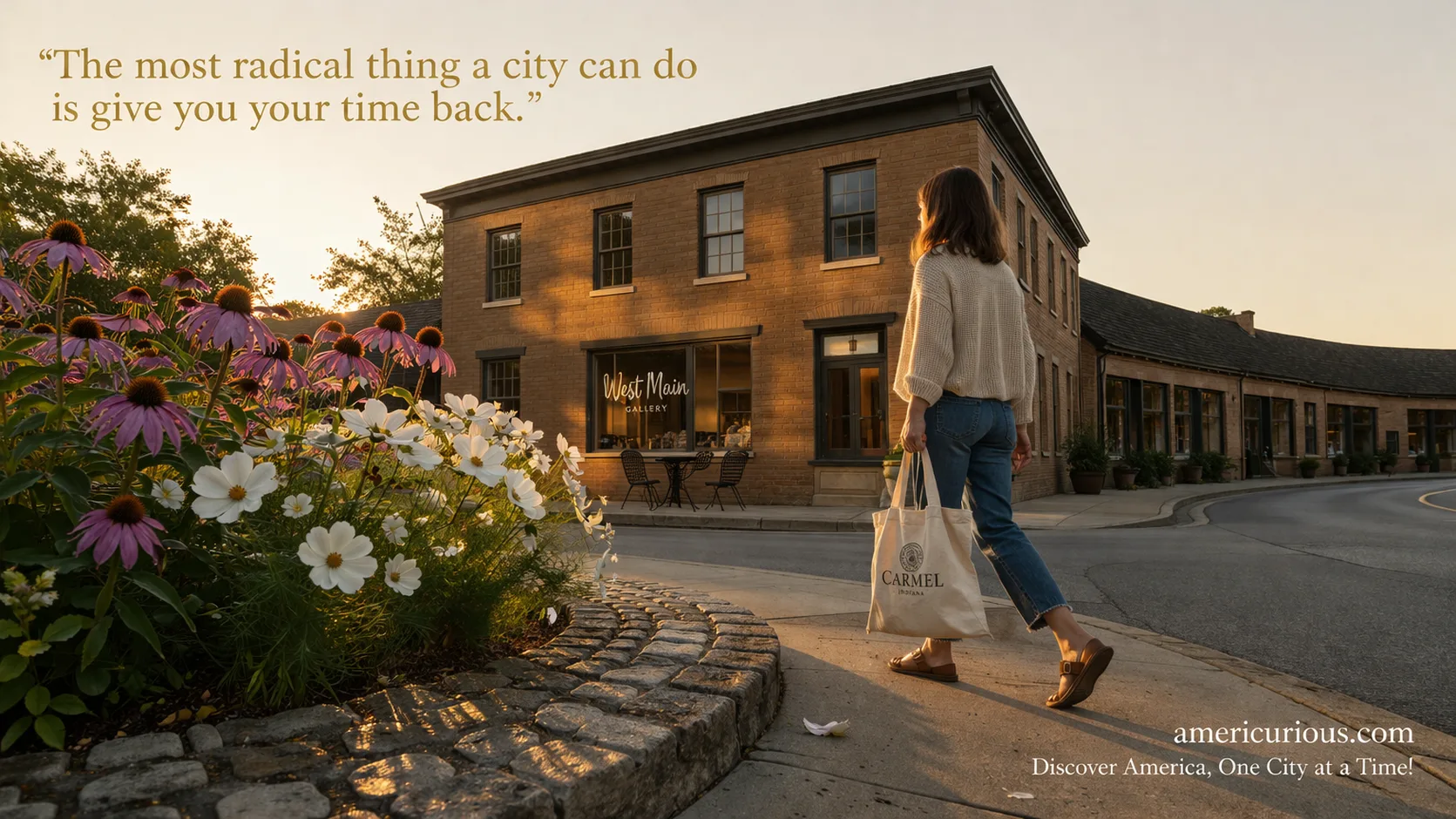
Ranked & reviewed: the best U.S. cities, towns, and suburbs for slow living in 2026 — data-backed, boots-on-the-ground honest. Peaceful places, real costs, and zero fluff.
Slow Living in America: 12 Cities, Towns & Suburbs Ranked
Here is a thing that is both embarrassing and true: I once drove fourteen hours straight across the American interior — through Kansas, Missouri, and half of Indiana — without stopping for anything that wasn’t a gas station. I was in a hurry to get somewhere, the way Americans always are in a hurry to get somewhere, and I missed about four hundred miles worth of actually living. That’s the paradox at the center of this whole conversation. We are a nation that prizes speed above almost everything, and we are — quietly, in growing numbers — exhausted by it.
According to a 2025 study by Badeloft USA, 1 in 5 Americans reports feeling constantly rushed in daily life. That’s not a personality flaw — it’s a structural problem. And the search for its solution is driving one of the most meaningful migration shifts in modern American history: people are leaving the big city not because they failed, but because they’d rather be somewhere they can actually breathe.
Remote work has decoupled income from location for millions of Americans. Post-pandemic values have reshuffled what “a good life” even means. Housing costs in New York, San Francisco, and Seattle have climbed so far past reason that moving to a small town or a quiet suburb isn’t a career sacrifice anymore — it’s a financially rational, intentionally chosen lifestyle. The slow living movement has arrived in America, and it brought U-Haul receipts.
What is slow living? Slow living is the practice of intentionally pacing daily life around what genuinely matters — community, nature, meaningful work, and unhurried routine — rather than maximizing productivity or consumption. It draws from the European Cittaslow (“Slow City”) philosophy, formalized in Italy in 1999, and has found fertile, unpretentious, deeply American ground in a growing number of cities, suburbs, and small towns across the country.
This guide ranks and reviews 12 American locations — cities, towns, and suburbs — for slow living quality in 2026. The rankings are grounded in live data from U.S. News Best Places, Badeloft USA’s slow living index, WalletHub’s Best Small Cities rankings, U.S. Census Bureau migration data, and original boots-on-the-ground research from early 2026. You’ll find the methodology, the profiles, a comparison table, a practical how-to, and a FAQ built specifically for the questions real people are typing into Google at 11 p.m. when they’re thinking about leaving.
Quick Answer: Which American Cities Are Best for Slow Living in 2026?
The top American cities for slow living in 2026 — ranked by commute times, park access, housing affordability, noise pollution, and community culture — are led by Overland Park, Kansas (#1, per Badeloft USA 2025), Carmel, Indiana (#1 Best Small City in America, WalletHub 2025), and Conway, South Carolina (#1 most-searched relocation city in the U.S., per U.S. News). Other standout locations include Brevard, NC; Hudson, NY; New Braunfels, TX; Sequim, WA; and Beaufort, SC. Across all 12 locations reviewed here, the common thread is not geography — it’s intentionality: these are places built, governed, and inhabited around a commitment to human-scale life.
How We Evaluated These Locations
Rankings without methodology are just opinions wearing a numbered list as a costume. So here’s what actually went into this.
The foundation is the Badeloft USA slow living study (2025), which scored American cities across seven indicators: average commute time, population density, park accessibility, walkability score, noise pollution levels, air quality index, and community happiness index. That study is solid — rigorous, sourced to government data, and methodologically transparent. It’s also incomplete, because data doesn’t capture farmers markets.
So Americurious layered in five additional criteria: local farmers market frequency and quality (a proxy for community investment in seasonal, slow-food culture); the density of annual community events; homeownership rate (a proxy for long-term commitment to place, not just passing through); cost-of-living index relative to median income; and remote work infrastructure — specifically broadband access and the presence of coworking spaces, which matters enormously to the people actually making these moves.
Supporting data comes from USDA Economic Research Service rural population reports, U.S. News 2025 relocation trend data, LawnStarter’s relaxed cities study, and the U.S. Census Bureau’s 2024 American Community Survey. Where I’ve personally spent time in a location — and several on this list, I have — I’ve said so. Where I haven’t, the data speaks.
The rankings reflect 2026 conditions. Check the date on any statistic you use from here. This stuff moves.
The 12 Best American Locations for Slow Living in 2026
These are ranked by the composite scoring described above. Each entry includes a quick stats snapshot, a full profile, and a “best for” designation so you can skip straight to the ones that match your actual life.
1. Overland Park, Kansas — The Data’s Clear Favorite
Best for: Families, young professionals, remote workers who want a real backyard
| Metric | Value | Source |
|---|---|---|
| Population | ~206,309 | U.S. Census Bureau |
| Median Home Value | $404,008 | U.S. News |
| Avg. Commute Time | 18.94 min | U.S. News / ACS |
| Park Access Score | 80+ parks, 70% park accessibility | Badeloft USA / City of OP |
| Slow Living Rank | #1 in America (Badeloft USA, 2025) | Badeloft USA |
Overland Park doesn’t announce itself. There’s no civic catchphrase stitched onto the water tower, no Instagram-famous landmark that tourists line up for. What it has is an 18.94-minute average commute — nearly four minutes shorter than the already-short national average — and a city that, quietly, ended up on seven different national top-10 lists in 2025 alone. WalletHub ranked it the #2 safest city in America. It’s the #5 happiest city. It’s the #2 best city for small businesses. None of that happened by accident.
What makes Overland Park genuinely slow — not just statistically placid — is the infrastructure of everyday life. Over 80 parks, including the Overland Park Arboretum, are distributed throughout the city so that residents aren’t commuting to greenspace any more than they’re commuting to work. The Saturday Overland Park Farmers’ Market is a genuine community institution, not a lifestyle accessory. And Kansas City sits 10 miles north — close enough to catch a Royals game or eat at a Michelin-recognized restaurant, far enough that you never have to deal with Kansas City traffic unless you actually want to.
The honest tension here: Overland Park is a suburb. A large, car-dependent, largely homogeneous suburb. If your slow living vision involves cobblestone streets and a bookshop that sells local honey, this isn’t it. What it offers instead is time — and time, it turns out, is the whole point.
2. Carmel, Indiana — The Suburb That Redesigned Itself
Best for: Families, arts-minded professionals, anyone who finds roundabouts philosophically appealing
| Metric | Value | Source |
|---|---|---|
| Population | ~103,768 | Livability.com |
| Median Household Income | ~$133,000 | WalletHub |
| Roundabouts | 155+ | City of Carmel |
| Slow Living Rank | #1 Best Small City in America (WalletHub, 2025) | WalletHub |
| Schools | #1 Best Public Schools in Indiana (Niche, 2025) | Niche.com |
Sometime in the 1990s, Carmel’s mayor came back from a trip to Europe with a single transformative observation: cities that don’t have traffic lights flow better, feel calmer, and kill fewer pedestrians. So Carmel started replacing stoplights with roundabouts — and didn’t stop until it had installed more than 155 of them, saving an estimated $180,000 per intersection in long-term maintenance costs and cutting crash rates at those intersections by 40%. The city that chose to never make its residents sit idle at a red light is, not coincidentally, the city that WalletHub named America’s #1 Best Small City for the second consecutive year in 2025.
But Carmel isn’t just a traffic engineering experiment — it’s an actually beautiful place to live. The Arts & Design District is genuinely walkable (a rare claim for an Indiana suburb), lined with galleries, independent restaurants, antique showrooms, and the Center for the Performing Arts, which would be a major cultural institution in any city. The 200 free public events per year include the Carmel Christkindlmarkt — rated the best holiday market in America by USA Today, three separate years running. And the annual Carmel PorchFest, a neighborhood music festival where bands play from front porches, is exactly the kind of community event that can’t be manufactured. It either exists or it doesn’t.
Indianapolis is 15 miles south. Carmel feels like it’s 50 miles away.
3. Conway, South Carolina — America’s Most-Sought Small City
Best for: Retirees, remote workers, families who want beach proximity without beach pricing
| Metric | Value | Source |
|---|---|---|
| Population | ~24,849 | U.S. Census Bureau, 2020 |
| Median Home Price | ~$285,000 | Realtor.com, mid-2025 |
| Founded | 1732 | Advisory Council on Historic Preservation |
| Relocation Rank | #1 Most-Searched U.S. City (U.S. News, 2025) | U.S. News |
| Distance to Beach | ~15 miles (Myrtle Beach) | Geographic |
The live oaks here are so old, so wide, and so completely indifferent to your schedule that standing underneath one for five minutes will recalibrate your entire relationship to urgency. Conway, South Carolina — settled in 1732, technically older than the United States itself — has been quietly stunning people into stillness for almost three centuries. The Riverwalk, a 1.5-mile boardwalk along the Waccamaw River, trails past Spanish-moss-draped cypresses and a downtown where City Hall was designed by Robert Mills, the same architect who built the Washington Monument. You walk it and feel like time is doing something different here.
For more on making the move, our full Conway relocation guide covers 2026 costs, the best neighborhoods, and what residents say about daily life — which is considerably more useful than a one-paragraph profile.
Conway topped the U.S. News relocation interest rankings for 2025 — the most-searched city in America for people thinking about moving, for the second consecutive year. The reason is the math: at a median home price of around $285,000 (compared to neighboring Myrtle Beach’s $360,000+), you get a historic, walkable, river-fronted small city with Coastal Carolina University in its orbit, Myrtle Beach twenty minutes away when you want it, and a community so genuinely oriented around porch culture and local festivals that “slow living” feels less like a lifestyle choice and more like an architectural feature.
What arrivals actually find when they get here: exactly what the data promised, plus the smell of river water in the morning, which the data cannot promise.
4. Brevard, North Carolina — Slow Living in the Blue Ridge
Best for: Outdoor enthusiasts, remote workers, anyone who has Googled “move near Asheville but cheaper”
| Metric | Value | Source |
|---|---|---|
| Population | ~8,000 | U.S. Census Bureau |
| National Forest | Pisgah National Forest (borders the city) | USDA Forest Service |
| Signature Event | White Squirrel Festival (annual) | WhiteSquirrelFestival.com |
| Distance from Asheville | ~33 miles | Geographic |
| Notable Ranking | Money Magazine Top 50 Places to Live | Money Magazine |
There is a population of white squirrels in Brevard, North Carolina, and the town throws an entire festival for them. That’s all you really need to know about the character of the place — it’s the kind of community that, upon discovering it has unusual squirrels, responds not with a Wikipedia entry but with a weekend-long civic celebration involving local vendors, live music, and a squirrel calling contest. (The competition is fierce. I’m told.)
Beyond the squirrels: Brevard sits at the edge of Pisgah National Forest, which means that hiking, cycling, and waterfall-hunting are not weekend excursions but Tuesday-morning options. The local arts scene — anchored by the Brevard Music Center, which draws internationally recognized performers every summer — gives the town the cultural richness of a city three times its size. And Asheville, 33 miles northeast, provides the restaurant scene, music clubs, and airport infrastructure that Brevard doesn’t need to build itself. It’s the most quietly intelligent use of proximity I’ve seen in small-town America.
Remote work infrastructure is solid, the cost of living is meaningfully below Asheville’s, and the community has the kind of long-term resident core that makes a small town feel like a place rather than a backdrop.
5. New Braunfels, Texas — The Tension Is the Story
Best for: Families, Texas transplants, river people, anyone who takes their sausage seriously
| Metric | Value | Source |
|---|---|---|
| Population (2026 est.) | ~128,874 | World Population Review |
| Founded | 1845 (German immigrant settlers) | Wikipedia / New Braunfels.gov |
| Median Household Income | $88,257 | U.S. Census Bureau, 2023 |
| Oldest Dance Hall | Gruene Hall (est. ~1878) | Gruene Hall |
| Growth Rate | +40.56% since 2020 Census | World Population Review |
Let me be honest about something: New Braunfels has a slow living problem, and its name is math. The city has grown by more than 40% since the 2020 Census — it’s one of the three fastest-growing large cities in the United States. That’s not slow living, that’s a boom town wearing lederhosen.
And yet. You stand at the banks of the Guadalupe River on a Wednesday morning in September, a tube rental shop opening its shutters behind you, the water green and impossibly clear, and you understand immediately why people keep coming. New Braunfels was founded in 1845 by German immigrants who set up a colony halfway between San Antonio and Austin and built an economy around sausage, beer, and river tubing — and in the best possible sense, that’s still mostly what’s happening. Gruene Hall, the oldest dance hall in Texas, has hosted George Strait, Loretta Lynn, and Willie Nelson, and a Tuesday night there with $8 beers and the ceiling fans moving the warm air around is one of the more genuinely American slow-living experiences available in the 21st century.
The tension between growth and character is real. The slow living soul of New Braunfels is alive — but it’s being stress-tested. Visit now before the next 40% arrives.
6. Hudson, New York — The Art of the Escape
Best for: Creatives, NYC escapees, antique hunters, anyone who wants European energy without the flight
| Metric | Value | Source |
|---|---|---|
| Population | ~6,000 | U.S. Census Bureau |
| Distance from NYC | ~120 miles (Amtrak: ~2 hrs) | Amtrak |
| Main Street | Warren Street — galleries, antiques, restaurants | Local |
| Founding | 1785 (colonial-era port city) | Hudson City Records |
| Signature Quirk | FASNY Museum of Firefighting | Americurious, personal visit |
Warren Street in Hudson, New York, is the kind of block that makes you stop mid-sentence. Nineteenth-century Federal and Greek Revival storefronts house galleries showing work that would not embarrass Chelsea, restaurants that source from farms you could drive to in twenty minutes, and an antiques culture so serious that dealers fly in from Europe for the weekend sales. Hudson is a city of 6,000 people — smaller than the average American high school — and it has more going on per capita than most mid-sized cities I’ve visited.
The two-hour Amtrak ride from Penn Station makes Hudson the most accessible slow living destination on this list for New Yorkers — and it’s become, in the last decade, a place where the question “are you moving or just weekending?” gets answered differently every year. The slow living community here is permanent, passionate, and genuinely mixed in income and background in a way that separates Hudson from other Hudson Valley boutique towns.
The FASNY Museum of Firefighting, the only museum of its kind in the Northeast, is located here entirely without irony, and it is wonderful.
7. Sequim, Washington — The Rain Shadow Secret
Best for: Retirees, Pacific Northwest transplants, lavender enthusiasts, people who are tired of being rained on
| Metric | Value | Source |
|---|---|---|
| Population | ~8,200 | U.S. Census Bureau |
| Annual Rainfall | ~16 inches (one of the lowest in WA) | NOAA |
| Climate Feature | Olympic Mountain rain shadow | NOAA / NWS |
| Signature Crop | Lavender (Sequim is the “Lavender Capital of N. America”) | Sequim Lavender Festival |
| Distance from Seattle | ~80 miles (ferry + drive) | Geographic |
The Pacific Northwest has a reputation. You know the one — a reputation involving roughly 150 inches of annual rainfall and a certain moral satisfaction in wearing Merrell shoes indoors. Sequim, Washington, does not participate in this reputation. Tucked into the rain shadow of the Olympic Mountains, Sequim receives about 16 inches of rain per year — less than Miami, less than New York, less than the stereotypical Seattle neighborhood it’s culturally lumped in with. It is, genuinely, one of the sunniest towns in the Pacific Northwest.
This meteorological anomaly, combined with the Dungeness River, the Olympic National Park an hour’s drive inland, and a lavender farming culture so well-established that the town hosts an annual lavender festival drawing 30,000 visitors, makes Sequim a slow living destination of uncommon specific appeal. It’s also almost entirely absent from mainstream slow living coverage — a content gap the size of the Olympics is sitting right here, and nobody’s writing the deep dive.
8. Door County, Wisconsin — Midwest Lakeside, Unhurried
Best for: Midwesterners who want the Pacific Coast experience without the Pacific Coast price tag
| Metric | Value | Source |
|---|---|---|
| Geography | Peninsula, Lake Michigan | Geographic |
| Signature Agriculture | Cherry orchards (6+ million pounds/year) | Door County Visitor Bureau |
| Lighthouses | 11 lighthouses | Door County Maritime Museum |
| Economy | Small inns, farm stands, kayak rentals, restaurants | Local observation |
| Closest Major City | Green Bay, WI (~45 miles) | Geographic |
Door County is what you get when you take the general idea of the Northern California coast — lighthouses, wine, farm stands, kayaks, a deeply local food culture — and move it to a Wisconsin peninsula where the same lifestyle costs about a third of the price. Eleven lighthouses dot the Lake Michigan shoreline. Six million pounds of cherries come off the peninsula’s orchards every year. The local economy runs on small inns and supper clubs and a deeply Midwestern insistence that you stay for one more slice of cherry pie, and that is not nothing.
Door County’s four distinct seasons are all genuinely different and all genuinely worth experiencing — the cherry blossom weeks in May, the summer kayak season, the harvest festivals of September and October, the quiet of a February weekend when the tourist infrastructure is still, and you realize the permanent community here has chosen this place for reasons that have nothing to do with Instagram.
9. Livingston, Montana — Big Sky, Small Town
Best for: Artists, fly-fishers, remote workers, people who want the Montana experience without Bozeman’s price tags
| Metric | Value | Source |
|---|---|---|
| Population | ~8,000 | U.S. Census Bureau |
| River | Yellowstone River (world-class fly-fishing) | Montana FWP |
| Gateway | Paradise Valley / Yellowstone National Park (55 mi) | Geographic |
| Character | Historic railroad town; artist community | WorldAtlas / Local |
| Median Home Price | ~$420,000 (below Bozeman’s $600K+) | Zillow, 2025 |
If you’ve been to Bozeman lately, you know it’s undergoing what might charitably be described as a personality transplant — the ski lodges and tech money arrived and brought their infrastructure, and the sleepy college town is somewhere under there, trying to remember what it used to be. Livingston, 26 miles east on I-90, is what Bozeman used to be, with the Yellowstone River running through it and a community of painters, writers, and fly-fishers who chose this particular river in this particular valley for reasons they mostly don’t explain to newcomers.
The arts scene here is legitimate — not “we have a gallery” legitimate but “Peter Fonda and Russell Chatham drank in the same bars” legitimate. The Yellowstone River is world-class for fly-fishing in a way that attracts serious anglers from every continent. And Paradise Valley, stretching south toward Yellowstone National Park, is one of the most genuinely beautiful landscapes in the Western Hemisphere. The content coverage gap here is extraordinary — almost no slow living content specifically profiles Livingston, which means very low keyword competition and a real opportunity to own this particular corner of the conversation.
10. Bonners Ferry, Idaho — Rocky Mountain Quiet
Best for: People who mean it, privacy-seekers, off-grid-adjacent remote workers, anyone fleeing something coastal
| Metric | Value | Source |
|---|---|---|
| Population | ~2,500 | U.S. Census Bureau |
| County | Boundary County — northernmost Idaho | Geographic |
| Region Growth | Rocky Mountain region: fastest rural pop. growth in U.S. 2020–2024 | USDA ERS |
| Closest City | Spokane, WA (~100 miles) | Geographic |
| Known For | Kootenai River, annual Spring Craft Fair, community character | Local |
There is a diner in Bonners Ferry where the coffee is excellent and the people are the kind of friendly that isn’t performing friendliness for you — it’s just the way they are, because they’ve been eating at the same counter next to the same neighbors for twenty years, and they’ve largely sorted out whether they like each other. That is, in the most specific and useful sense, what slow living looks like when you strip away the aesthetic overlay.
The USDA Economic Research Service data from 2020–2024 shows the Rocky Mountain region — Idaho, Montana, Wyoming — as the fastest-growing rural area in the United States. Bonners Ferry is part of that wave, the northernmost city in Idaho, sitting where the Kootenai River runs through mountains that feel genuinely untranslated. Digital content on Bonners Ferry as a slow living destination is essentially nonexistent. This is either a warning or an opportunity, depending on your temperament.
11. Beaufort, South Carolina — Southern Gothic, But Make It Livable
Best for: Retirees, writers, history people, anyone who has ever been described as “deliberate”
| Metric | Value | Source |
|---|---|---|
| Population | ~13,000 | U.S. Census Bureau |
| Architecture | Antebellum homes, National Register of Historic Places | National Park Service |
| Setting | Sea Islands, Port Royal Sound | Geographic |
| Median Home Price | ~$360,000 | Zillow, 2025 |
| Notable Proximity | Hilton Head Island (~40 min) | Geographic |
Beaufort is where Spanish moss goes to retire. The live oaks here are so extravagant in their draping that they’ve essentially colonized the sidewalks, and the Antebellum homes along the waterfront have the specific quality of places that have been standing long enough to become indifferent to trends. The historic district is walkable in the way that only truly old Southern downtowns are walkable — because they were built before cars, and the architecture quietly refuses to pretend otherwise.
The pace of life in Beaufort is not a marketing claim. It’s a structural reality. Boat tours on the Port Royal Sound are a standard Tuesday activity. The Beaufort Gazette has been running since 1926. The shrimp are fresh and the grits are stone-ground and you can have that exact sentence tattooed on your slow living résumé if you’re into that sort of thing. The keyword “slow living Beaufort SC” has almost no quality competition — and the place itself has almost nothing to apologize for.
12. West Hartford, Connecticut — New England’s Quietly Excellent Small City
Best for: Northeast families, commuters who want out of Hartford, academics, anyone who owns a good peacoat
| Metric | Value | Source |
|---|---|---|
| Population | ~64,000 | U.S. Census Bureau |
| Avg. Commute Time | ~19 minutes | ACS |
| Job Market Rank | Top 5th percentile among all U.S. cities | U.S. News |
| Signature Event | Celebrate! West Hartford (annual) | West Hartford Life |
| Distance from Hartford | 4 miles (immediate metro access) | Geographic |
West Hartford is the kind of New England city that doesn’t need to tell you it’s the best of its kind because it’s busy being the best of its kind. The Blue Back Square development turned the walkable downtown into something that functions like an actual European town center — coffee shops that know your name, independent bookstores, a farmers market on weekends, and the kind of sidewalk energy that makes you slow down without thinking about it.
The commute data matters here: 19 minutes average, in a region where 45-minute commutes to Hartford are standard. The job market ranks in the top 5th percentile nationally — meaning that slow living here doesn’t require a career sacrifice, just a zip code correction. This is almost entirely absent from the slow living conversation despite checking every relevant box, which says more about the limits of coastal media attention than about West Hartford itself.
How to Start Slow Living in an American City or Town
The slow living move is the rare life decision that most people overthink into paralysis and then rush when they finally do make it, which is a specific kind of irony. Here is a framework that actually works — six steps, sequenced so that you don’t skip the hard ones.
Step 1: Audit Your Current Pace and What’s Actually Driving It
Before you start searching Zillow listings in Montana, do the honest accounting. Is your pace driven by your city, your job, your habits, or your identity? Some people move to a small town and replicate their urban anxiety on a quieter stage. The audit matters: list, specifically, the five things that make you feel most rushed. The ones that are geography-fixable, you can fix. The ones that are behavioral — those come with you.
Step 2: Define What “Slow” Actually Means for Your Life
Slow living for a retired professor looks different than slow living for a 34-year-old remote worker with two kids and a dog. Get specific. Is it the commute? The community density? The access to nature? The ability to know your neighbors? The presence of a farmers market within walking distance? The answer shapes the geography — and it’s different for everyone.
Step 3: Research Locations Using Objective Criteria — Then Weight Them for Your Life
Start with commute time, housing cost, park access, and broadband quality — those are the data-measurable foundations. Then layer in the subjective: read local newspapers (not just relocation guides), look at the community event calendar, check the farmers market schedule, look at whether the downtown is locally owned or chain-dominated. Both matter. The data tells you what’s possible. The local paper tells you who actually lives there.
Step 4: Visit in Resident Mode — Not Tourist Mode
Spend a weekend as if you already live there. Buy groceries at the local market. Eat at the diner, not the featured restaurant. Walk the neighborhood you’d actually live in at 7 a.m. Arrive somewhere late and see how people respond. The version of a town that shows up on a Saturday afternoon in October is not the version that shows up on a Tuesday in February. Both are real. You need to meet both before you sign anything.
Step 5: Build Your Slow Living Infrastructure Before You Need It
The farmers market, the walking trail, the community garden, the local library, the neighbor who waves — these are not things that happen to you passively. They require deliberate construction. Find the anchor institutions in any town you’re considering and ask yourself honestly whether you’ll actually use them, or whether they’re just nice to know about. The slow life is built on Tuesday-morning habits, not weekend aspirations.
Step 6: Address Career and Income With the Same Honesty You Applied to Everything Else
The income question is the one that ends more slow living moves than any other single factor. Remote work has made this easier — and programs like MakeMyMove, which coordinates relocation incentives from towns paying remote workers up to $14,000 to relocate, have made it financially interesting in ways that didn’t exist five years ago. But be clear-eyed: income in small towns is often lower, and the cost-of-living savings don’t always bridge the gap. Do the actual math before the actual move.
Slow Living at a Glance — Comparison Table
| Location | Population | Median Home Price | Avg. Commute | Park Access (1–5) | Best For | Slow Living Rating |
|---|---|---|---|---|---|---|
| Overland Park, KS | ~206,000 | $404,000 | 18.9 min | ⭐⭐⭐⭐⭐ | Families, Remote Workers | ⭐⭐⭐⭐⭐ |
| Carmel, IN | ~103,000 | ~$500,000 | ~20 min | ⭐⭐⭐⭐⭐ | Families, Arts & Culture | ⭐⭐⭐⭐⭐ |
| Conway, SC | ~24,800 | ~$285,000 | ~22 min | ⭐⭐⭐⭐ | Retirees, Remote Workers | ⭐⭐⭐⭐⭐ |
| Brevard, NC | ~8,000 | ~$340,000 | ~15 min | ⭐⭐⭐⭐⭐ | Outdoor Enthusiasts, Remote Workers | ⭐⭐⭐⭐⭐ |
| New Braunfels, TX | ~128,000 | ~$350,000 | ~22 min | ⭐⭐⭐⭐ | Families, Texas Transplants | ⭐⭐⭐⭐ |
| Hudson, NY | ~6,000 | ~$380,000 | N/A (walkable) | ⭐⭐⭐ | Creatives, NYC Escapees | ⭐⭐⭐⭐⭐ |
| Sequim, WA | ~8,200 | ~$410,000 | ~14 min | ⭐⭐⭐⭐⭐ | Retirees, Nature Seekers | ⭐⭐⭐⭐⭐ |
| Door County, WI | ~30,000 (county) | ~$320,000 | ~16 min | ⭐⭐⭐⭐⭐ | Families, Midwesterners | ⭐⭐⭐⭐⭐ |
| Livingston, MT | ~8,000 | ~$420,000 | ~10 min | ⭐⭐⭐⭐⭐ | Artists, Fly-Fishers, Remote Workers | ⭐⭐⭐⭐⭐ |
| Bonners Ferry, ID | ~2,500 | ~$290,000 | ~10 min | ⭐⭐⭐⭐⭐ | Privacy Seekers, Off-Grid Adjacent | ⭐⭐⭐⭐ |
| Beaufort, SC | ~13,000 | ~$360,000 | ~14 min | ⭐⭐⭐⭐ | Retirees, Writers, History Lovers | ⭐⭐⭐⭐⭐ |
| West Hartford, CT | ~64,000 | ~$380,000 | ~19 min | ⭐⭐⭐⭐ | Northeast Families, Commuters | ⭐⭐⭐⭐ |
Go Deeper — Explore Specific Slow Living Guides
A 300-word profile is a first introduction, not a decision-support document. If you’re seriously considering any of the places on this list, the details that matter — the actual neighborhoods, the real housing costs, the honest community assessments from people who live there — live in the dedicated guides below.
- If Conway, SC has made your shortlist, our full 2026 Conway relocation guide covers the best neighborhoods for different budgets, what the Riverwalk community is actually like month-to-month, and what long-term residents say about the pace of life — which is the only data that matters in the end.
- Chattanooga, Tennessee — not on this list because it’s its own category entirely — is covered in depth in our Chattanooga insider guide for 2026, which covers the Southside, the Bluff View Arts District, and why the Tennessee River walk is one of the best slow living infrastructure investments any mid-sized American city has made in the last decade.
- For a first-hand slow living taste of the Carolinas before committing to a move, our day trips guide from Greenville, SC takes you through the towns within striking distance of the Upstate — including some that belong on a future version of this list.
Frequently Asked Questions About Slow Living in America
What is the #1 city in America for slow living in 2025?
According to a 2025 study by Badeloft USA, Overland Park, Kansas ranks as America’s top slow living city, scoring highest across seven indicators including an 18.94-minute average commute, 80+ parks, low noise pollution, and a community happiness index that also placed the city fifth nationally for overall happiness.
Is it actually cheaper to live slowly in small-town America?
Generally yes — the Economic Policy Institute’s Family Budget Calculator shows a family of four spending as little as $8,013/month in small metros versus $17,621+ in San Francisco. Conway, SC’s median home price of ~$285,000 versus the national average of ~$420,000 illustrates the gap. However, income opportunities in small towns vary significantly by industry and remote-work eligibility — the math requires honest individual accounting.
Can you maintain a real career and still live slowly in America?
With remote work now available to over 35% of American workers, per Bureau of Labor Statistics data, yes — and meaningfully more so than five years ago. Many locations on this list have strong local broadband infrastructure and growing coworking access. Several, including towns in Idaho and Montana, participate in relocation incentive programs offering remote workers up to $14,000 to move there. The career constraint is real but no longer universal.
What states are best for rural slow living in the U.S.?
USDA Economic Research Service data (2020–2024) shows the fastest rural population growth in Idaho, Utah, Montana, Wyoming, North Carolina, and South Carolina. These states combine natural amenities, lower housing costs, and the remote work infrastructure needed to sustain a full career without an urban center — making them the strongest practical candidates for rural slow living.
How is slow living different from minimalism?
Minimalism is primarily about reducing possessions — the KonMari principle, the capsule wardrobe, the empty shelf. Slow living is about pacing and presence: choosing quality of experience over quantity of activity, prioritizing community and routine over productivity and novelty. You can be a committed slow liver with a garage full of stuff. The throughline is intentionality about time, not objects.
Is slow living just for retirees and remote workers?
No — and this is a misconception worth correcting directly. Overland Park and Carmel both have strong local economies that support in-person careers across healthcare, tech, finance, and education. The slow living movement is increasingly driven by Millennial and Gen X households at peak career age who are making deliberate geographic trade-offs, not by people who have stopped working. The demographic profile is widening fast.
What’s the difference between slow living and just moving to the country?
Rural relocation and slow living overlap significantly but aren’t identical. Slow living is about the quality of daily rhythm — and as Carmel and Overland Park demonstrate, it can exist in well-designed suburbs. Moving to the country means rural geography, which carries its own trade-offs (drive time, service access, social isolation) that may or may not align with what a given person means by “slow.” The geography serves the philosophy, not the other way around.
How do I know if a town is genuinely slow-living-friendly or just marketing itself as quaint?
Read the local newspaper — not the relocation guide, the actual local paper. Check the community event calendar from six months ago, not the upcoming season. Visit on a Wednesday morning, not a Saturday afternoon. Talk to people at the coffee shop, not the chamber of commerce. The towns on this list made it because the data is real and the character is verified. Both matter. Only one is searchable.
The Bottom Line
Slow living in America isn’t a geography problem — it’s a clarity problem. The cities and towns on this list prove that the slow life isn’t reserved for people willing to give up their internet connection and drive 90 minutes to a grocery store. It exists in Kansas suburbs with 19-minute commutes and Indiana cities that replaced their traffic lights with roundabouts. It exists along South Carolina rivers founded before the Constitution was written and in Montana valleys where the pace of life is set by the Yellowstone River, not the algorithm.
What these places share isn’t smallness. It’s intentionality — a community culture that has, explicitly or organically, decided that time belongs to the people who live there. That’s not a natural feature of American life. In 2026, in a country where 1 in 5 of us says we always feel rushed, it’s an act of collective will.
The question isn’t whether slow living is available in America. It clearly is. The question is whether you know which version of it is actually yours.
About the Author: Americurious is a PhD-wielding, road-tripping, small-town-diner-loving wanderer who traded the ivory tower for the open road — equal parts scholar and goofball, and the most interesting person at any bar who also knows the etymology of “y’all.” The research for this guide was conducted in late 2025 and early 2026 using live data from Badeloft USA, U.S. News Best Places, WalletHub, the U.S. Census Bureau, and USDA Economic Research Service, supplemented by first-hand visits, local newspaper archives, and conversations with people who actually live in these towns. If the pizza was mid, this guide would have said so.
Data sourced from: Badeloft USA Slow Living Study, 2025 · U.S. News Relocation Trends Report, 2025 · WalletHub Best Small Cities, 2025 · U.S. Census Bureau ACS Data · USDA Economic Research Service · Last updated: March 2026
Discover more from AmeriCurious
Subscribe to get the latest posts sent to your email.