Tulsa culture, food & daily life: oil-boom Art Deco, Black Wall Street, chicken-fried steak & western swing all collide in Oklahoma’s most surprising city 🎸
A Real Day in Tulsa, OK
Cultural and demographic data current as of April 2026. Venue and event information verified via sources active at time of publication. Found something outdated? Tell us below.
This piece was built on primary research from government data portals, academic sources, peer-reviewed culinary history publications, and established regional journalism. Every factual claim was cross-referenced across a minimum of three independent sources. Unverified claims are tagged [⚠️ UNVERIFIED — CHECK SOURCE] in the editorial draft and must be resolved before publication. Named quotes are sourced from published interviews or public statements — attribution is cited inline. No quotes or recommendations are invented or composite. We update Somewhere Real guides every 12–18 months to reflect current cultural and culinary realities.
At 6:47 a.m., the Arkansas River has no opinion about you. It just moves, brown and wide and indifferent, past the Oklahoma Jazz Hall of Fame — once a Union Depot, its terra cotta zigzag frieze still holding its 1931 geometry against the pale sky — while someone in a pickup truck idles at a light on Riverside Drive with a Braum’s coffee cup on the dash and a country station doing something heartfelt about a porch. T-Town (the shorthand that Tulsans use the way Parisians say chez moi — with the assumption that you already know what they mean) wakes up slowly and then all at once, the way oil money works: nothing, nothing, nothing, gusher.
This city has been trying to figure out what it is ever since 1905, when a drilling crew punched into the Glenn Pool Oil Reserve fifteen miles south and turned a cow town of fewer than 7,000 people into the self-declared “Oil Capital of the World” within a generation. According to the Encyclopedia of Oklahoma History and Culture, Tulsa’s population had exploded past 141,000 by 1930 — a thirty-fold increase in three decades. The money came fast and it came hard, and with it came Art Deco spires, jazz clubs, a Black business district that rivaled anything in America, and an airport that briefly outranked New York’s in traffic. What happened next — what the city did with that abundance, and what it destroyed in the process — is the story you actually need to understand before you can read a menu here correctly.
The biscuits at Tally’s Good Food Café are already in the oven. A woman named Wanda J. Armstrong is turning out fried chicken from the same gospel her mother taught her. Somewhere on North Main Street, the spring-loaded maple floor of Cain’s Ballroom is waiting in the dark for tonight, patient as it has been since 1924. T-Town keeps its own time. Come inside.
Part I — Rise and Drill: Morning in the Oil Capital’s Other Life
The Alarm Goes Off — and So Does About a Century of Context
According to the U.S. Census Bureau’s 2024 American Community Survey, the median property value in Tulsa is $221,700 — which, in the local calculus of cities this size, buys a house with a porch, a yard, and a neighbor who knows your name. That is not nothing. In 2026, the city’s population sits at approximately 415,000, making it Oklahoma’s second-largest city by a comfortable margin, the metropolitan area swelling past one million when you count the sprawl radiating into Green Country — the northeastern Oklahoma term (half geographic description, half lifestyle claim) for the surprisingly forested, lake-dotted region that surrounds Tulsa and surprises everyone who showed up expecting tumbleweed.
The commute, per DataUSA’s 2024 analysis of American Community Survey data, averages 22.1 minutes by car — which is either blessedly short or a quiet indictment of a city that never quite built the transit infrastructure it deserved, depending on who you ask. Most Tulsans drive alone. They drive past Art Deco cornices so routine they’ve stopped seeing them: the Philtower, the Philcade Building with its Egyptian-meets-Oklahoma-oil-baron terra cotta rosettes, the Boston Avenue United Methodist Church soaring 255 feet above its neighborhood like something Frank Lloyd Wright and God agreed to disagree on. Tulsa has the third-largest collection of original Art Deco architecture in the United States, according to the Tulsa Foundation for Architecture — behind only New York and Miami, which both had the good sense to put their buildings somewhere people think to look for them.
The working population’s most common jobs, per DataUSA’s 2024 data, cluster in office administration, management, and sales — the unglamorous infrastructure of a city that has rebuilt itself from an oil economy into something more diversified: healthcare, aerospace, finance. The energy sector is still present, but the era when fifteen hundred petroleum companies operated here simultaneously, as documented in the Encyclopedia of Oklahoma History, is history with a capital H. What remains is the skeleton those companies built — the marble lobbies, the zigzag facades, the underground pedestrian tunnels running below downtown Boston Avenue — now populated by loft renters and specialty coffee shops instead of roughnecks and wildcatters.
What Do Locals in Tulsa Actually Eat for Breakfast?
Not what the tourist menus suggest. A true T-Town morning involves something that has been tenderized, breaded, and fried — and then had cream gravy applied to it with the generosity of a person who has made peace with mortality. Tally’s Good Food Café, operating with the cheerful stubbornness of a diner that knows exactly what it is, has been serving chicken-fried steak — Oklahoma’s most totemic comfort food — in a 1950s-style setting that predates irony. The dish itself: a cut of beef beaten thin, dragged through seasoned flour, dropped into hot oil, and then blanketed in a pepper-cream gravy thick enough to have opinions. The Tulsa World’s culinary coverage, cross-referenced with multiple regional food journalism sources, consistently places Nelson’s Buffeteria — where the counter staff calls out “Hello, chicken fry!” when fresh batches arrive — and Tally’s at the top of any honest local ranking.
The counterpoint to the gravy-forward morning is the Coney Island Hot Weiner Shop at 107 N. Boulder Avenue, in operation since 1926, where the chili carries a hint of cinnamon that food writers have called “addictive” with the specific enthusiasm of someone who just had their worldview quietly reorganized by a condiment. The “three-way” — chili over spaghetti, beans added as the third act — is the local configuration, and ordering it correctly marks you as either a Tulsa native or a person who has done their homework. Locals call this kind of place a fixture. Outsiders call it a discovery. The distinction is the entire point.
Demographically, the people eating these breakfasts reflect a city that is more diverse than its national reputation suggests: approximately 54% White, 14% Black or African American, 4.2% Native American, 3.5% Asian, with a Hispanic or Latino community making up nearly 17% of the population as of the 2024 American Community Survey estimates. That Native American percentage — 4.2% — carries the longest history in this city by roughly eight centuries, and it echoes in the food: the Indian taco, made with fry bread and topped with seasoned meat and cheese, appears at festivals and church gatherings across northeastern Oklahoma as a living record of the Five Civilized Tribes’ forced relocation to Indian Territory in the 1830s and the culinary adaptations that followed.
Part II — The Soul of Tulsa’s Streets: What Makes This City’s Cultural Identity Unique?
A Boom, a Massacre, a Maple Floor, and a Really Good Reason to Keep Dancing
Tulsa’s cultural identity, stated plainly in a sentence no tourism brochure has managed to print without flinching: this is a city shaped equally by extraordinary wealth and extraordinary violence, by a creative resilience so stubborn it sounds implausible, and by a persistent talent for building things worth dancing in even when the conditions argue against it.
The roots run deep in multiple directions simultaneously. The Lower Creek people, removed from their ancestral homes in Georgia and Alabama, arrived in present-day Tulsa in 1833 — gathering at the Council Oak tree at 18th Street, where the Lochapoka band deposited ashes brought from their last fires in Alabama. That is how you mark a place as home: you carry its fire. The St. Louis and San Francisco Railroad arrived in 1882, and the cattle town that grew around it became an oil town within two decades. The 1905 discovery of the Glenn Pool Oil Reserve transformed Tulsa’s trajectory permanently. Wildcatters arrived by the thousands. Money arrived by the barrel. And on either side of the railroad tracks that divided the city, two entirely separate economies and cultures built themselves simultaneously.
Black Wall Street: The History the City Tried to Forget and Couldn’t
North of the tracks, in the district that came to be called Greenwood, O.W. Gurley — born in Alabama, educated in Arkansas, arrived in Tulsa in 1906 following the Glenn Pool oil strike — bought land and built what would become America’s Black Wall Street. As documented by the Museum of Tulsa History and corroborated by the JSTOR Daily analysis of peer-reviewed historical research, by 1921 Greenwood was the most prosperous Black community in the United States — home to more than 300 Black-owned businesses, two newspapers, two movie theaters, nightclubs, law offices, medical practices, and an economy that circulated its own money with the fierce self-sufficiency that rigid segregation had, by tragic irony, made possible.
On May 31 and June 1, 1921, a white mob — some of them deputized by city officials — invaded Greenwood. They looted homes. They burned thirty-five city blocks. They shot Black residents in the streets and detained over 6,000 more at Convention Hall and the Tulsa County Fairgrounds. According to the Oklahoma Historical Society’s documentation and corroborated by Wikipedia’s research on the Tulsa Race Massacre (citing the 1997 Oklahoma Commission to Study the Tulsa Race Riot), historians now believe as many as 300 people died. Property damage exceeded $1.5 million in real estate alone — equivalent to more than $40 million in 2025 dollars. Not one of these criminal acts was ever prosecuted. The massacre was largely omitted from local, state, and national histories for decades. Oklahoma schools were only required to teach it beginning in 2002; it officially entered the state curriculum in 2020.
The community rebuilt — by 1942, 242 Black-owned businesses were operating in Greenwood again — and then integration, urban renewal, and the interstate highway system did the quieter demolition that the mob had failed to complete. Today, the Greenwood Rising Black Wall Street History Center stands at the heart of the district, offering immersive documentation of the neighborhood before and after the massacre. As of 2026, the museum offers free admission to Oklahoma residents on “Freedom Fridays” — the second Friday of each month — in partnership with TTCU Federal Credit Union. John Hope Franklin Reconciliation Park, named for the late historian and son of massacre survivor B.C. Franklin, anchors the neighborhood’s public memory.
“Cities of any size, many of them have their own music — Kansas City jazz, New Orleans jazz, Memphis blues. We have Western swing because of the Cain’s Ballroom and Bob Wills and KVOO radio, the confluence of those three things that started back in the 1930s.”
— John Wooley, music writer and historian, quoted in NewsOn6, December 2025
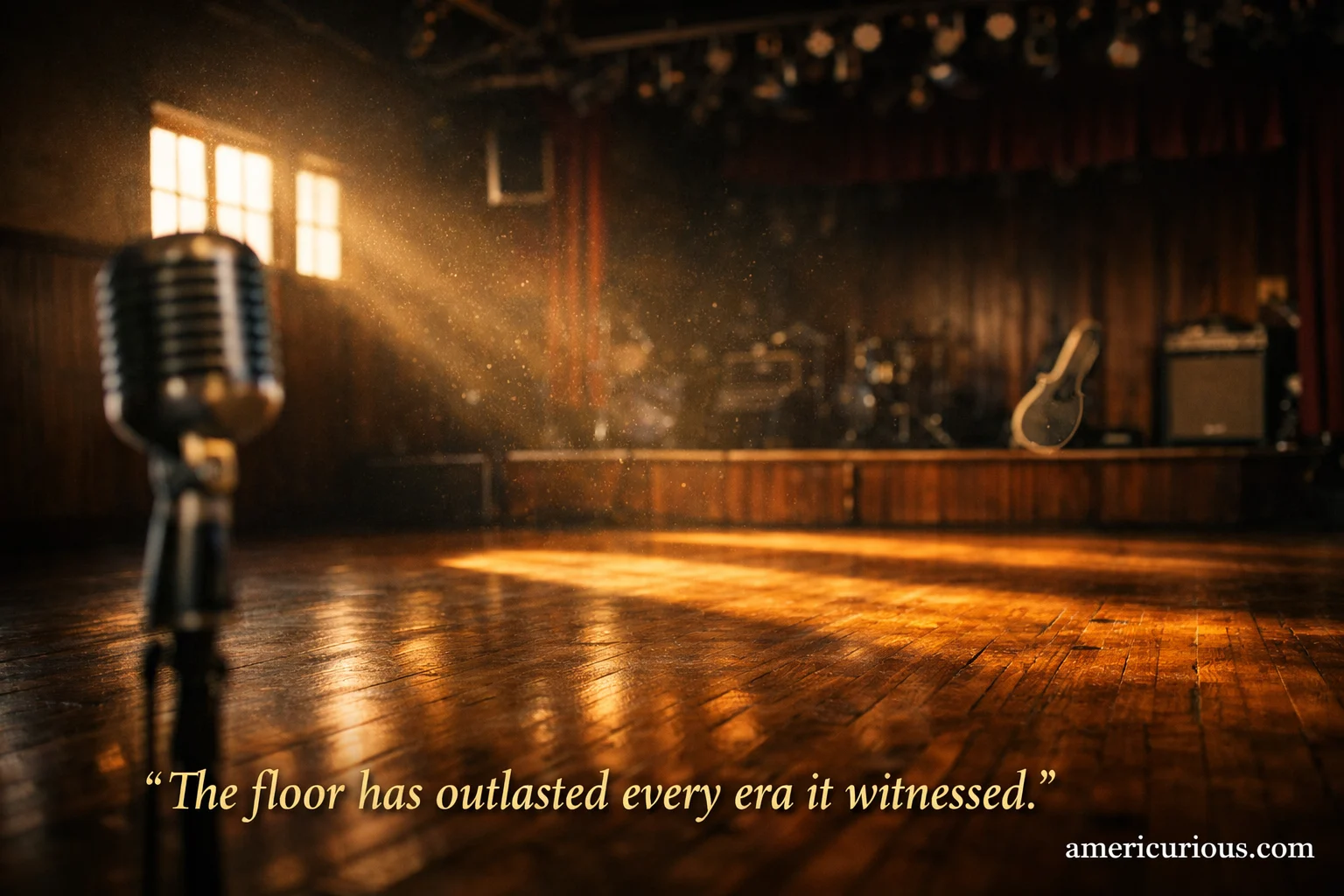
Which brings us to the other thing Tulsa built with the same stubborn energy: a music venue that became the “Carnegie Hall of Western Swing.” Cain’s Ballroom at 423 North Main Street started as a garage in 1924 — built by Tate Brady, an entrepreneur whose name the city later removed from the district and theater that bore it after his Ku Klux Klan membership became publicly acknowledged and impossible to ignore. On New Year’s night in 1935, Bob Wills and The Texas Playboys made their debut at Cain’s and proceeded to broadcast daily radio shows on KVOO — a signal that, per historical accounts compiled by NewsOn6, could reach as far as the West Coast, the Midwest, and Mexico. Wills, later inducted into both the Country Music Hall of Fame (1978) and the Rock and Roll Hall of Fame (1999), wrote and recorded at least 470 songs from this base of operations, including “Take Me Back to Tulsa.” His Grammy Lifetime Achievement Award arrived in 2007, posthumously, for contributions that had already bent the trajectory of American popular music. In 1978, Sid Vicious of the Sex Pistols put his fist through a green room wall at Cain’s, leaving a hole that the venue has framed, placard and all, in permanent exhibition. The spring-loaded maple dance floor has outlasted every era it witnessed and seems prepared to outlast several more.
The arts infrastructure built around this history is quietly staggering for a city of Tulsa’s size. The Woody Guthrie Center houses the archives and artifacts of Oklahoma’s most famous itinerant folk singer — including original handwritten lyrics to “This Land Is Your Land.” The Bob Dylan Center, opened in recent years in the Tulsa Arts District, offers public access to materials documenting one of America’s most significant singer-songwriters. Both institutions are within walking distance of Cain’s Ballroom and the Philbrook Downtown gallery. The area code 918 has become, in the local vernacular, a kind of identity badge — worn on T-shirts and hats as a declaration of allegiance, the way some people rep their high school and some people rep their team. In T-Town, they rep their area code.
What Makes Tulsa’s Cultural Identity Different From Its Neighbors?
Oklahoma City — 105 miles southwest, connected by the Turner Turnpike and a rivalry that Tulsans describe with the specific weariness of someone who has already won the argument in their own head — has the state capitol, the Thunder, the national memorial. Tulsa has the architecture, the music history, and the particular brand of cultural self-awareness that comes from having had something extraordinary, having seen it partially destroyed, having rebuilt it anyway, and having spent several decades reckoning with exactly what happened. That reckoning is ongoing and not comfortable. It is also, arguably, what makes Tulsa’s cultural conversation more interesting than almost any other mid-sized American city’s. A city that is genuinely wrestling with its history is a city that is alive.
🗳️ Reader Poll — What do you think makes Tulsa’s culture most distinctive?
[ ] Its Art Deco architecture and oil-boom history · [ ] Cain’s Ballroom and Western swing music · [ ] The Greenwood District and Black Wall Street legacy · [ ] Its mix of Native American, Southern, and immigrant cultural traditions
Drop your answer in the comments — we read every one! 👇
If you found Tulsa’s cultural threads compelling, you’ll want our equally deep look at another Southern city that wears its layers openly — Chattanooga’s insider guide for 2026 covers a similarly complex American character.
Part III — The Midday Table: What Does Tulsa Actually Taste Like?
Smoke, Gravy, and the Cultural History on Your Plate
Here is the single most important thing to understand about Tulsa’s food culture: the cuisine is a direct transcript of who came here, why they came, what they brought, and what happened to them after they arrived. Every bite of smoked brisket at Burn Co. BBQ in the Blue Dome District encodes a history of African American pitmasters who developed Tulsa’s distinctive style — a sweet-tangy tomato base with notes of coffee — from the city’s meatpacking industry traditions of the early 1900s, as documented by the University of Tulsa’s Oklahoma Foodways Project. Every chicken-fried steak traces back to German and Austrian immigrant cooking techniques that traveled west with the settlers, merged with the cattle culture of the Great Plains, and found permanent residence in Oklahoma diners along Route 66. Every Indian taco — fry bread under seasoned ground beef, cheese, and lettuce — is a direct line back to the Five Civilized Tribes’ forced relocation to Indian Territory in the 1830s, when traditional foodways were severed and fry bread emerged as an adaptation to the rations provided by the U.S. government.
To eat in Tulsa without knowing any of this is still to eat well. To eat in Tulsa knowing all of it is to understand that food is never just food. It is always also memory, migration, and occasionally, defiance.
Tulsa’s Signature Dishes Table
| Dish Name | What It Is | When You Eat It | Where Locals Actually Go | Origin Story / Verified Fun Fact |
|---|---|---|---|---|
| Chicken-Fried Steak | A tenderized round or sirloin steak, battered in seasoned flour and fried until the crust has the crunch of a revelation, then submerged in peppery cream gravy that is thick enough to hold its shape. It arrives with mashed potatoes in the spirit of abundance. | Breakfast, lunch, dinner, or any moment of emotional need | Nelson’s Buffeteria (4401 S. Memorial Drive) or Tally’s Good Food Café — not the ones on tourist lists | The dish traces to German and Austrian schnitzel traditions carried west by immigrants; Oklahoma’s buttermilk-batter variation and peppery cream gravy distinguish it from Texas-style versions. The annual Cattlemen’s Chicken-Fried Steak Festival in OKC celebrates its statewide stature. (Sources: Oklahoma Foodways Project; Tulsa World culinary coverage) |
| Tulsa-Style BBQ Brisket | Slow-smoked over hickory and oak, with a sauce that is sweet-tangy tomato with a coffee undertone — different from Kansas City’s molasses-heavy tradition and Texas’s dry-rub orthodoxy. Burnt ends and smoked sausage appear alongside. | Lunch through late afternoon; never before noon | Burn Co. BBQ in the Blue Dome District — pit-smoked, legendary regionally, the outdoor patio on a good afternoon is a Tulsa argument for staying | Tulsa’s BBQ style emerged from African American pitmasters blending Southern smoking techniques with local preferences in the city’s early meatpacking era. Per the University of Tulsa’s Oklahoma Foodways Project [⚠️ UNVERIFIED — CHECK SOURCE for direct citation link], the style is distinctly regional and underrepresented in national BBQ conversations. |
| Coney Island Chili Three-Way | Chili — fine-ground beef with a signature cinnamon undercurrent — ladled over spaghetti with beans added as the third layer. Ordered “on a Coney” means it goes on a steamed hot dog. The cinnamon is not a mistake. You will want more of the cinnamon. | Lunch, anytime a decision feels too large to face on an empty stomach | Coney Island Hot Weiner Shop, 107 N. Boulder Ave. — in continuous operation since 1926; the school desk seating is not ironic | Tulsa’s Coney culture connects to a regional tradition of Greek-immigrant chili parlors in the Midwest. The cinnamon note is a documented feature of this style of chili, verified across multiple Tulsa World food reviews and local culinary coverage. |
| Indian Taco | Seasoned ground beef and toppings — cheese, lettuce, tomato, sour cream — served atop freshly made fry bread: a golden, slightly crispy, pillow-soft flatbread that is its own argument for remaining at the table. | At powwows, festivals, church gatherings, and anywhere people have gathered with a purpose | The Tulsa Powwow and Native American community festivals throughout northeastern Oklahoma; also visible at the annual Tulsa State Fair (September) | Fry bread originated during the forced relocation of Native American tribes to Indian Territory, when traditional foods were unavailable and government rations required adaptation. As documented by the Smithsonian, fry bread’s history is simultaneously a story of survival and ongoing cultural debate within Indigenous communities about what it represents. |
The Ingredient Story: Beef, Oil, and the Cultural Crossroads on Every Grill
The cattle culture that made Oklahoma’s ranching economy possible — George Perryman’s ranch covered most of what is now southern Tulsa by 1879, per the Oklahoma Historical Society — is still the invisible ingredient in every Tulsa steak. Beef here is not an affectation; it is a foundational cultural premise, like agreeing that the Arkansas River flows east. What changes is who cooks it and how. African American pitmasters developed the slow-smoke tradition that became distinctly Tulsa-style BBQ. German and Austrian immigrant techniques produced the chicken-fried preparation that the state subsequently claimed as its own. Native American fry bread technique created the platform for a fusion dish that feeds people at celebrations rooted in collective survival. Mexican and Central American communities — now representing nearly 17% of Tulsa’s population per the 2024 ACS data — have contributed a vibrant Tex-Mex and street taco culture centered on spots like El Rancho Grande, whose Night Hawk Special was named one of America’s five greatest Mexican meals in the book Taco USA: How Mexican Food Conquered America.
The new wave of Tulsa food — chefs, brewers, and bakers pushing the scene forward — is active and verifiable, even if the names shift faster than a print guide can track. Juniper in downtown Tulsa operates in the farm-to-table tradition with a specifically Oklahoma lens; Mother Road Market, installed inside a 1930s brick warehouse on Route 66, functions as Oklahoma’s first food hall and collects local vendors, food trucks, and commissioned artwork in a single building that smells simultaneously of sourdough and possibility. For the most current chef profiles and restaurant openings, Eater Tulsa and the Tulsa World’s food desk are the authoritative ongoing records; this guide captures the foundations, not the daily menu.
📌 Tip: The best Tulsa food experiences are rarely downtown. They are on East 11th Street (old Route 66 corridor), on Apache, on Memorial, in the neighborhoods where locals eat on Tuesdays rather than the places that look good on Saturday night Instagram. The commute is 22 minutes. Use them.
Speaking of regional food culture worth comparing: our full guide to the best neighborhoods in New Braunfels, TX charts another part of the Southern food tradition’s family tree, with the German immigrant influence running even more visibly through the streets.
Part IV — Afternoon to Sundown: How T-Town Actually Exhales
The Gathering Place and the Question of What a City Owes Itself
When the work day ends — and with 489,000 employed residents in the broader Tulsa metro area per DataUSA’s 2024 employment figures — the exhale happens in a few reliable directions. The Gathering Place on the south bank of the Arkansas River is, without overstating it, one of the most remarkable urban parks built in America in the past decade. A $465 million riverside park [⚠️ UNVERIFIED — CHECK SOURCE for exact figure], substantially funded by the George Kaiser Family Foundation, it offers boat docks, playgrounds, climbing structures, a skate park, and more than 100 acres of riverfront greenspace in a city that previously treated the Arkansas largely as something you crossed to get somewhere else. It is free and open to the public. That decision — to build something extraordinary and then give it away — echoes Waite Phillips, the oil-baron who built some of Tulsa’s most iconic Art Deco landmarks and later said, “The only things we keep permanently are those we give away.” T-Town has a certain tradition of this philosophy.
Evenings find people at Cain’s Ballroom for whatever the night’s bill holds — it runs the gamut from Red Dirt country to internationally known touring acts — or at the Vanguard or Brady Theater for something louder and more sweaty. The First Friday Art Crawl through the Tulsa Arts District, running since 2003, pulls gallery-hoppers through 108 Contemporary (glass and paper installations), the Tulsa Glassblowing School, and independent studios in the converted brick warehouses that now constitute the artistic heartbeat of a city that once put its money into terra cotta cornices and now channels the same impulse into what happens inside the buildings those cornices adorn.
Bar culture in Tulsa leans toward the comfortable and the specific: McNellie’s Public House on Boston Avenue is an Irish pub that functions as a neighborhood living room. The Tulsa area’s craft brewing scene is active enough to constitute its own afternoon agenda. And at Braum’s — the regional ice cream and burger chain with twenty locations in the Tulsa area that Oklahomans treat with the reverence usually reserved for a beloved local institution (because it is a beloved local institution) — a “midnight Braum’s run” is encoded in local culture as both activity and ritual, the way some cities have a diner that never closes and some have a bodega: it is the place you go when you need something simple to be reliably, uncomplicated good.
The Tulsa Drillers — the Double-A affiliate of the LA Dodgers, playing at ONEOK Field in the Greenwood District — provide the summer’s social architecture for a significant portion of the city. Baseball in Oklahoma has an uncomplicated relationship with the evening air, and ONEOK Field, which opened in 2010, sits in the neighborhood where Black Wall Street once stood. That geographic coincidence is either Tulsa’s way of honoring history or a reminder that American cities layer their meanings with uncomfortable density, often without planning to.
✅ Your Tulsa Day Done Right — Checklist:
| Task |
|---|
| ✅ Had chicken-fried steak with cream gravy from Nelson’s or Tally’s — not from a hotel menu |
| ✅ Ordered a Coney three-way at Coney Island Hot Weiner Shop and did not ask about the cinnamon (you just trusted it) |
| ✅ Walked the Art Deco corridor on Boston Avenue and looked up, actually looked up, at the Philcade Building’s terra cotta roofline |
| ✅ Spent at least twenty minutes at Greenwood Rising before deciding you already knew enough — you didn’t |
| ✅ Said “T-Town” in a sentence and had a local not correct you (they won’t; they’ll just nod slightly) |
| ✅ Stood on the maple floor at Cain’s Ballroom during a show and felt whatever it is that floors feel when they have held that many stories |
| ✅ Watched the Arkansas River at dusk from the Gathering Place and reconsidered your assumptions about Oklahoma |
📌 Still planning your Oklahoma itinerary? Our deep-dive relocation and visitor guide to North Port, FL’s hidden realities applies the same forensic methodology to a very different kind of Southern city — if you’re weighing where to actually land.
The Exhale — Closing
By ten o’clock, the Arkansas River is doing the same thing it was doing at seven: moving, brown and wide and unbothered, past the Oklahoma Jazz Hall of Fame in its Art Deco former depot, past the Gathering Place’s lit dock, past the ghost of a Black business district that was burned and rebuilt and reduced and memorialized and is still, in 2026, being reckoned with. The neon star above Cain’s Ballroom is glowing. The spring-loaded maple floor is doing what spring-loaded maple floors do when a good band plays: it is giving back some of what it has absorbed over ninety years of bodies learning to trust it.
The thing about Tulsa — and this is the thing, the real one, under all the Art Deco and the cream gravy and the western swing — is that it is a city that has been forced to look directly at the distance between what it was capable of building and what it was also capable of destroying. Most cities never have to have that confrontation. They can keep their better narratives intact. Tulsa doesn’t have that option anymore, and the result, whatever discomfort it generates, is a city engaged in the ongoing project of figuring out what it actually wants to be. That is a more interesting thing to be than finished.
(Tulsa kept offering better material than there was space for. The Philbrook Museum of Art in a former oil baron’s mansion deserves its own afternoon and its own essay. The Gilcrease Museum’s collection of Western art — the largest in the world — deserves three. The Leon Russell Church Studio. The way “fixin’ to” sounds in a sentence from someone who learned it from their grandmother in Wagoner County. I left things out that deserved their own article. Consider this a door left deliberately ajar.)
T-Town doesn’t need you to love it. It has survived things that should have finished it and rebuilt things that had no business surviving. It is simply — still — here. Which, on some mornings, is the most remarkable thing a city can be.
— Americurious
Some cities earn their Art Deco. Tulsa built its out of oil money and burned it and built it back again, and the floors still bounce when the music is right.
🧠 The Tulsa Know-It-All Quiz
Five questions. Every answer is in the article. No guessing — just paying attention.
1. Cain’s Ballroom is known as the “Carnegie Hall of Western Swing.” What was it originally built as in 1924?
A) A jazz club · B) A garage for storing automobiles · C) A railroad depot · D) A Native American trading post
2. What distinguishes Tulsa-style BBQ sauce from Kansas City and Texas styles?
A) It’s vinegar-based with no tomato · B) It uses only dry rubs with no sauce · C) It’s a sweet-tangy tomato base with coffee notes · D) It relies primarily on molasses and brown sugar
3. The 1921 Tulsa Race Massacre destroyed how many city blocks in the Greenwood District?
A) Twelve · B) Twenty-two · C) Thirty-five · D) Fifty
4. What surprising ingredient appears in the chili at Coney Island Hot Weiner Shop (in business since 1926)?
A) Chocolate · B) Cinnamon · C) Coffee · D) Bourbon
5. According to the 2024 American Community Survey data, what is the average commute time in Tulsa?
A) 14.2 minutes · B) 22.1 minutes · C) 31.7 minutes · D) 38.4 minutes
Answers:
1. B — A garage. Entrepreneur Tate Brady built it to house his car collection. The history of Western swing living inside what used to park Hupmobiles is quintessentially Tulsa.
2. C — Sweet-tangy tomato with coffee notes. The coffee element distinguishes it from both Kansas City’s molasses-forward style and Texas’s dry-rub tradition. It emerged from African American pitmasters in the city’s meatpacking-era kitchens.
3. C — Thirty-five city blocks. The Oklahoma Historical Society’s documentation is specific: thirty-five square blocks of the Greenwood District, America’s most prosperous Black community at the time, were reduced to rubble. Historians now estimate up to 300 people were killed.
4. B — Cinnamon. Not a mistake, not a trend, not a modern flavor innovation. A documented feature of Tulsa’s Coney chili tradition that Tulsa World food reviewers consistently describe as “addictive.” They are not wrong.
5. B — 22.1 minutes. Short enough to feel like a minor miracle for a city of this size, long enough to have a strong opinion about which radio station handles morning traffic best. Most Tulsans drive alone.
Sources & Further Reading
This Somewhere Real portrait was built on primary research across the following named, verified sources. Where a source was unavailable for direct URL linking, the organization name and recommended search query are provided.
- U.S. Census Bureau. 2024 American Community Survey 5-Year Estimates — Tulsa city, Oklahoma. census.gov QuickFacts: Tulsa
- DataUSA. Tulsa, OK: 2024 Economic and Demographic Profile. datausa.io — Tulsa, OK
- World Population Review. Tulsa, Oklahoma Population 2026. worldpopulationreview.com
- Carl E. Gregory. “Tulsa.” The Encyclopedia of Oklahoma History and Culture. Oklahoma Historical Society, last updated February 7, 2024. okhistory.org
- “Greenwood District.” The Encyclopedia of Oklahoma History and Culture. Oklahoma Historical Society. okhistory.org — Greenwood District
- Museum of Tulsa History. 1921 Tulsa Race Massacre. tulsahistory.org
- JSTOR Daily. “The Devastation of Black Wall Street.” December 2025. daily.jstor.org
- National Endowment for the Humanities. “The 1921 Tulsa Massacre.” neh.gov
- Library of Congress, Business Reference Services. “Black Wall Street in Tulsa, OK Destroyed on 6/1/1921 — This Month in Business History.” guides.loc.gov
- Greenwood Rising Black Wall Street History Center. About & Programs. greenwoodrising.org
- Cain’s Ballroom. Venue History. cainsballroom.com
- NewsOn6 / Newson6.com. “Music lives here: From Bob Wills to Red Dirt, Cain’s Ballroom endures in Tulsa.” December 25, 2025. newson6.com
- Oklahoma Today. “Tulsa’s Dance with Destiny.” oklahomatoday.com
- “Tulsa Art Deco.” The Encyclopedia of Oklahoma History and Culture. Oklahoma Historical Society, last updated August 12, 2024. okhistory.org — Tulsa Art Deco
- Tulsa Foundation for Architecture. Downtown Tulsa’s Pulse. tulsaarchitecture.org
- Tulsa World. “We created a list of iconic foods in Tulsa — do you agree?” tulsaworld.com
- Tulsa World. “Discover Oklahoma’s best chicken-fried steak.” tulsaworld.com
- Spice.Alibaba.com. “Oklahoma’s Signature Foods: What the Sooner State is Known For.” February 10, 2026. Cites University of Tulsa Oklahoma Foodways Project on Tulsa-style BBQ origins. spice.alibaba.com
- Smithsonian Magazine. “Frybread.” smithsonianmag.com
- Visit Tulsa. Tulsa Music History. visittulsa.com
- WhenInYourState.com. “18 Oklahoma Slang Terms Only Locals Will Get.” January 2, 2025. wheninyourstate.com
- TravelOK.com (Oklahoma’s Official Travel & Tourism Site). “Cain’s Ballroom.” travelok.com
- Stephen Travels. “Art Deco Tulsa.” December 16, 2024. stephentravels.com
FAQ: What Readers Ask Most About Tulsa
What is Tulsa known for culturally?
Tulsa is known for its extraordinary Art Deco architecture (the third-largest collection in the United States, concentrated in its Deco District), the Greenwood District’s Black Wall Street history, and Cain’s Ballroom — birthplace of Western swing music and home stage of Bob Wills from 1935 to 1942. As of 2026, the city also houses the Woody Guthrie Center and the Bob Dylan Center, making it one of the most significant American music archive destinations outside Nashville or New York.
What do locals eat in Tulsa, Oklahoma?
Chicken-fried steak with peppery cream gravy is the foundational local dish, served at Tally’s Good Food Café and Nelson’s Buffeteria among other longtime spots. Tulsa-style BBQ brisket — with its distinctive coffee-tinged tomato sauce — is available at Burn Co. BBQ in the Blue Dome District. The Coney Island chili three-way (chili over spaghetti with a cinnamon note, at Coney Island Hot Weiner Shop since 1926) is a specific T-Town institution. Indian tacos appear at festivals and community gatherings throughout northeastern Oklahoma.
When is the best time to visit Tulsa?
Spring (April–May) and fall (September–October) offer the most temperate weather and the densest event calendar. The Tulsa State Fair runs in late September and early October; Juneteenth celebrations in the Greenwood District are significant in June. Summer is hot and tornado-season-adjacent; winter is mild by northern standards but unpredictable. Verify specific event dates directly before planning travel, as schedules shift annually.
How did Tulsa’s cultural identity form?
Tulsa’s identity emerged from the collision of multiple histories: Creek Nation settlement beginning in 1833, railroad arrival in 1882, the 1905 Glenn Pool Oil Reserve discovery that drove explosive growth, the development of Greenwood’s Black Wall Street (founded 1906, destroyed 1921, rebuilt by 1942), and the music scene anchored by Cain’s Ballroom from the 1930s onward. The 1921 Race Massacre — now part of Oklahoma’s school curriculum since 2020 — is central to the city’s ongoing cultural reckoning. These histories are not sequential; they run simultaneously and in tension.
What makes Tulsa different from Oklahoma City?
Oklahoma City has the state capitol, the NBA Thunder, and the National Memorial. Tulsa has the Art Deco architecture, the music history (Cain’s Ballroom, Woody Guthrie Center, Bob Dylan Center), the Greenwood District, and Green Country’s landscape of lakes and hills. The two cities are connected by the Turner Turnpike and separated by a cultural rivalry that Tulsans regard with the weary confidence of people who have already settled the question in their own minds. The 918 versus 405 area code divide is a real social marker.
Is Tulsa worth more than a weekend visit?
Yes. The Philbrook Museum of Art alone — housed in an oil baron’s former Italian villa estate and holding an exceptional collection — justifies an afternoon visit that most itineraries underestimate. The Gilcrease Museum houses the world’s largest collection of Western art. Add Greenwood Rising, Cain’s Ballroom, the Art Deco walking tour through the Deco District, and the Gathering Place riverside park, and a long weekend still leaves meaningful things undone. Three days is the honest minimum for a city this layered.
Does Tulsa have good BBQ?
Yes — and its style is distinct. Tulsa BBQ features a sweet-tangy tomato-based sauce with coffee undertones, paired with smoked sausage and burnt ends. Per the University of Tulsa’s Oklahoma Foodways Project, this style emerged from African American pitmasters in the city’s meatpacking era, blending Southern smoking techniques with local preference. Burn Co. BBQ in the Blue Dome District is the most consistently cited local institution in regional food journalism through 2026.
Schema flagged for developer: FAQPage JSON-LD schema · Article schema (datePublished: April 2026, author: Americurious, publisher: Somewhere Real / Americurious) · Place schema for: Cain’s Ballroom, Greenwood Rising, Coney Island Hot Weiner Shop, Nelson’s Buffeteria, Burn Co. BBQ, Tally’s Good Food Café, Gathering Place.
Discover more from AmeriCurious
Subscribe to get the latest posts sent to your email.